SparringVest
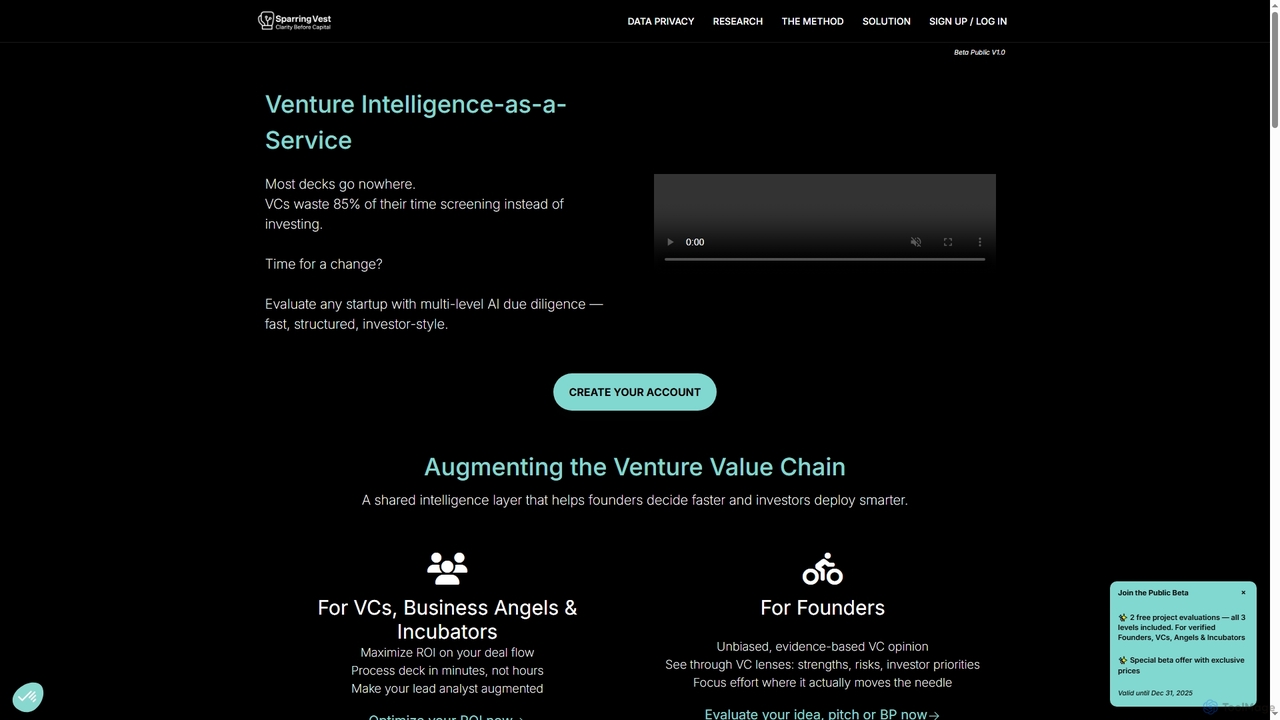
SparringVest is an AI-powered startup evaluation platform designed for founders and investors. It provides unbiased, evidence-based venture capital …
SparringVest is an AI-powered startup evaluation platform designed for founders and investors. It provides unbiased, evidence-based venture capital opinions, helping founders refine their strategies and investors streamline deal flow screening with structured, data-driven insights.
About Business Advisor
AI Business Advisor tools are a specialized category of AI assistants designed to provide data-driven strategic insights and actionable recommendations for business operations. They leverage advanced analytics, machine learning, and large language models to analyze complex internal and external data, such as financial records, market trends, and competitor activities. This enables businesses to make more informed decisions, identify growth opportunities, and mitigate potential risks. Unlike general AI assistants that focus on task execution, AI Business Advisors act as a virtual consultant, offering guidance on strategy, finance, and operations.
Core Features
- Market & Competitive Analysis: Automatically gathers and analyzes market data, consumer trends, and competitor strategies to identify opportunities and threats.
- Financial Forecasting & Modeling: Creates predictive models for revenue, cash flow, and profitability based on historical data and market variables.
- Strategic Planning Support: Assists in developing business plans, setting KPIs, and simulating the potential impact of different strategic decisions.
- Operational Efficiency Analysis: Identifies bottlenecks in workflows, suggests process improvements, and analyzes operational costs to enhance productivity.
- Risk Assessment: Evaluates potential financial, operational, and market risks, providing early warnings and mitigation suggestions.
Use Cases
These tools are particularly valuable for startup founders, small to medium-sized enterprise (SME) owners, and corporate strategy departments. For instance, a startup can use an AI Business Advisor to validate a business model against market data, while an SME can use it for cash flow management and forecasting. Corporate teams can leverage it for in-depth competitive intelligence and new market entry analysis.
How to Choose
When selecting an AI Business Advisor, consider the following: the tool's data integration capabilities (e.g., with CRM, ERP, and accounting software), the depth and accuracy of its analytical models, its specialization in your specific industry, the clarity and actionability of its reports, and the security protocols in place to protect sensitive business data.

Business AdvisorUse Cases
Validating a Startup Business Plan
An entrepreneur preparing to launch a new tech startup uses an AI Business Advisor to stress-test their business plan. They input their proposed product features, target market demographics, pricing strategy, and initial financial projections. The AI analyzes current market trends, identifies key competitors, and simulates potential revenue streams under various economic scenarios. The output is a detailed report highlighting the plan's strengths, potential risks like market saturation, and actionable suggestions, such as refining the target audience or adjusting the pricing model to improve profitability forecasts.
Analyzing Cash Flow for a Small Business
The owner of a small retail business connects their accounting software (like QuickBooks or Xero) to an AI Business Advisor. The tool automatically analyzes months of transaction data to identify cash flow patterns. It generates a visual dashboard showing peak revenue periods, major expense categories, and forecasts cash flow for the next quarter. The advisor flags a potential cash shortfall in two months due to seasonal inventory purchases and suggests strategies like securing a short-term credit line or running a targeted promotion to boost sales in advance.
Conducting Competitive Intelligence
A marketing manager at a mid-sized company uses an AI Business Advisor to monitor key competitors. The tool is configured to track competitors' websites, social media channels, and press releases for changes in pricing, new product launches, and marketing campaigns. Each week, the AI generates a summary report with key insights, such as a competitor's successful new ad campaign on a specific platform or a subtle price drop on a competing product. This allows the manager to react quickly with counter-strategies instead of spending hours on manual research.
Developing a New Market Entry Strategy
A corporate strategy team is tasked with evaluating expansion into Southeast Asia. They use an AI Business Advisor to gather and synthesize vast amounts of data on market size, consumer behavior, regulatory landscapes, and local competition in several target countries. The AI provides a comparative analysis, ranking the countries based on a weighted score of opportunity versus risk. It also suggests potential entry modes (e.g., joint venture, direct investment) for the top-ranked country and provides a preliminary financial model for the first three years of operation, significantly accelerating the initial research phase.
Optimizing Operational Efficiency
An operations manager for a manufacturing company integrates their ERP system with an AI Business Advisor to analyze production data. The AI identifies a recurring bottleneck in the assembly line that causes a 15% delay on average. It analyzes machine uptime, worker schedules, and supply chain delivery times to pinpoint the root cause. The advisor then suggests reallocating two workers during peak shifts and adjusting the raw material delivery schedule, projecting a potential 10% increase in overall output without additional capital investment.
Formulating a Product Pricing Strategy
A product manager is tasked with setting the price for a new software-as-a-service (SaaS) product. They use an AI Business Advisor and input data on development costs, target customer value perception, competitor pricing tiers, and desired profit margins. The AI runs simulations to model demand at different price points and recommends an optimal three-tiered pricing strategy (Basic, Pro, Enterprise). It provides a rationale for each tier, suggesting specific feature sets to justify the price differences and maximizing both customer acquisition and lifetime value.