
ToolMage
Sign in

Best 1 Startup Evaluation AI tools for Venture Capital

Popular Startup Evaluation AI tools in Venture Capital include SparringVest, helping you work more efficiently.

SparringVest
Freemium

SparringVest

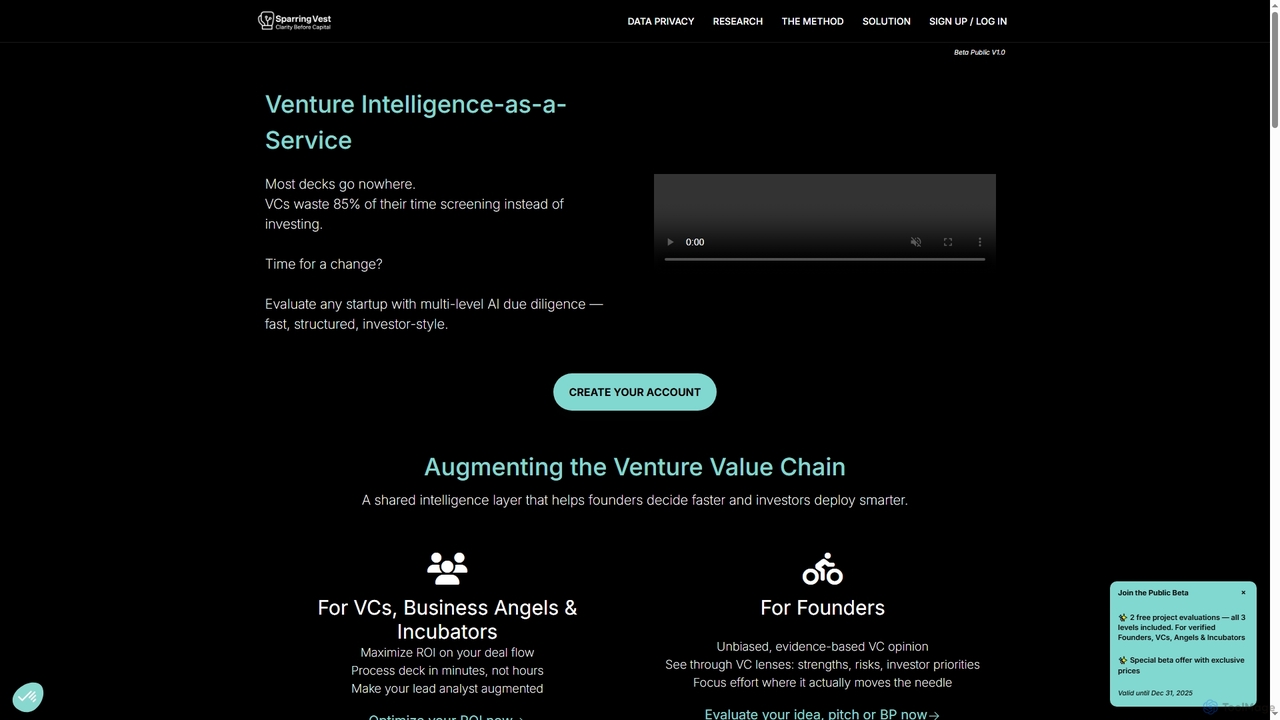
SparringVest is an AI-powered startup evaluation platform designed for founders and investors. It provides unbiased, evidence-based venture capital opinions, helping founders refine their strategies and investors streamline deal flow screening with structured, data-driven insights.

Business Advisor
Visits 5.5KFavorites 129Likes 120

About Startup Evaluation

AI Startup Evaluation tools are specialized platforms that use artificial intelligence to analyze and assess the potential of early-stage companies. These tools leverage machine learning algorithms to process vast datasets, including financial projections, market trends, and team composition, providing data-driven insights for valuation and risk assessment. They help investors, accelerators, and founders make more objective and informed decisions by automating key aspects of the due diligence process. This approach standardizes evaluation criteria and can uncover patterns that are difficult for human analysts to detect.

Core Features

  • Financial Model Analysis: Automatically ingests and scrutinizes financial statements and projections to identify key metrics, growth drivers, and potential red flags.
  • Market & Competitor Analysis: Gathers and synthesizes data on market size (TAM, SAM, SOM), growth rates, and the competitive environment.
  • Team Assessment: Evaluates the founding team's experience, track record, and industry connections based on public data.
  • Risk Scoring: Generates a composite risk score based on multiple factors, including market risk, execution risk, and financial risk.
  • Valuation Benchmarking: Compares a startup's valuation metrics against similar companies in the same sector and stage.

Use Cases

These tools are primarily used by venture capital firms, angel investors, and corporate venture arms to streamline their deal flow and due diligence processes. Accelerators and incubators use them to select and monitor promising startups. Founders also utilize these platforms for self-assessment, helping them identify weaknesses and prepare compelling pitches for fundraising rounds.

How to Choose

When selecting an AI Startup Evaluation tool, consider the depth and source of its data. Evaluate the transparency of its analytical models and the specific metrics it tracks. Assess its integration capabilities with other platforms like CRMs or data rooms. Finally, consider the user interface and the clarity of its reports, ensuring the insights are actionable for your investment committee or team.

Startup Evaluation use cases

1

Streamlining Investor Due Diligence

An angel investor receives dozens of pitch decks weekly. Instead of manual review, they use an AI evaluation tool to automatically screen each startup. The tool analyzes the pitch deck, extracts key financial metrics, assesses the market size, and provides a preliminary score. This allows the investor to focus their time on the top 10% most promising opportunities, reducing screening time by over 80% and ensuring a consistent, data-backed initial review process.

2

Founder Self-Assessment Before Fundraising

A SaaS founder is preparing for their Seed funding round. They use an AI evaluation platform to get an objective assessment of their company's strengths and weaknesses. The tool benchmarks their traction, financial projections, and team against successful startups in their sector. The resulting report highlights an over-optimistic revenue forecast and a gap in their team's marketing experience, allowing them to address these issues before approaching investors.

3

VC Portfolio Health Monitoring

A venture capital firm needs to track the performance of 50+ portfolio companies. They connect their data sources to an AI evaluation platform, which continuously monitors key performance indicators (KPIs) like Monthly Recurring Revenue (MRR), customer churn, and burn rate. The system automatically flags companies that are deviating from their projected growth path, enabling the VC partners to intervene proactively and offer support where it's needed most.

4

Validating a New Business Idea

An entrepreneur has an idea for a new fintech app. Before writing a single line of code, they use an AI evaluation tool to conduct initial market research. The tool analyzes market trends, identifies key competitors, estimates the Total Addressable Market (TAM), and assesses the regulatory landscape. This provides a data-driven validation of the market opportunity, helping the entrepreneur refine their business plan and value proposition.

5

Objective Candidate Screening for Accelerators

A startup accelerator receives thousands of applications for its annual cohort. The selection committee uses an AI evaluation tool to score and rank each applicant based on a predefined set of criteria, such as team strength, market potential, product innovation, and traction. This removes initial human bias from the screening process and ensures that all applications are evaluated consistently, helping the committee identify high-potential startups that might otherwise be overlooked.

6

M&A Target Identification and Screening

A corporate development team is tasked with identifying potential acquisition targets in the AI space. They use a startup evaluation platform to screen thousands of early-stage companies. By setting filters for technology stack, team size, funding stage, and growth metrics, they can quickly generate a shortlist of qualified targets. The AI's analysis provides an initial valuation range and risk assessment for each, accelerating the M&A pipeline.

Startup Evaluation FAQ

What are AI Startup Evaluation tools?

AI Startup Evaluation tools are software platforms that use artificial intelligence and machine learning to analyze a startup's potential for success. They process data from various sources—such as financial documents, market reports, and team profiles—to provide objective assessments, risk scores, and valuation benchmarks. These tools are designed to augment, not replace, the judgment of investors and founders by providing data-driven insights.

How do you choose a suitable AI Startup Evaluation tool?

To choose the right tool, consider these factors:

  • Data Sources: Verify the quality, breadth, and recency of the data the tool uses for its analysis.
  • Model Transparency: Understand how the AI model works. A 'black box' model can be less trustworthy than one that explains its reasoning.
  • Feature Set: Ensure the tool analyzes the factors most important to you, whether it's team composition, financial health, or market fit.
  • Integration: Check if it can connect with your existing workflow tools, such as CRMs or deal flow management software.
What is the difference between AI evaluation and traditional manual due diligence?

The primary difference is speed, scale, and objectivity. Traditional due diligence is a manual, time-intensive process conducted by human analysts, which can be prone to cognitive biases. AI evaluation tools can analyze thousands of data points across hundreds of companies in minutes, applying a consistent set of criteria. AI serves to automate the initial screening and data analysis, allowing human experts to focus on qualitative aspects like founder interviews and strategic fit.

What key metrics do AI Startup Evaluation tools analyze?

These tools typically analyze a wide range of quantitative and qualitative metrics. Common financial metrics include revenue growth, burn rate, runway, and customer acquisition cost (CAC). Market metrics include Total Addressable Market (TAM), market growth rate, and competitive density. They also often score team-related factors like founder experience, industry expertise, and network strength.

Who benefits from using AI Startup Evaluation tools?

A wide range of users benefit from these tools. Venture capitalists and angel investors use them to screen deals and conduct due diligence more efficiently. Startup accelerators and incubators use them to select applicants for their programs. Founders and entrepreneurs use them for self-assessment to strengthen their business plans and pitches before seeking investment. Corporate development teams also use them to identify potential M&A targets.