
Ai Assistant Best in category 1 results Financial Reporting AI Tool

Popular AI tools in the Financial Reporting field of Ai Assistant include Cranston, etc., helping you quickly improve efficiency.

Cranston

Cranston

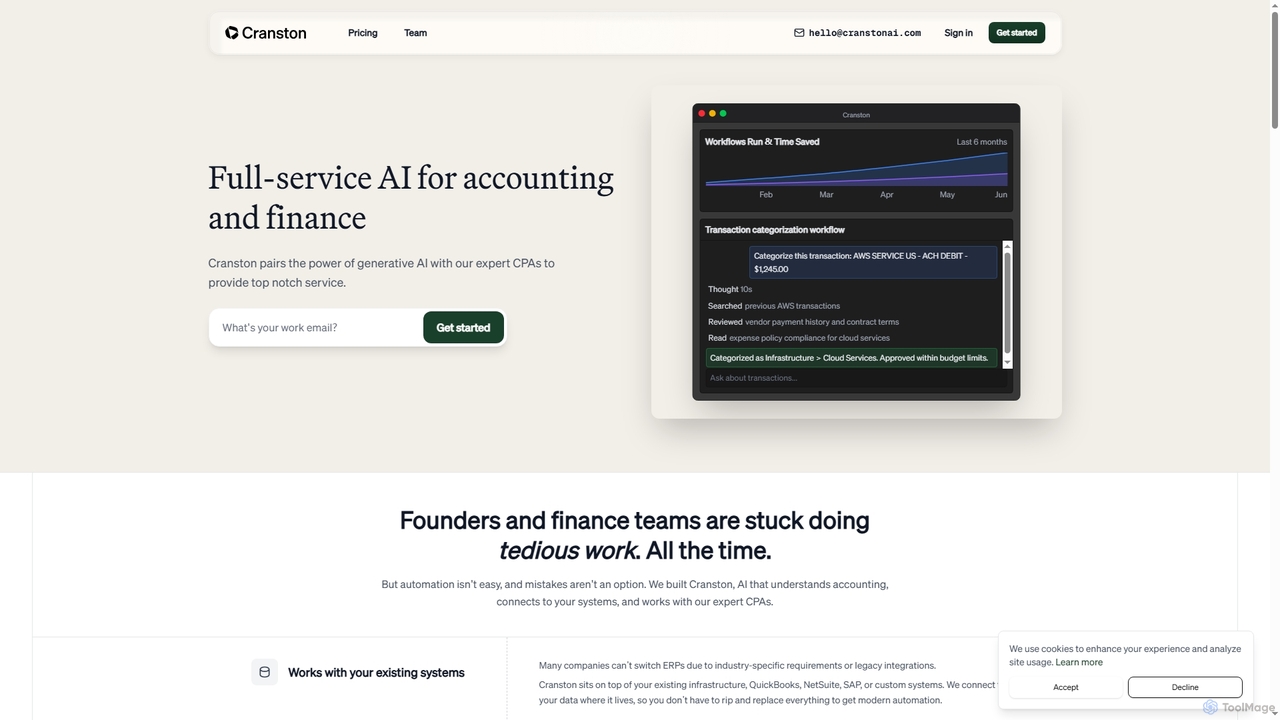
Cranston is an AI-powered accounting platform that combines generative AI with expert CPAs to automate bookkeeping, payroll, tax …

3.1K

About Financial Reporting

Financial Reporting tools are AI-powered solutions designed to automate and enhance the entire process of generating, analyzing, and presenting financial statements and reports. These tools leverage advanced algorithms, machine learning, and natural language processing to extract data, detect anomalies, and provide actionable insights from complex financial datasets. They aim to streamline traditional accounting workflows, improve accuracy, and ensure compliance, serving as intelligent assistants within the broader AI Assistant category.

Core Features

  • Automated Data Extraction: Automatically pulls financial data from various sources like ERPs, spreadsheets, and invoices.
  • Intelligent Report Generation: Creates customized financial statements (P&L, Balance Sheet, Cash Flow) and management reports with minimal manual input.
  • Anomaly Detection: Identifies unusual patterns or discrepancies in financial data that may indicate errors or fraud.
  • Predictive Analytics: Uses historical data to forecast future financial performance and trends.
  • Compliance & Audit Support: Helps ensure reports adhere to regulatory standards and provides audit trails.

Use Cases

Finance departments use these tools to accelerate month-end closing processes by automating data consolidation and report generation. Auditors leverage AI to quickly review large datasets for inconsistencies and compliance breaches. Business analysts utilize predictive features for more accurate budgeting and strategic planning.

How to Choose

When selecting an AI financial reporting tool, consider its integration capabilities with existing accounting systems, the breadth of report types it can generate, its compliance features for relevant regulations, and the level of customization offered for report formats and data analysis.

Financial ReportingUse Cases

1

Automating Monthly Financial Statement Generation

Finance teams can use AI financial reporting tools to automatically consolidate data from various ledgers and ERP systems, generating accurate profit & loss statements, balance sheets, and cash flow reports within minutes. This significantly reduces manual data entry and reconciliation time, allowing analysts to focus on strategic insights rather than data compilation.

2

Real-time Anomaly Detection in Transactions

Auditors and internal control teams deploy these AI tools to continuously monitor transaction data for unusual patterns, large deviations, or potential fraudulent activities. The AI can flag suspicious entries or trends in real-time, enabling immediate investigation and mitigation of financial risks, enhancing the integrity of financial records.

3

Enhancing Budgeting and Forecasting Accuracy

Financial planners and business leaders leverage AI financial reporting for more precise budgeting and forecasting. By analyzing historical financial data, market trends, and external economic indicators, the AI generates predictive models that offer more accurate revenue projections and expense estimates, supporting better strategic decision-making.

4

Streamlining Regulatory Compliance Reporting

Companies operating in regulated industries utilize AI tools to ensure their financial reports comply with specific accounting standards (e.g., IFRS, GAAP) and tax regulations. The AI can automatically format reports, cross-reference data with compliance rules, and highlight potential non-compliance issues, reducing the risk of penalties and audit complexities.

5

Personalized Management Reporting for Executives

Executives and department heads can receive customized financial reports tailored to their specific needs and KPIs. AI financial reporting tools can aggregate relevant data and present it in intuitive dashboards or summaries, providing quick access to critical performance metrics without requiring extensive manual report customization from finance staff.

6

Due Diligence for Mergers & Acquisitions

During M&A activities, financial analysts use AI reporting tools to rapidly process and analyze target company financial statements, identifying key financial health indicators, potential liabilities, and growth opportunities. This accelerates the due diligence process, providing comprehensive insights in a fraction of the time compared to manual review.

Financial ReportingFrequently Asked Questions