BRXCE
BRXCE is an AI-powered task management and workflow automation application that allows users to organize and execute tasks …
BRXCE is an AI-powered task management and workflow automation application that allows users to organize and execute tasks using natural language commands. It integrates with major LLM clients to provide an intuitive, conversational interface for managing personal and team projects, reducing complex clicks and streamlining productivity.

ConvoLive
ConvoLive is an AI-powered language learning app designed for experiential conversation practice. It helps users achieve fluency by …
ConvoLive is an AI-powered language learning app designed for experiential conversation practice. It helps users achieve fluency by engaging with AI avatars in realistic scenarios, offering interactive quizzes, personalized feedback, and the ability to create custom conversations. Available on iOS and Android, it makes language acquisition natural and engaging, focusing on learning by doing.

Sandbar
Sandbar is an interface company that developed the Stream Ring, a voice-first smart ring for capturing thoughts, building …
Sandbar is an interface company that developed the Stream Ring, a voice-first smart ring for capturing thoughts, building ideas through conversational AI, and controlling music. It acts as a seamless extension of your mind for instant, private, and effortless interaction.
WizNote
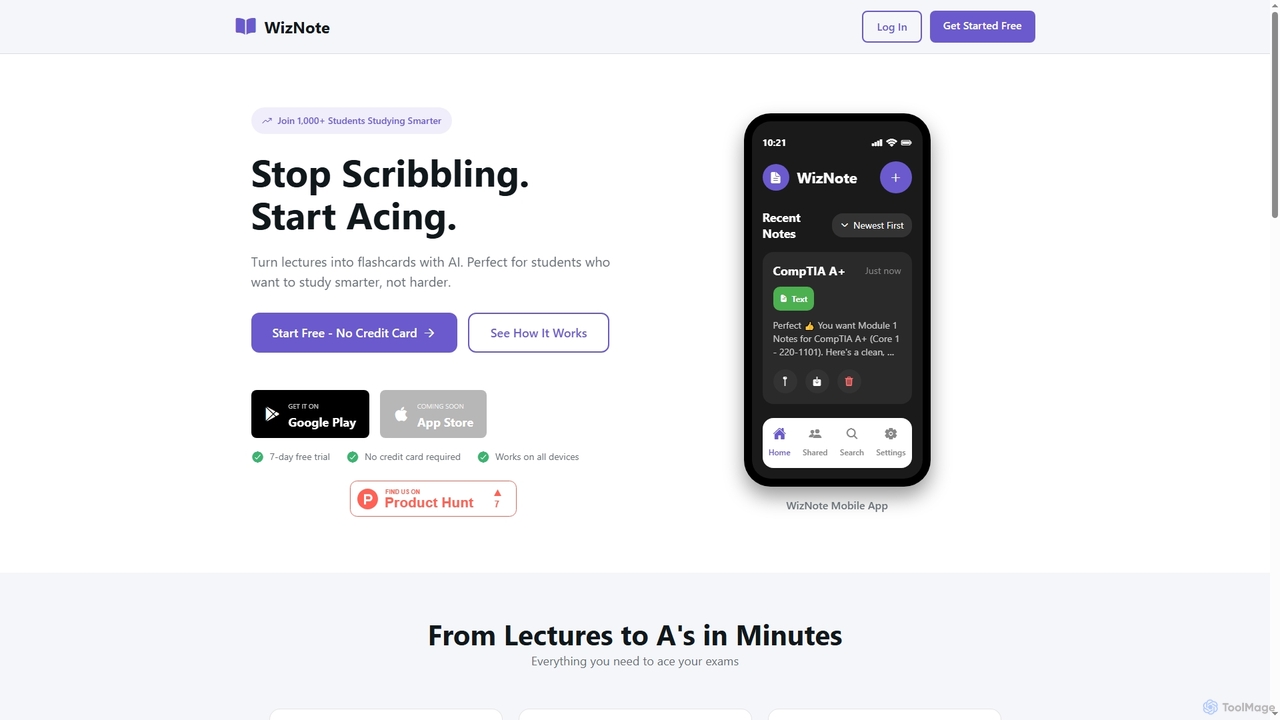
WizNote is an AI-powered study tool designed for students to transform lectures and notes into effective learning materials. …
WizNote is an AI-powered study tool designed for students to transform lectures and notes into effective learning materials. It offers instant AI transcriptions of recordings, automatic flashcard generation, smart summaries, and practice quizzes. Students can also upload PDFs for text extraction and access their study materials across all devices with real-time sync, aiming to help them study smarter and achieve better academic results.
About Ai Assistants
AI Assistants are intelligent software tools designed to understand user commands and automate tasks through natural language interaction. They leverage technologies like Natural Language Processing (NLP) and machine learning to perform a wide range of functions, from scheduling meetings to retrieving complex information. These assistants integrate into workflows to enhance productivity, streamline communication, and provide personalized support across various digital platforms. Their key advantage lies in their ability to learn from interactions and proactively anticipate user needs.
Core Features
- Natural Language Processing (NLP): Understand and respond to human language in text or voice to accurately interpret commands.
- Task Automation: Execute multi-step tasks such as scheduling meetings, sending emails, managing data, or booking travel.
- Personalization: Learn user preferences, habits, and context to provide tailored and relevant assistance.
- Cross-Platform Integration: Connect with calendars, email clients, CRMs, project management tools, and other applications to centralize control.
- Proactive Assistance: Offer suggestions, send reminders, and perform actions based on context and learned patterns without explicit commands.
Use Cases
AI Assistants are used by a wide range of professionals. Executives and managers utilize them to automate scheduling and manage communications. Sales teams integrate them with CRMs to streamline data entry and follow-ups. Developers employ specialized assistants for code generation and debugging, while content creators use them for research and summarization.
How to Choose
When selecting an AI Assistant, consider its integration capabilities with your existing software stack (e.g., Google Workspace, Slack, Salesforce). Evaluate the scope of its automation features to ensure it matches your specific needs, whether for scheduling, research, or coding. Also, assess its platform availability (browser extension, desktop app, API) and its capacity for customization and learning your unique workflows.
Ai AssistantsUse Cases
Automate Meeting Scheduling and Follow-ups
For project managers and executives, coordinating schedules for a multi-person meeting can consume significant time. An AI Assistant automates this entire process. The user simply specifies the attendees and the meeting's purpose. The assistant then accesses everyone's calendars via integration, identifies common availability, proposes times, and sends out invitations once a slot is confirmed. After the meeting, it can process the audio recording to generate a transcript, summarize key discussion points, and create a list of action items, assigning them to the relevant participants in a project management tool.
Streamline Sales CRM Data Entry
Sales representatives often spend hours on manual data entry, updating their CRM after calls and meetings. An AI Assistant integrated with a CRM like Salesforce can eliminate this burden. The assistant can join sales calls, transcribe the conversation, and automatically identify and extract key information such as contact details, budget, timeline, and next steps. It then populates the relevant fields in the CRM, creates a summary of the call, and sets a reminder for the follow-up task. This frees up the sales team to focus on building relationships and closing deals rather than on administrative work.
Accelerate Research and Content Summarization
For researchers, analysts, and content creators, gathering and synthesizing information from multiple sources is a core task. An AI Assistant can act as a powerful research partner. A user can ask it to find the latest studies on a specific topic, and the assistant will browse academic journals, news articles, and reports to compile a list of relevant sources. Furthermore, it can summarize long documents, extract key statistics and quotes, and even generate a draft outline for an article or report based on the collected information. This significantly reduces research time and helps users quickly grasp the essence of complex subjects.
Intelligent Code Completion and Debugging
For software developers, an AI Assistant specialized in coding acts as an intelligent pair programmer. Integrated into an IDE like VS Code, it provides real-time code suggestions that go beyond simple syntax completion. It can generate entire functions or code blocks based on a natural language comment describing the desired logic. When encountering bugs, the developer can ask the assistant to analyze the problematic code. The assistant can then identify potential errors, explain the root cause, and suggest one or more corrected versions of the code, drastically speeding up the debugging process and improving code quality.
Manage Team Workflows and Project Updates
Team leads can use an AI Assistant to maintain visibility across complex projects without constant manual checks. By integrating with tools like Asana, Jira, or Trello, the assistant can respond to natural language queries like, "What's the status of the Q3 marketing campaign?" or "Show me all overdue tasks for the design team." It can automatically compile this information into a daily or weekly digest and send it via Slack or email. Furthermore, it can be instructed to remind team members of upcoming deadlines, flag potential bottlenecks, and even generate draft progress reports for stakeholder meetings.
Personalized Daily Briefings and Task Prioritization
For any busy professional, starting the day organized is crucial. An AI Assistant can create a personalized daily briefing. It connects to the user's calendar, email, and task list to provide a consolidated view of the day ahead. The briefing might include the day's schedule with relevant links for meetings, a summary of important unread emails, a prioritized list of tasks for the day, and even relevant news updates based on the user's industry or interests. This proactive summary helps users immediately focus on what's most important, saving the time typically spent manually reviewing different applications.