Failspot
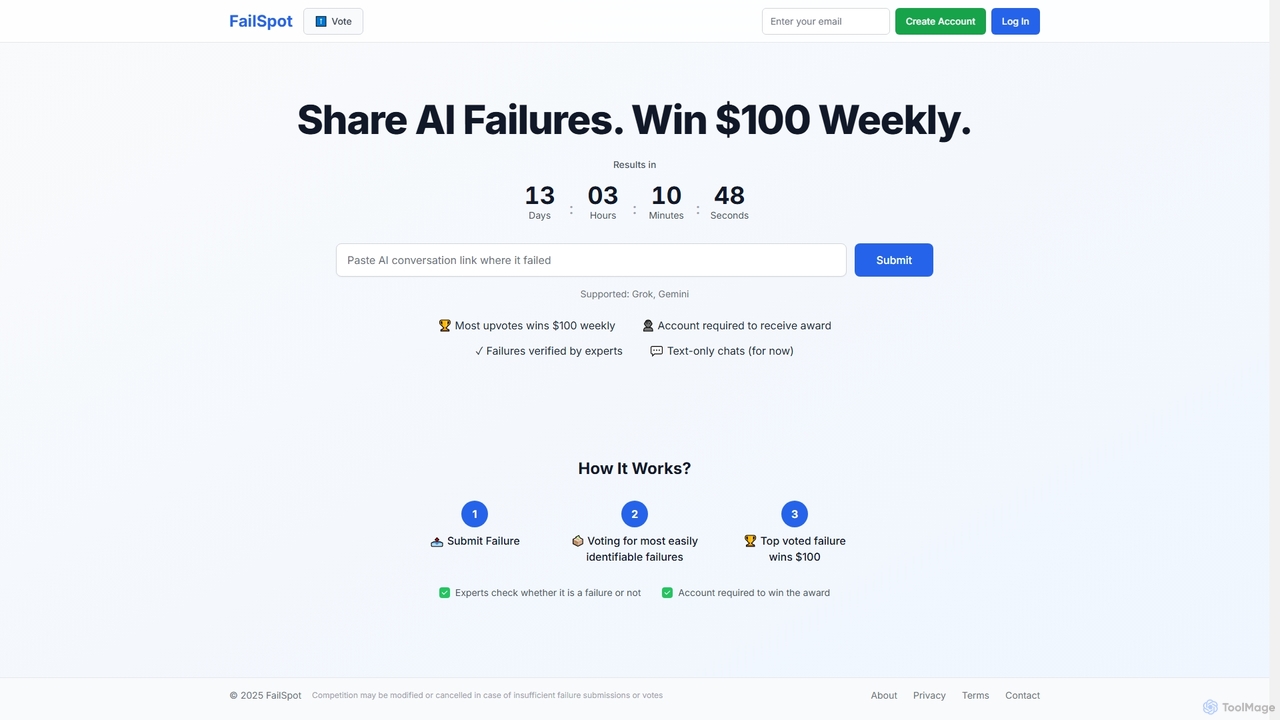
Failspot is a community platform where users submit and vote on AI model failures, with experts verifying submissions. …
Failspot is a community platform where users submit and vote on AI model failures, with experts verifying submissions. The most upvoted failure wins a weekly $100 prize, fostering a collaborative environment for identifying and understanding AI limitations, particularly for models like Grok and Gemini.
About Quality Assurance
AI Quality Assurance tools are specialized platforms designed to ensure the reliability, performance, and ethical integrity of artificial intelligence systems throughout their lifecycle. These tools leverage advanced analytics and machine learning techniques to validate data quality, evaluate model behavior, and identify potential biases or vulnerabilities. They are crucial for developers and enterprises building trustworthy AI applications within the broader AI development landscape, ensuring that AI solutions meet stringent performance standards and deliver predictable, fair outcomes.
Core Features
- Data Validation & Preprocessing: Automatically checks training data for consistency, completeness, and bias, ensuring high-quality input for model development.
- Model Performance Evaluation: Provides metrics and visualizations for assessing model accuracy, precision, recall, F1-score, and other performance indicators.
- Bias Detection & Mitigation: Identifies and quantifies algorithmic bias in models and data, offering strategies or tools to reduce unfair outcomes.
- Adversarial Robustness Testing: Simulates malicious attacks or unexpected inputs to evaluate a model's resilience and identify vulnerabilities.
- Explainable AI (XAI) Insights: Generates explanations for model predictions, helping users understand the reasoning behind AI decisions.
Use Cases
AI developers and MLOps teams integrate these tools into CI/CD pipelines for automated testing, ensuring model quality before deployment. Data scientists employ them to validate datasets for bias and representativeness, improving model fairness. Enterprises utilize them to monitor deployed AI models for performance degradation and data drift, maintaining long-term reliability and compliance.
How to Choose
Consider the specific AI lifecycle stage (data, model training, deployment) the tool targets and its compatibility with your existing AI development frameworks. Evaluate its capabilities for bias detection, explainability, and adversarial testing, aligning with ethical AI requirements. Review the level of automation, reporting features, and scalability for efficient quality management across your AI projects.

Quality AssuranceUse Cases
Automating AI Model Performance Testing
An MLOps engineer integrates an AI QA tool into their CI/CD pipeline to automatically run performance tests on new model versions. The tool evaluates accuracy, latency, and resource usage, flagging any regressions before deployment. This ensures consistent model quality and significantly reduces manual testing effort, accelerating the release cycle for AI-powered applications.
Detecting and Mitigating Algorithmic Bias
A data scientist working on a loan application AI model uses a QA tool to analyze the training data and model predictions for demographic bias. The tool identifies disparities in approval rates across different groups and suggests data re-sampling or model re-weighting techniques to promote fairness, ensuring ethical and equitable AI decision-making.
Ensuring Data Quality for Machine Learning
A machine learning engineer uses an AI QA platform to validate incoming data streams for a real-time recommendation system. The tool automatically detects anomalies, missing values, and inconsistencies, preventing corrupted data from negatively impacting model training and inference. This proactive approach maintains the integrity of the data pipeline and the reliability of the AI system.
Evaluating AI Model Robustness Against Attacks
A security researcher employs an AI QA tool to perform adversarial attacks on a computer vision model used for autonomous driving. The tool generates perturbed images that trick the model, helping developers understand and strengthen its resilience against potential real-world threats. This ensures the AI system can operate safely and reliably even under malicious or unexpected conditions.
Generating Explanations for AI Decisions
A healthcare AI developer uses an XAI-focused QA tool to provide transparent explanations for a diagnostic AI's predictions. The tool highlights which features contributed most to a diagnosis, enabling clinicians to trust and verify the AI's recommendations. This enhances accountability and facilitates regulatory compliance in critical applications where understanding AI reasoning is paramount.
Monitoring Deployed AI Models for Drift
A product manager oversees an AI-powered customer service chatbot. An AI QA tool continuously monitors the chatbot's performance in production, detecting concept drift (changes in user query patterns) or data drift (changes in input data distribution), and alerts the team to retrain the model. This ensures the AI remains effective and relevant to evolving user needs over time.