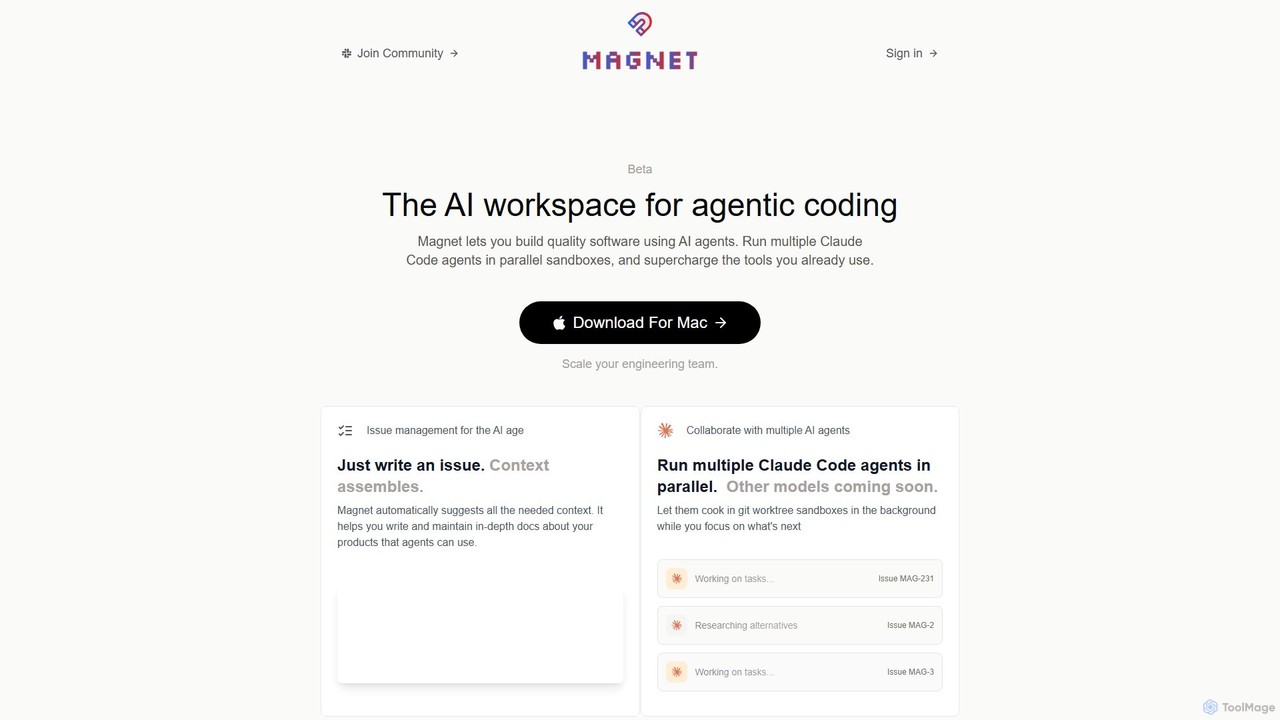
Magnet
Magnet is an AI-powered workspace for agentic coding, enabling developers to build software by orchestrating multiple AI agents. …
Magnet is an AI-powered workspace for agentic coding, enabling developers to build software by orchestrating multiple AI agents. It allows you to run Claude Code agents in parallel sandboxes, acting as a context engine to make development faster, cheaper, and more reliable. It's a native macOS application designed to supercharge your existing engineering workflows.
About Agent Orchestration
Agent Orchestration refers to AI-powered tools designed to manage, coordinate, and optimize the interactions and workflows of multiple AI agents or large language models (LLMs) to achieve complex goals. These systems provide a framework for breaking down intricate problems into manageable sub-tasks, assigning them to specialized agents, and overseeing their collaborative execution. As a vital part of AI Infrastructure, Agent Orchestration enhances the reliability, scalability, and intelligence of autonomous AI systems, enabling them to tackle multi-step challenges with greater efficiency and adaptability.
Core Features
- Task Planning & Decomposition: Automatically breaks down complex objectives into a sequence of smaller, executable tasks for various agents.
- Agent Coordination & Communication: Facilitates seamless interaction and data exchange between different AI agents to ensure collaborative progress.
- Workflow Execution & Monitoring: Manages the sequential or parallel execution of tasks, tracking agent performance and overall workflow status.
- Error Handling & Recovery: Implements mechanisms to detect and resolve issues during agent execution, ensuring robust and resilient operations.
- Dynamic Adaptation & Learning: Adjusts agent strategies and workflows in real-time based on feedback and environmental changes to optimize outcomes.
Use Cases
Agent Orchestration is crucial for scenarios requiring sophisticated AI collaboration, such as automating multi-stage business processes, developing autonomous research systems, or creating adaptive customer service solutions. It empowers organizations to deploy AI for tasks that demand dynamic decision-making and coordinated action across specialized AI components.
How to Choose
When selecting an Agent Orchestration tool, consider its scalability to handle varying agent loads, integration capabilities with your existing LLMs and tools, and the flexibility for custom workflow definitions. Evaluate its monitoring and debugging features for transparency, and assess its support for dynamic adaptation and learning to ensure future-proof AI operations.

Agent OrchestrationUse Cases
Automated Complex Customer Support
Customer service departments can leverage agent orchestration to handle multi-faceted inquiries. An orchestrator might coordinate a "triage" agent to understand the initial query, a "knowledge base" agent to retrieve relevant information, and a "resolution" agent to formulate a personalized response or escalate to a human, significantly reducing resolution times and improving customer satisfaction.
Dynamic Research & Report Generation
Researchers or analysts can use orchestration to automate the entire research lifecycle. Agents are coordinated for tasks like identifying relevant data sources, extracting information, performing data analysis, summarizing findings, and finally generating a comprehensive report, allowing for rapid insights and reduced manual effort in complex data environments.
Intelligent Workflow Automation
In enterprise settings, agent orchestration can automate complex, adaptive business processes. For instance, an orchestrator could manage agents responsible for processing invoices, verifying vendor details, flagging anomalies, and initiating payment approvals, dynamically adjusting the workflow based on real-time data and compliance requirements, leading to greater operational efficiency.
Personalized Learning Path Creation
Educational platforms can employ agent orchestration to create highly personalized learning experiences. An orchestrator might combine agents for student profiling, content recommendation, progress tracking, and adaptive assessment, continuously tailoring the curriculum and resources to individual student needs and learning styles, enhancing engagement and outcomes.
Supply Chain Optimization
Logistics and operations managers can utilize agent orchestration to optimize complex supply chains. This involves coordinating agents for real-time inventory management, demand forecasting, route optimization, and supplier communication, enabling proactive adjustments to disruptions, minimizing costs, and ensuring timely delivery of goods across a global network.
Autonomous Software Development
Software engineering teams can explore agent orchestration for automating parts of the development process. An orchestrator could manage agents for requirement analysis, code generation, testing, debugging, and even deployment, creating a more efficient and potentially self-improving development pipeline, accelerating innovation and reducing human error.