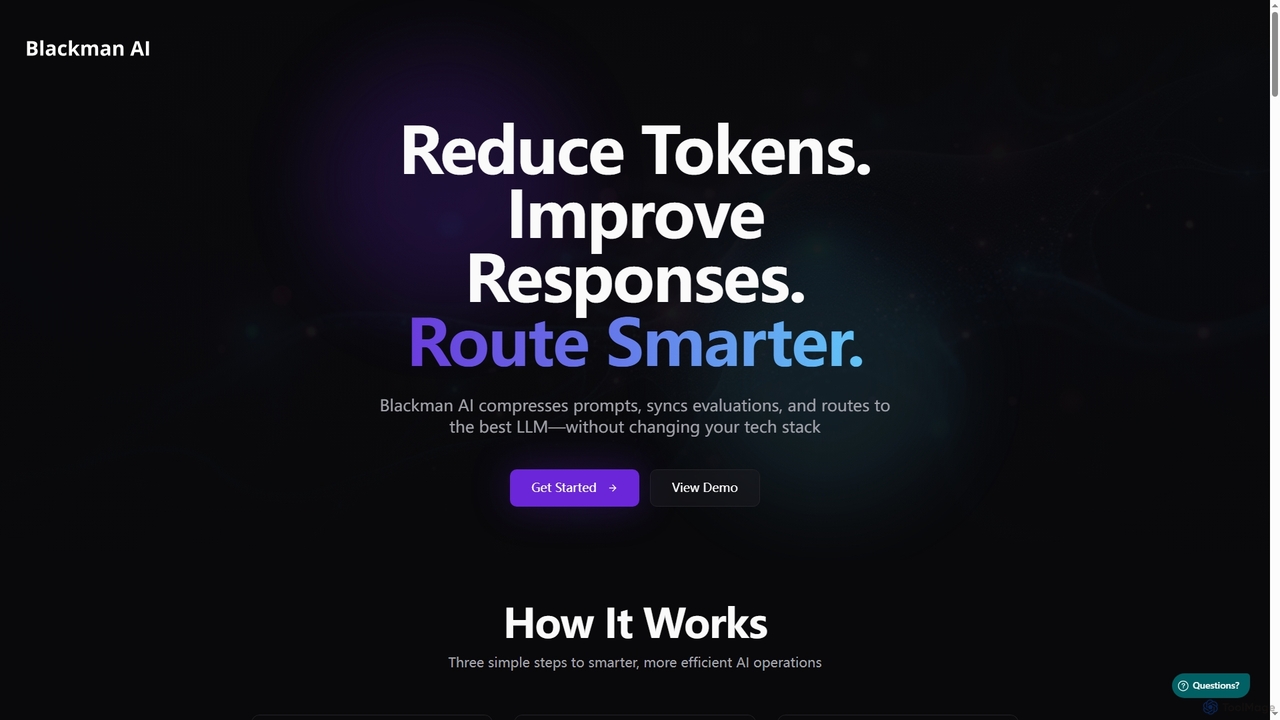
Blackman AI
Blackman AI is an intelligent platform designed to optimize AI operations by reducing token usage, improving LLM responses, …
Blackman AI is an intelligent platform designed to optimize AI operations by reducing token usage, improving LLM responses, and routing requests to the most cost-effective models. It provides real-time analytics and robust security features without altering your existing tech stack.
AI Phantom
AI Phantom is a unified multi-modal AI platform providing access to over 100 AI models from providers like …
AI Phantom is a unified multi-modal AI platform providing access to over 100 AI models from providers like OpenAI, Google, and Anthropic through a single API. It specializes in intelligent routing, performance optimization, and real-time analytics for text, image, video, and audio generation.
About Model Routing
Model Routing tools are a class of AI infrastructure services that dynamically direct incoming requests to the most appropriate large language model (LLM) or foundation model. They act as an intelligent layer, analyzing each query and selecting a model based on predefined rules such as cost, speed, required capabilities, or current availability. This process optimizes both performance and expenditure, ensuring simple tasks are handled by cheaper, faster models while complex queries are sent to more powerful ones. This approach also enhances system reliability by providing automatic fallback options if a primary model fails.
Core Features
- Dynamic Routing Logic: Automatically selects the best model for a request based on content, complexity, or custom metadata.
- Cost Optimization: Routes tasks to the most cost-effective model that can successfully complete them, significantly reducing API expenses.
- Performance Balancing: Distributes traffic to minimize latency and maximize throughput by selecting the fastest available model.
- Model Fallback & Retries: Ensures high availability by automatically rerouting failed requests to an alternative model, preventing service interruptions.
- A/B Testing: Allows for comparing the performance of different models on live traffic to make data-driven decisions.
Use Cases
Model Routing is essential for developers, AI engineers, and product managers building scalable AI applications. It is widely used in high-volume chatbot services, content generation platforms, and enterprise AI systems where balancing cost, quality, and reliability is critical. For instance, a customer service application can use it to route simple FAQs to a cheap model and complex support tickets to a premium one.
How to Choose
When selecting a Model Routing tool, consider its compatibility with the models you use (e.g., OpenAI, Anthropic, Google). Evaluate the sophistication of its routing rules engine—can it handle complex conditional logic? Also, assess its integration capabilities (API, SDKs), performance monitoring dashboards, and pricing structure (e.g., per-request fee vs. subscription) to ensure it aligns with your technical and business needs.

Model RoutingUse Cases
Optimizing Costs for High-Volume Chatbot Services
A customer support team uses a model router to manage thousands of daily queries. Simple, FAQ-style questions are automatically routed to a fast, inexpensive model like GPT-3.5-Turbo. More complex, multi-turn conversations that require deep reasoning are directed to a powerful but more expensive model, such as Claude 3 Opus or GPT-4. This tiered approach significantly reduces overall LLM API costs, often by 40-60%, without compromising the quality of support for complex user needs.
Reducing Latency in Real-Time AI Applications
A developer building an AI-powered code completion tool uses a model router to minimize response time. The router dynamically sends requests to the model with the lowest current latency, potentially choosing between different providers or geographically distributed endpoints. It can also use a fast, smaller model as a first-pass option, only escalating to a larger cloud model if the initial response is insufficient. This ensures a consistently snappy and responsive user experience, which is critical for real-time tools.
Ensuring High Availability with Automatic Model Fallbacks
An enterprise running a mission-critical AI service cannot afford downtime. They configure a model router with a primary model (e.g., from OpenAI) and a secondary backup model (e.g., from Anthropic or Google). If the primary model's API experiences an outage or high error rates, the router automatically and instantly reroutes all traffic to the backup model. This seamless failover mechanism maintains service continuity for end-users, enhancing the application's overall reliability and resilience.
A/B Testing and Performance Comparison of LLMs
A product manager wants to evaluate a new, promising language model without a full-scale migration. Using a model router, they can direct a small percentage of live user traffic (e.g., 10%) to the new model while the rest continues to use the current production model. The router collects and compares key performance metrics like latency, error rates, and user feedback scores for both models. This allows for a direct, data-driven comparison, enabling the team to confidently decide whether to adopt the new model.
Content-Aware Routing for Creative Platforms
A content creation platform that generates both text and images uses a model router to direct requests based on their type. A request for a blog post is sent to a text-generation model like GPT-4, while a request for a product image is sent to an image-generation model like DALL-E 3. The router analyzes the prompt's intent or associated metadata to select the correct specialized model, simplifying the application's internal logic and ensuring the best tool is always used for the job.
Enforcing Data Residency and Compliance Policies
A financial services company operating in Europe must comply with GDPR. Their model router is configured to analyze user metadata. Requests originating from the EU are automatically routed to models hosted on servers within the European Union, while requests from other regions can be sent to global endpoints. This ensures that sensitive data does not leave its required jurisdiction, helping the company meet its regulatory and data privacy obligations seamlessly without complex application-level logic.