Google Labs
Google Labs is the official hub for Google's AI experiments, offering early access to a diverse range of …
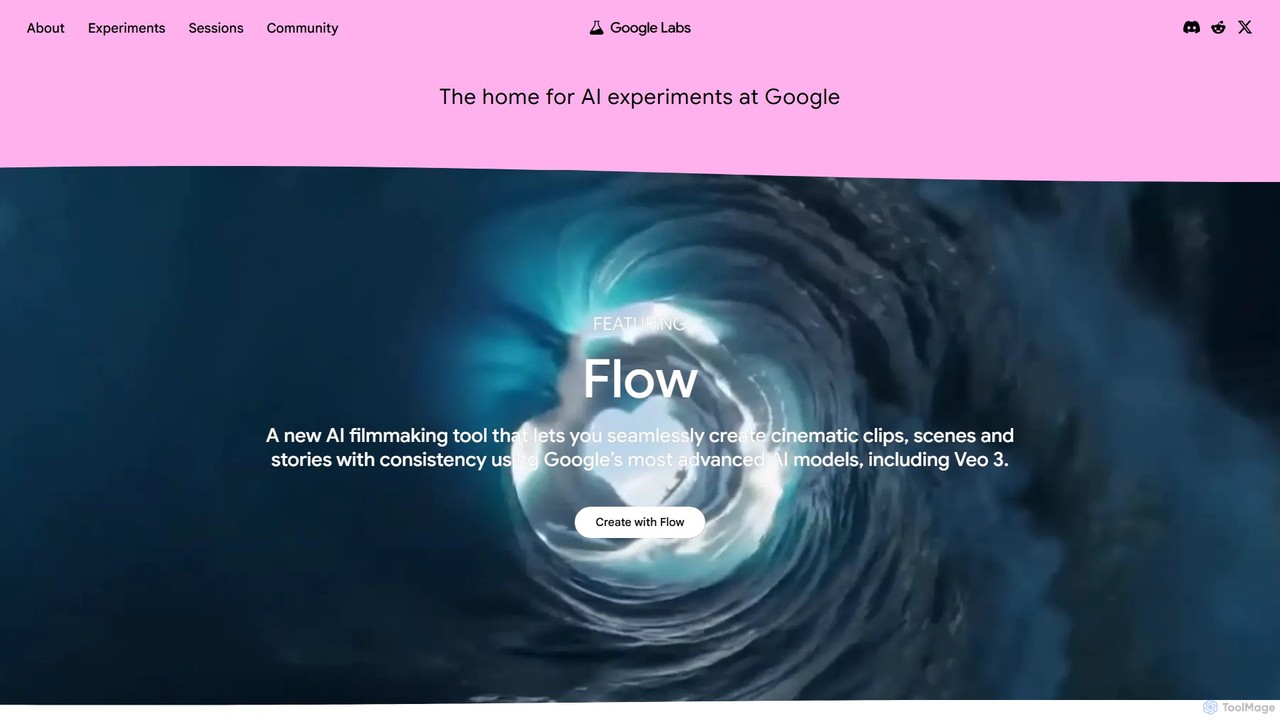
Google Labs is the official hub for Google's AI experiments, offering early access to a diverse range of creative and productivity tools. Users can explore, test, and provide feedback on cutting-edge technologies like Gemini and Veo, directly influencing the future of Google's AI products. It's a playground for creators, developers, and enthusiasts to experience the forefront of artificial intelligence innovation, from AI filmmaking and music generation to coding assistants and design tools.
About Ai Lab
AI Lab platforms are integrated environments for experimenting with, comparing, and managing a diverse range of artificial intelligence models. These tools provide a unified interface to access foundational models from various providers, removing the need to manage multiple separate APIs. They empower users to test prompts, evaluate performance metrics like latency and cost, and prototype AI-driven applications with greater efficiency. This centralized approach accelerates development and aids in selecting the most suitable model for a specific task.
Core Features
- Model Playground: Directly interact with various AI models in a sandbox environment to test prompts and capabilities.
- Side-by-Side Model Comparison: Run the same input across multiple models simultaneously to compare output quality, style, and accuracy.
- Unified API Access: Use a single API key to programmatically access a wide array of models from different developers.
- Performance & Cost Analytics: Track token usage, request latency, and spending across all models to optimize performance and budget.
- Prompt Management: Create, save, and version control effective prompts for consistent and repeatable results.
Use Cases
AI Labs are primarily used by developers building AI-powered applications, researchers conducting comparative studies on model behavior, and product managers prototyping new features. For example, a startup can quickly test five different language models for its chatbot, or a data science team can benchmark vision models for an image recognition task without extensive setup.
How to Choose
When selecting an AI Lab platform, consider the breadth of available models and whether they align with your project needs. Evaluate the platform's API reliability, pricing structure, and the clarity of its cost-tracking tools. Also, assess the user-friendliness of the playground interface and the depth of its prompt engineering and analytics features.
Ai LabUse Cases
Selecting the Best Language Model for a Chatbot
A development team at a SaaS company is tasked with building a new customer support chatbot. Instead of committing to a single model provider, they use an AI Lab platform. They create a standardized set of 50 common customer queries and run them simultaneously across models like GPT-4, Claude 3, and Llama 3. The platform's side-by-side comparison interface allows them to evaluate response accuracy, tone, and helpfulness. They also analyze the cost-per-query and latency data provided by the lab, ultimately selecting the model that offers the best balance of performance and cost for their specific use case.
Rapid Prototyping of an AI Summarization Feature
A product manager wants to demonstrate the value of an AI-powered article summarizer for their content platform. Without needing engineering resources, they use an AI Lab's playground. They paste several long-form articles into the interface and test various summarization prompts with different models. Within an hour, they have multiple high-quality summary examples. They use these outputs in a presentation to stakeholders to get buy-in for developing the feature, having validated the concept quickly and at zero development cost.
Comparing Vision Models for Automated Product Tagging
An e-commerce company wants to automate the process of tagging new product images with attributes like 'color', 'style', and 'material'. Their data science team uses an AI Lab that supports vision models. They upload a test batch of 100 images representing different product categories. They then use the unified API to send these images to several vision models. The lab's interface allows them to easily compare the JSON outputs from each model, evaluating the accuracy and completeness of the generated tags. This process helps them select the most reliable model before investing in a full-scale integration.
Optimizing Prompts to Reduce API Costs
A marketing agency uses an AI model to generate ad copy variations. They notice their monthly API costs are increasing. Using an AI Lab's prompt management and analytics tools, they test several versions of their core prompt. They experiment with providing more concise instructions and few-shot examples. The analytics dashboard shows them the token count and cost for each prompt variation. By identifying a shorter, more efficient prompt that produces equally good results, they manage to reduce their average token usage per request by 30%, leading to significant cost savings without sacrificing quality.
Academic Research on AI Model Behavior
A university researcher is studying linguistic bias in large language models. They use an AI Lab to systematically test a hypothesis across a dozen different models. They prepare a dataset of prompts designed to elicit potentially biased responses related to gender and profession. Using the lab's unified API, they programmatically send these prompts to all models and collect the outputs. This centralized setup saves significant time compared to setting up individual API clients for each model, allowing the researcher to focus on analyzing the comparative results and drawing conclusions for their paper.
Educational Exploration of AI Model Parameters
A student learning about AI uses an AI Lab's playground to understand the impact of different parameters. They start with a simple prompt like 'Tell me a story about a dragon.' First, they run it with the default settings. Then, they adjust the 'temperature' parameter to a high value and observe how the story becomes more creative and unpredictable. Next, they lower the temperature to near zero and see the output become more deterministic and repetitive. This hands-on experimentation provides them with an intuitive understanding of model controls that is difficult to grasp from theory alone.