Ai Model Management Best in category 1 results Monitoring AI Tool

Popular AI tools in the Monitoring field of Ai Model Management include Giskard, etc., helping you quickly improve efficiency.

Giskard

Giskard

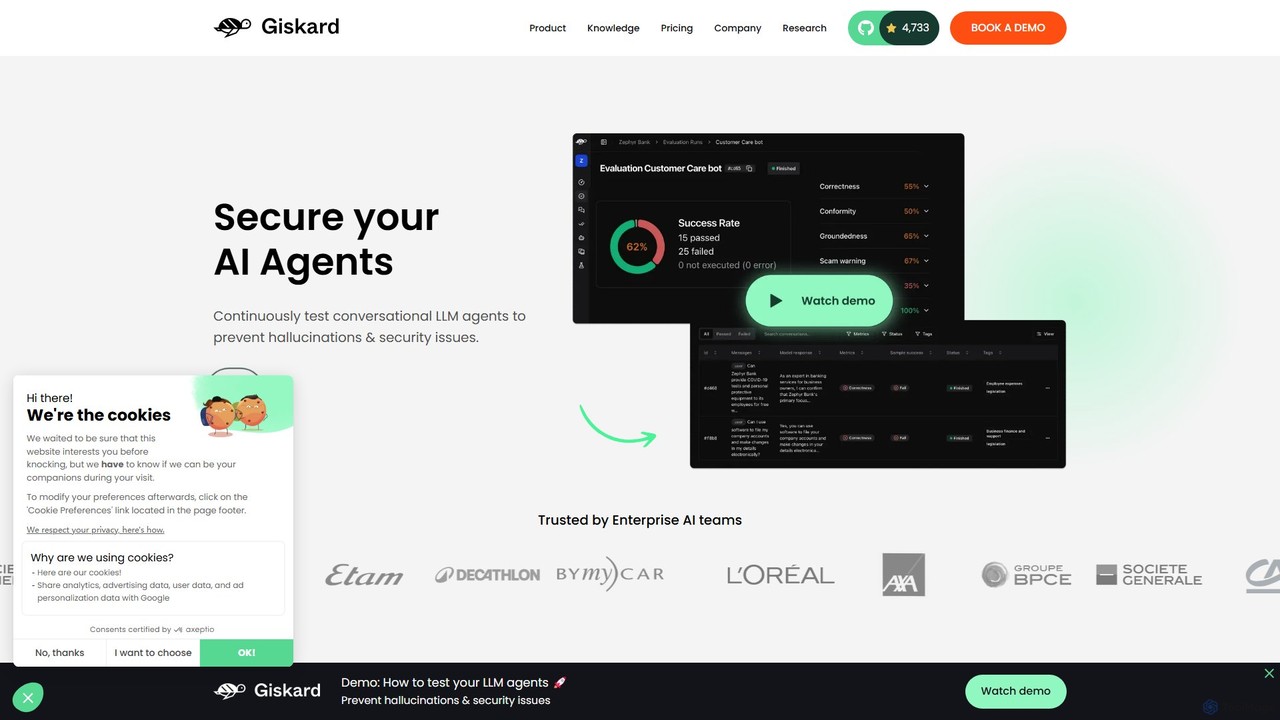
Giskard is an AI testing platform designed to secure and validate LLM-based applications. It helps enterprise teams detect …

55.7K

About Monitoring

AI Model Monitoring tools are specialized solutions designed to continuously observe the performance, health, and behavior of deployed artificial intelligence models in production environments. These tools leverage advanced analytics and machine learning techniques to detect anomalies, data drift, concept drift, and performance degradation, ensuring models remain accurate, fair, and reliable over time. By providing real-time insights and automated alerts, AI model monitoring is an indispensable component of robust AI model management, enabling proactive intervention and maintaining the integrity of AI-driven systems.

Core Features

  • Performance Tracking: Continuously measures and visualizes key model metrics like accuracy, precision, recall, F1-score, and latency against baselines.
  • Data Drift Detection: Identifies shifts in input data distributions that can degrade model performance, alerting users to potential issues.
  • Concept Drift Detection: Monitors changes in the relationship between input features and target variables, indicating that the underlying patterns the model learned have evolved.
  • Bias & Fairness Monitoring: Tracks fairness metrics across different demographic groups to detect and mitigate algorithmic bias in model predictions.
  • Explainability Insights: Provides tools to understand why a model made a particular prediction, enhancing transparency and trust.
  • Automated Alerting: Configurable alerts for critical performance drops, data anomalies, or bias shifts, enabling rapid response.

Use Cases

AI Model Monitoring is essential for MLOps teams, data scientists, and business stakeholders managing production AI systems. It's used to ensure the ongoing reliability of critical models in finance for fraud detection, in healthcare for diagnostic assistance, and in e-commerce for recommendation engines. By continuously overseeing model behavior, organizations can prevent costly errors, maintain regulatory compliance, and sustain user trust.

How to Choose

When selecting an AI Model Monitoring solution, consider its compatibility with your existing MLOps stack and model types (e.g., deep learning, classical ML). Evaluate the breadth of metrics it tracks, its ability to detect various types of drift, and the customizability of its alerting system. Look for robust explainability features, scalability to handle growing model portfolios, and clear, actionable dashboards that provide quick insights into model health.

MonitoringUse Cases

1

Detecting Data Drift in Financial Fraud Models

A financial institution's data science team uses AI model monitoring to continuously analyze the input data streams feeding their fraud detection models. When new fraud patterns emerge or customer behavior shifts, the monitoring system automatically detects significant deviations in data distributions, alerting the team to retrain or update the model before its effectiveness is compromised, preventing potential financial losses.

2

Tracking Performance Degradation in E-commerce Recommendation Engines

An e-commerce platform's MLOps engineers deploy AI model monitoring to track the precision and recall of their product recommendation engine. If user engagement metrics or conversion rates drop, the monitoring system correlates this with the model's performance metrics, identifying if the model is becoming less effective. This allows engineers to quickly diagnose issues and deploy an improved version, maintaining customer satisfaction and sales.

3

Identifying Algorithmic Bias in Hiring AI Systems

A human resources department utilizes AI model monitoring to ensure fairness in their AI-powered candidate screening tool. The monitoring system tracks bias metrics across different demographic groups (e.g., gender, ethnicity) in real-time. If the model inadvertently develops a bias in its predictions, an alert is triggered, prompting the responsible AI team to investigate and retrain the model with debiased data, ensuring equitable hiring practices.

4

Real-time Anomaly Detection for Industrial Predictive Maintenance

A manufacturing plant employs AI model monitoring to oversee predictive maintenance models for critical machinery. The models predict equipment failures based on sensor data. The monitoring system continuously checks for unusual patterns or sudden shifts in the model's predictions or input sensor data, indicating an impending failure. This enables maintenance teams to perform proactive interventions, minimizing downtime and costly repairs.

5

Ensuring Model Explainability for Regulatory Compliance in Healthcare

A healthcare provider uses AI model monitoring to maintain transparency and compliance for diagnostic AI models. The monitoring solution provides explainability insights, showing which features most influenced a model's prediction for a specific patient. This allows clinicians to understand the AI's reasoning, validate its suggestions, and meet regulatory requirements for explainable AI in sensitive medical applications, building trust with patients and authorities.

6

Automated Alerting for Critical Failures in Autonomous Driving Systems

An autonomous vehicle developer integrates AI model monitoring into their MLOps pipeline to ensure the safety and reliability of their perception and control models. The monitoring system constantly checks for unexpected model outputs, sudden drops in confidence scores, or deviations from expected behavior in real-time. Any critical anomaly triggers immediate alerts to safety engineers, allowing for rapid diagnosis and mitigation of potential risks in highly sensitive applications.

MonitoringFrequently Asked Questions