Best of the Year 1 results Ai Operations AI Tools

Popular AI tools in the Ai Operations field include PloyD, etc., helping you quickly improve efficiency.

PloyD

PloyD

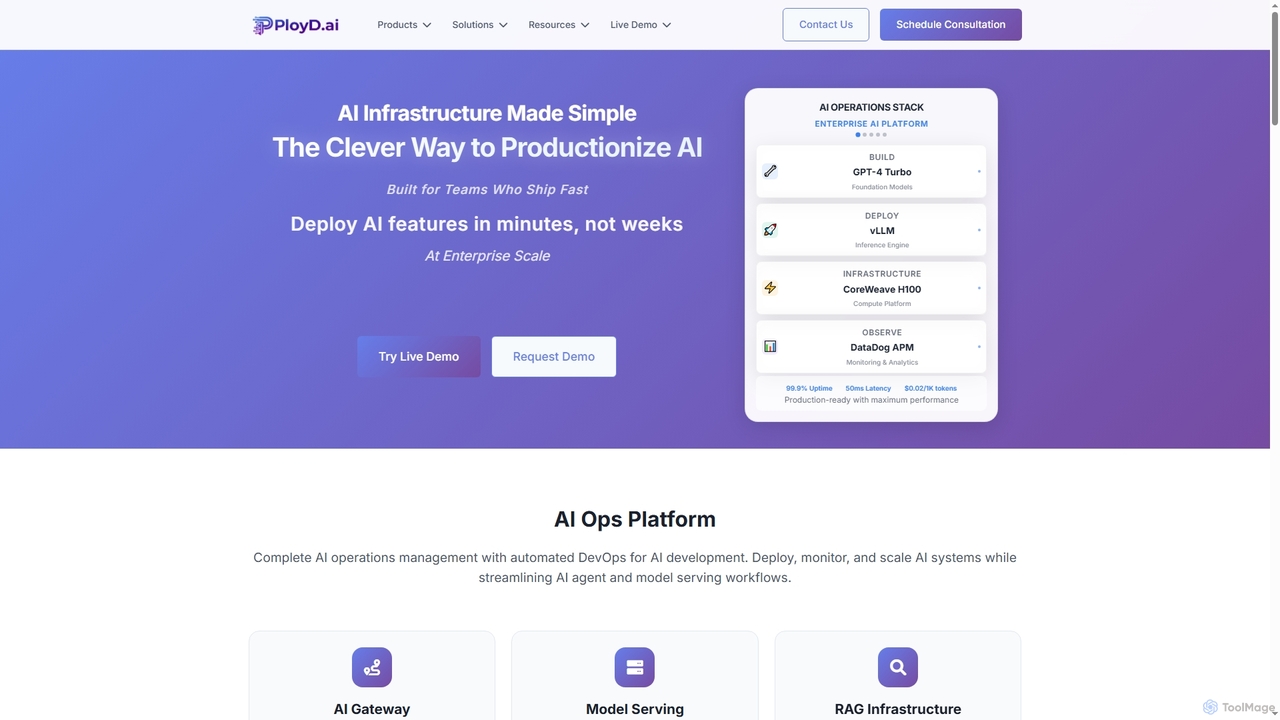
PloyD is an enterprise AI operations platform designed to streamline the productionization of AI models and applications. It …

2.3K

About Ai Operations

Ai Operations are AI-powered tools that streamline and automate the management, deployment, and monitoring of artificial intelligence models and applications. These platforms leverage machine learning to optimize the entire AI lifecycle, from data preparation and model training to deployment, scaling, and ongoing performance management. They enhance efficiency, reduce operational overhead, and ensure the reliability and governance of AI systems in production environments. Ultimately, AI Operations tools empower organizations to effectively manage complex AI initiatives and derive maximum value from their investments.

Core Features

  • Model Versioning & Tracking: Manages different iterations of AI models, ensuring reproducibility and traceability.
  • Automated Deployment: Facilitates seamless deployment of trained models into production environments.
  • Performance Monitoring: Continuously tracks model accuracy, latency, and resource utilization in real-time.
  • Drift Detection: Identifies deviations in data or model predictions that impact performance over time.
  • Resource Optimization: Dynamically allocates computational resources for training and inference workloads.

Use Cases

Organizations with multiple AI projects can use AI Operations tools to centralize model management, automate deployment pipelines, and ensure consistent performance across diverse applications. Data scientists and MLOps engineers leverage these platforms to monitor model health, detect performance degradation, and efficiently update models without disrupting services. This ensures that AI initiatives scale effectively and deliver sustained business value.

How to Choose

When selecting an AI Operations platform, consider its integration capabilities with existing MLOps tools and cloud infrastructure. Evaluate its scalability to handle growing model portfolios and data volumes, as well as its monitoring and alerting features for proactive issue detection. Additionally, assess the platform's governance and compliance features, along with its cost-effectiveness for your specific operational needs.

Ai OperationsUse Cases

1

Automate AI Model Deployment and Scaling

For MLOps engineers, manually deploying and scaling AI models across various environments can be time-consuming and error-prone. AI Operations tools enable automated CI/CD pipelines for models, allowing engineers to define deployment strategies, manage infrastructure, and automatically scale resources based on demand. This ensures rapid, consistent, and reliable delivery of AI capabilities, reducing manual effort by up to 70% and accelerating time-to-market for new AI features.

2

Monitor AI Model Performance Continuously

Data scientists need to ensure their deployed AI models maintain accuracy and reliability over time. AI Operations platforms provide real-time dashboards and alerting systems that track key metrics like prediction accuracy, latency, and data drift. When performance degrades or anomalies are detected, automated alerts notify the team, allowing for prompt investigation and retraining. This proactive monitoring helps prevent significant business impact from underperforming models, ensuring sustained model effectiveness.

3

Manage AI Model Versions and Ensure Governance

Enterprises often deploy multiple versions of AI models, requiring robust version control and governance. AI Operations tools provide a central repository for models, tracking every iteration, its associated data, and training parameters. This ensures auditability, compliance with regulations, and the ability to roll back to previous stable versions if issues arise. It streamlines collaboration among data science, MLOps, and compliance teams, enhancing transparency and reducing risks in AI deployments.

4

Optimize Computational Resources for AI Workloads

Running AI training and inference at scale can be resource-intensive and costly. AI Operations platforms offer intelligent resource management, dynamically allocating GPUs, CPUs, and memory based on workload demands and predefined policies. This prevents over-provisioning, reduces cloud computing costs by an average of 30%, and ensures that critical AI tasks have the necessary resources to perform efficiently. It allows organizations to maximize their infrastructure investment while maintaining high performance.

5

Proactively Detect Model Anomalies and Data Drift

The performance of AI models can degrade over time due to changes in input data (data drift) or shifts in the relationship between inputs and outputs (concept drift). AI Operations tools continuously monitor data streams and model predictions, using statistical methods to detect these drifts and anomalies early. This allows MLOps teams to proactively retrain or update models before significant performance degradation impacts business outcomes, maintaining the relevance and accuracy of AI systems.

6

Streamline AI Model Experimentation and Iteration

Data scientists frequently experiment with different algorithms, hyperparameters, and datasets to build optimal AI models. AI Operations platforms provide experiment tracking, allowing scientists to log and compare results from various model training runs. This facilitates efficient iteration, helps identify the most promising models, and ensures that the best-performing models are promoted to production. It reduces the time spent on manual tracking and improves the overall productivity of AI development teams.

Ai OperationsFrequently Asked Questions