Failspot
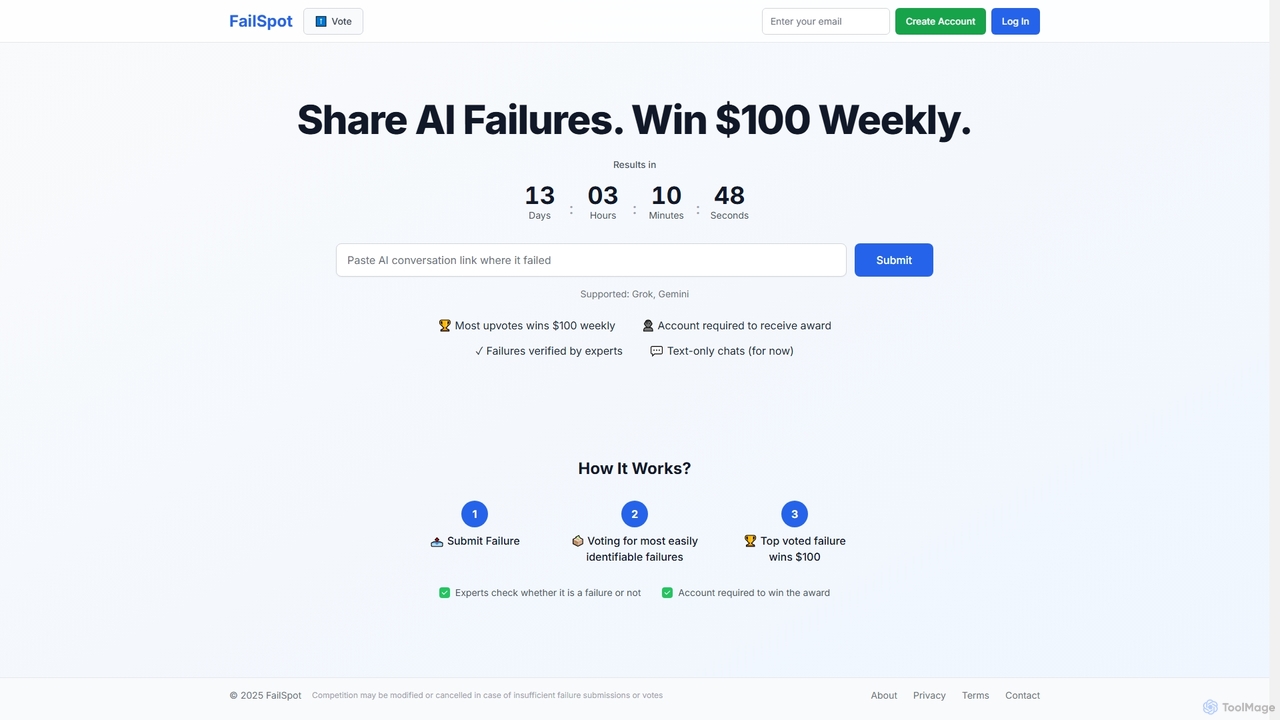
Failspot is a community platform where users submit and vote on AI model failures, with experts verifying submissions. …
Failspot is a community platform where users submit and vote on AI model failures, with experts verifying submissions. The most upvoted failure wins a weekly $100 prize, fostering a collaborative environment for identifying and understanding AI limitations, particularly for models like Grok and Gemini.
About Ai Testing
AI Testing refers to specialized processes and tools designed to evaluate the performance, reliability, robustness, and ethical aspects of Artificial Intelligence systems and machine learning models. These tools leverage advanced methodologies to ensure AI applications function as intended across diverse scenarios, handling complex data inputs and producing accurate, unbiased, and secure outputs. Effective AI testing is crucial for deploying trustworthy and high-performing AI solutions in real-world applications.
Core Features
- Model Validation: Systematically verifies the accuracy, precision, and recall of AI models against predefined benchmarks and datasets.
- Data Drift Detection: Identifies changes in input data distributions over time that could degrade model performance.
- Bias Detection & Mitigation: Uncovers and helps address unfair or discriminatory outcomes in AI models, ensuring ethical deployment.
- Adversarial Robustness Testing: Evaluates how well AI models withstand malicious attacks designed to trick or compromise their functionality.
- Explainability (XAI) Tools: Provides insights into why an AI model made a particular decision, enhancing transparency and trust.
Applicable Scenarios
AI testing is essential across various industries, from finance and healthcare to autonomous driving and e-commerce. Data scientists and MLOps engineers use these tools to validate new model deployments, while compliance officers ensure AI systems meet regulatory standards for fairness and transparency. Developers integrate AI testing into CI/CD pipelines to maintain model quality throughout its lifecycle, preventing performance degradation in production environments.
How to Choose
When selecting AI testing tools, consider the types of AI models you are working with (e.g., NLP, computer vision), the specific aspects you need to test (e.g., performance, bias, security), and the tool's integration capabilities with your existing MLOps pipeline. Evaluate the level of automation offered, the clarity of diagnostic reports, and the community support or vendor's expertise. Scalability for handling large datasets and complex models is also a critical factor.
Ai TestingUse Cases
Validating New AI Model Deployments
Data scientists and MLOps engineers use AI testing tools to rigorously validate newly trained machine learning models before they are deployed to production. This involves running comprehensive test suites to check for accuracy, performance under various load conditions, and potential biases, ensuring the model meets all quality and ethical standards before impacting users.
Monitoring AI Performance in Production
For deployed AI systems, MLOps teams utilize AI testing to continuously monitor model performance and detect issues like data drift or concept drift. These tools automatically alert engineers when the model's predictions start to degrade due to changes in real-world data, allowing for timely retraining or recalibration to maintain optimal functionality.
Ensuring Fairness and Mitigating Bias
Organizations in sensitive sectors like finance or hiring employ AI testing to identify and mitigate biases within their AI algorithms. These tools analyze model outputs across different demographic groups, highlighting disparities and providing insights to adjust the model or training data, ensuring equitable and non-discriminatory decision-making.
Testing AI System Robustness Against Adversarial Attacks
Security teams use AI testing platforms to assess the vulnerability of AI models to adversarial attacks, where malicious inputs are designed to trick the model. This proactive testing helps identify weaknesses and implement defenses, safeguarding critical AI applications like autonomous vehicles or fraud detection systems from potential exploitation.
Automating Regression Testing for AI Updates
As AI models are frequently updated or retrained, developers use AI testing tools to automate regression testing. This ensures that new versions of the model do not introduce unintended side effects or degrade performance on previously well-handled cases, streamlining the development cycle and maintaining consistent quality.
Generating Explanations for AI Decisions (XAI)
In regulated industries or for critical applications, AI testing tools provide explainability features (XAI) to understand why an AI model made a particular decision. This helps compliance officers and domain experts audit AI behavior, build trust with users, and debug complex models by revealing the factors influencing their outputs.