Rawbot
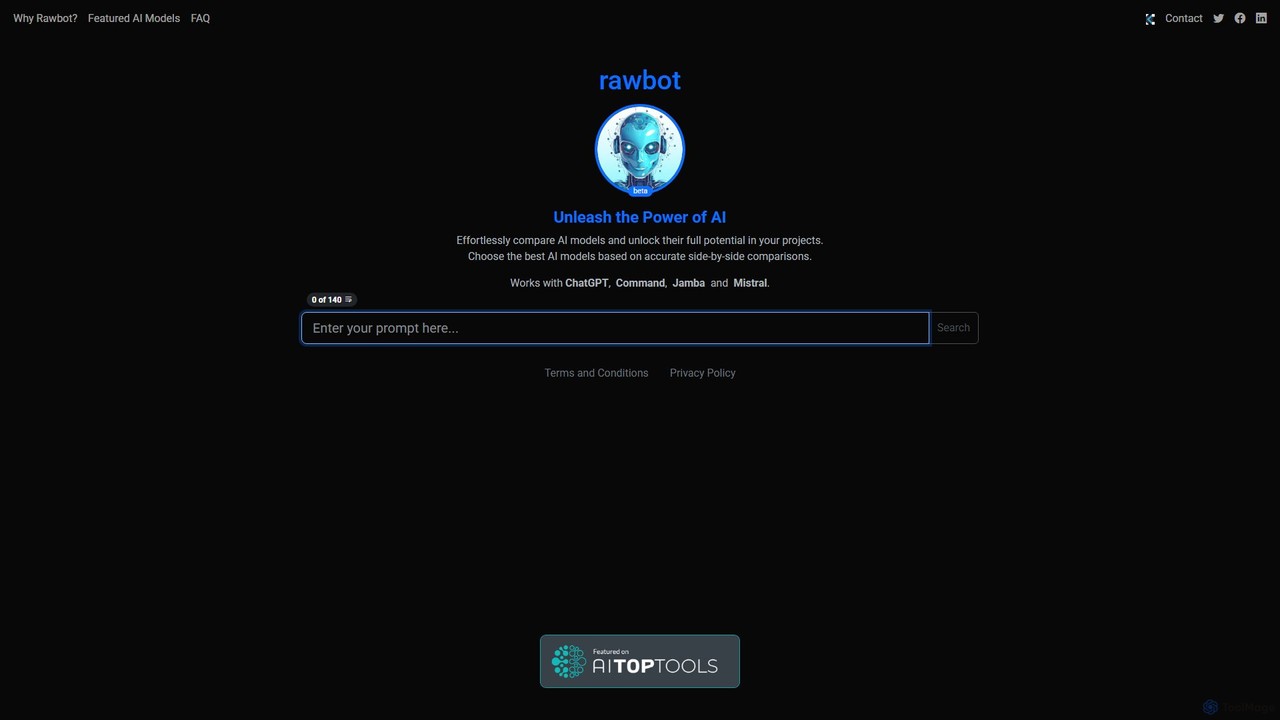
Rawbot is an intuitive AI tool for simple and effective side-by-side comparison of large language models. Input a …
Rawbot is an intuitive AI tool for simple and effective side-by-side comparison of large language models. Input a single prompt and instantly see responses from various models like ChatGPT, Mistral, Jamba, and Command. This helps developers, writers, and researchers make informed decisions by directly evaluating model performance, style, and accuracy for their specific needs, streamlining the model selection process.
About Ai Model Management
AI Model Management tools are specialized platforms for governing the entire lifecycle of machine learning models in a production environment. They provide a centralized framework for versioning, deploying, monitoring, and retiring models at scale. These tools bridge the gap between data science development and IT operations, enabling robust MLOps (Machine Learning Operations) practices. By automating and standardizing model management, they ensure reliability, reproducibility, and compliance for AI applications.
Core Features
- Model Registry: A central repository to store, version, and document machine learning models and their associated metadata.
- Automated Deployment: Streamlines the process of packaging models and deploying them as scalable services or APIs on cloud or on-premise infrastructure.
- Performance Monitoring: Continuously tracks key metrics like latency, throughput, and prediction accuracy, and detects issues like data drift or model degradation.
- Governance and Compliance: Implements access controls, audit trails, and model explainability features to meet regulatory and internal policy requirements.
- CI/CD for ML Integration: Connects with CI/CD pipelines to automate the testing, validation, and promotion of models from development to production.
Use Cases
These tools are essential for organizations deploying multiple machine learning models, particularly in regulated industries like finance, healthcare, and insurance. MLOps engineers, data scientists, and IT teams use them to manage complex model ecosystems, ensuring consistent performance and reducing operational risks.
How to Choose
When selecting an AI Model Management tool, consider its integration with your existing ML frameworks (e.g., TensorFlow, PyTorch), supported deployment targets (e.g., Kubernetes, serverless), the sophistication of its monitoring and alerting capabilities, and the strength of its governance and security features.

Ai Model ManagementUse Cases
Enterprise-Scale Model Deployment and Governance
A large financial services company manages hundreds of models for fraud detection, credit scoring, and algorithmic trading. They use an AI Model Management platform to create a centralized model registry, enforcing standardized validation and security checks before deployment. This ensures that all models in production are compliant with financial regulations, with a full audit trail for every version and prediction.
Automating Retraining with MLOps CI/CD Pipelines
An e-commerce platform's recommendation engine needs frequent updates based on new user behavior. An MLOps team integrates a model management tool into their CI/CD pipeline. When new training data is available, the pipeline automatically triggers model retraining, validation, and A/B testing. The best-performing model is then promoted to production with zero downtime, keeping recommendations fresh and relevant.
Monitoring Production Models for Performance Drift
A logistics company relies on an AI model to predict delivery times. Over time, changes in traffic patterns and delivery zones cause the model's accuracy to degrade (a phenomenon known as model drift). The AI Model Management tool continuously monitors prediction accuracy against actual outcomes. When performance drops below a set threshold, it automatically alerts the data science team to investigate and initiate a retraining cycle.
A/B Testing and Champion-Challenger Model Rollouts
A marketing team wants to test a new customer churn prediction model (the 'challenger') against the existing one (the 'champion'). Using a model management platform, they can easily deploy both models simultaneously and route a small percentage of live traffic (e.g., 10%) to the challenger. The platform collects performance metrics for both, allowing the team to make a data-driven decision on which model to fully roll out.
Ensuring Compliance in Healthcare AI Applications
A medical imaging startup develops an AI model to detect diseases from scans. To achieve regulatory approval (e.g., from the FDA), they must document the entire model lifecycle. An AI Model Management platform provides the necessary governance, capturing data lineage, model versions, training parameters, and validation results. This creates a reproducible and auditable record, demonstrating the model's safety and efficacy.
Centralizing Models for Team Collaboration
A large corporation has multiple data science teams working in different business units. Without a central system, they often build similar models, duplicating effort. An AI Model Management platform acts as a shared 'model store.' Teams can publish, discover, and reuse pre-trained and validated models, accelerating project timelines and fostering collaboration across the organization.