Lushair
Lushair is an AI-powered hair and scalp analysis system that uses a smart dermascope and a mobile app …
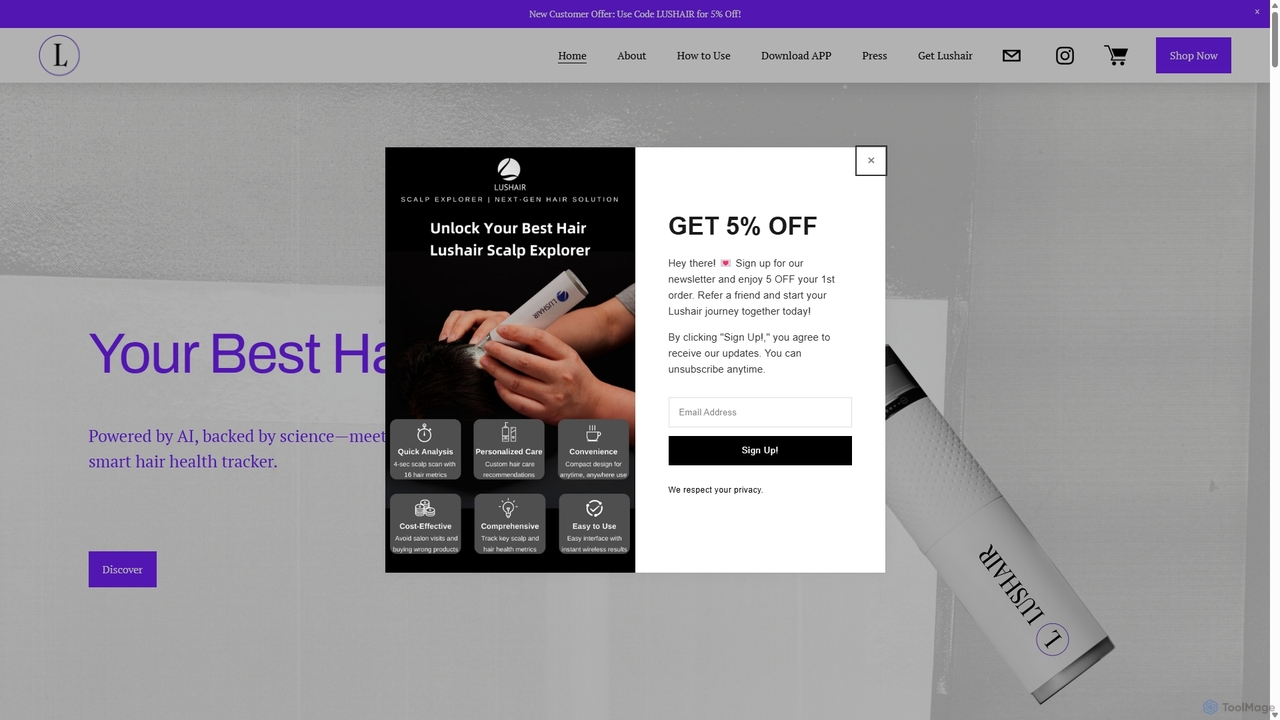
Lushair is an AI-powered hair and scalp analysis system that uses a smart dermascope and a mobile app to provide clinic-grade diagnostics at home. It analyzes 16 vital signs to generate personalized care plans, including product, lifestyle, and professional recommendations, helping users proactively manage their hair health.
About Diagnostics
AI Diagnostics tools are specialized platforms designed to monitor, analyze, and troubleshoot the performance, behavior, and reliability of artificial intelligence models and systems. These tools leverage advanced analytics and machine learning techniques to identify issues such as model drift, data quality problems, performance degradation, and algorithmic bias. Their primary purpose is to ensure the robust operation, fairness, and transparency of AI applications throughout their lifecycle, from development to production deployment.
Core Features
- Model Performance Monitoring: Real-time tracking of key metrics like accuracy, latency, and throughput to detect anomalies.
- Data Drift Detection: Identifying shifts in input data distributions that can degrade model performance over time.
- Bias & Fairness Analysis: Detecting and quantifying algorithmic biases across different demographic groups or sensitive attributes.
- Explainability (XAI) Insights: Providing human-understandable explanations for AI model predictions and decisions.
- Error & Anomaly Detection: Pinpointing specific errors, outliers, or unexpected behaviors within AI system outputs.
Use Cases
AI Diagnostics are crucial for MLOps engineers to maintain healthy production models, data scientists to debug complex model behaviors, and compliance teams to ensure ethical AI. They are applied in scenarios ranging from continuous monitoring of deployed AI services to in-depth analysis during model development and validation, ensuring AI systems remain reliable and fair.
How to Choose
When selecting an AI Diagnostics tool, consider its integration capabilities with your existing MLOps stack, the breadth of diagnostic features (e.g., drift, bias, explainability), scalability to handle your data volume, and the clarity of its reporting and alerting mechanisms. Evaluate its support for various AI frameworks and ease of use for your team.

DiagnosticsUse Cases
Monitoring Production AI Model Health
MLOps engineers utilize AI Diagnostics tools to continuously monitor the performance and health of deployed AI models in real-time. This involves tracking metrics like prediction accuracy, latency, resource utilization, and error rates. The tools automatically alert engineers to anomalies, model drift, or sudden drops in performance, enabling proactive intervention to prevent service degradation and maintain high operational reliability for critical AI applications.
Debugging AI Model Failures in Development
Data scientists and machine learning engineers employ AI Diagnostics during the model development phase to identify and resolve issues causing unexpected model behavior or poor performance. These tools help pinpoint the root causes of errors, analyze feature importance, and understand specific prediction failures, significantly accelerating the debugging process and improving model robustness before deployment.
Detecting and Mitigating Algorithmic Bias
AI ethicists and developers use diagnostic platforms to systematically detect and quantify potential biases within AI models and their training data. By analyzing predictions across different demographic groups or sensitive attributes, these tools highlight unfair outcomes. This enables teams to implement targeted mitigation strategies, ensuring AI systems make equitable and responsible decisions, crucial for regulatory compliance and public trust.
Validating Data Quality for AI Training
Data engineers and scientists leverage AI Diagnostics to assess the quality, consistency, and integrity of data used for training AI models. Before a model is trained, these tools can identify missing values, outliers, inconsistencies, or data schema violations. Ensuring high-quality input data is fundamental for building accurate and reliable AI models, preventing "garbage in, garbage out" scenarios.
Explaining Complex AI Model Decisions
Business analysts, compliance officers, and domain experts use AI Diagnostics with Explainable AI (XAI) capabilities to understand why a particular AI model made a specific prediction or decision. This is vital in regulated industries like finance or healthcare, where transparency is mandated. XAI insights help build trust, validate model logic, and facilitate auditing processes by providing clear, interpretable reasons behind AI outputs.
Optimizing AI Model Performance and Efficiency
Machine learning engineers apply diagnostic insights to fine-tune and optimize AI models. By analyzing performance bottlenecks, resource consumption, and prediction patterns, these tools help identify areas for improvement in model architecture, hyperparameter tuning, or inference efficiency. This leads to more performant, cost-effective, and scalable AI solutions, maximizing the return on AI investments.