TENET
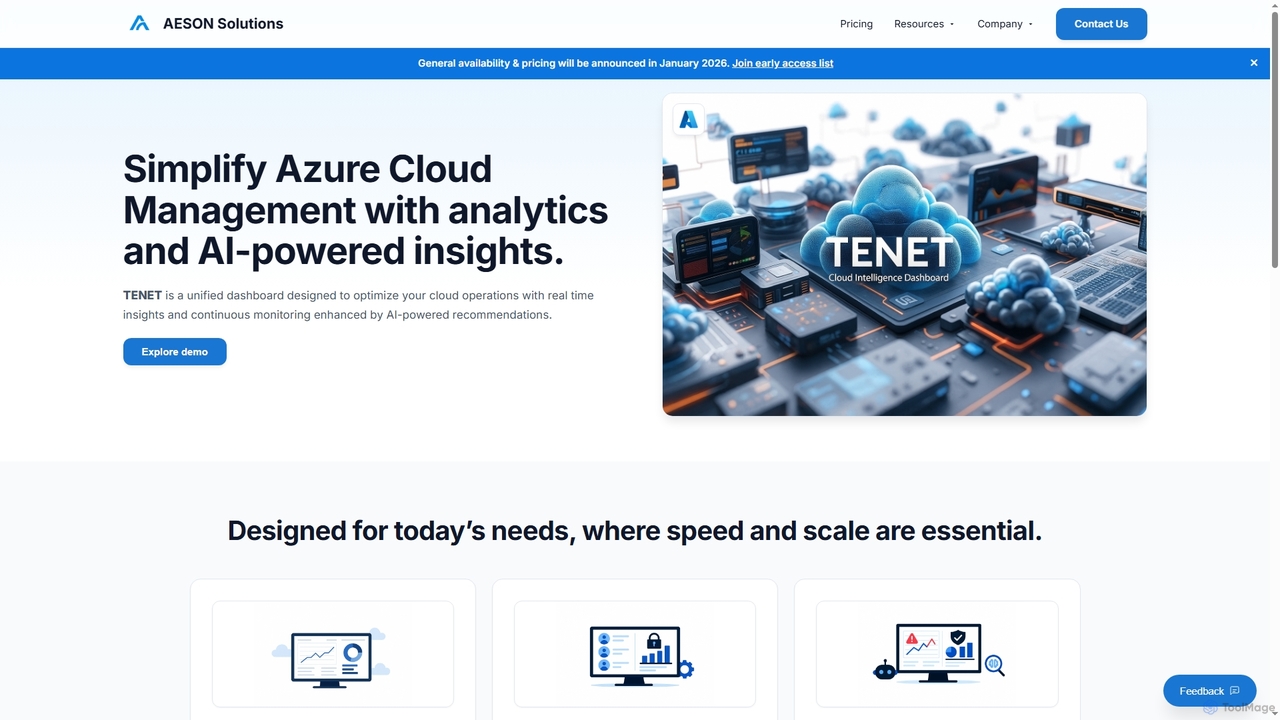
TENET is an AI-powered Azure Cloud Intelligence Platform by AESON Solutions, designed to simplify cloud management. It provides …
TENET is an AI-powered Azure Cloud Intelligence Platform by AESON Solutions, designed to simplify cloud management. It provides a unified dashboard with real-time analytics and continuous monitoring, enhanced by AI-driven insights and recommendations to optimize cloud operations, detect anomalies, and strengthen security.
About Cloud Monitoring
Cloud Monitoring tools are a specialized category within analytics that provide real-time visibility into the performance, health, and availability of cloud infrastructure and applications. These tools leverage automated data collection and advanced analytics to track key metrics, identify anomalies, and ensure optimal operational efficiency. They are essential for maintaining service reliability, optimizing resource utilization, and proactively addressing potential issues in dynamic cloud environments.
Core Features
- Real-time Metrics Collection: Continuously gathers performance data from cloud resources like CPU, memory, network I/O, and disk usage.
- Log Management & Analysis: Centralizes, indexes, and analyzes logs from various cloud services for troubleshooting and security.
- Alerting & Notifications: Configurable alerts based on predefined thresholds or detected anomalies, delivered via various channels.
- Application Performance Monitoring (APM): Tracks end-to-end application performance, identifying bottlenecks and user experience issues.
- Cost Optimization Insights: Provides data on resource usage to help identify underutilized resources and optimize cloud spending.
Applicable Scenarios
DevOps teams use cloud monitoring to track application deployments, identify performance regressions, and ensure continuous delivery pipelines run smoothly. Site Reliability Engineers (SREs) rely on these tools for proactive incident management, setting up alerts for critical system health indicators to maintain high availability. Cloud architects and IT managers utilize monitoring data to optimize resource allocation, forecast capacity needs, and manage cloud costs effectively across their infrastructure.
How to Choose
When selecting a cloud monitoring solution, consider its compatibility with your specific cloud providers (AWS, Azure, GCP) and the breadth of services it supports. Evaluate its data collection capabilities, including real-time metrics, logs, and traces, and the flexibility of its alerting system. Look for robust visualization and reporting features, and assess its scalability and pricing model to ensure it aligns with your operational needs and budget.

Cloud MonitoringUse Cases
Optimizing Cloud Resource Utilization
DevOps engineers use cloud monitoring dashboards to identify idle or underutilized virtual machines and databases. By analyzing usage patterns and performance metrics, they can right-size resources, scale down unnecessary instances, and automatically shut down non-production environments during off-hours, leading to a significant reduction in unnecessary cloud expenditure, often by up to 30%.
Proactive Incident Detection & Resolution
Site Reliability Engineering (SRE) teams configure alerts for unusual spikes in error rates, latency, or resource consumption for critical microservices. When an anomaly is detected, the cloud monitoring system automatically notifies the on-call team via PagerDuty or Slack, enabling them to investigate and resolve issues quickly, often before they impact end-users or service level agreements (SLAs).
Ensuring Application Performance & User Experience
Application owners and product managers track key APM metrics like response times, transaction throughput, and error rates across different geographic regions and user segments. This helps pinpoint performance bottlenecks in specific services, database queries, or third-party API calls, ensuring a smooth and consistent user experience for their customers globally.
Security Event Monitoring & Compliance
Security operations teams centralize logs from firewalls, identity services, network flows, and cloud-native security services. Cloud monitoring tools help detect suspicious login attempts, unauthorized access patterns, data exfiltration attempts, and compliance violations (e.g., HIPAA, GDPR), triggering immediate alerts for investigation and enabling rapid response to potential threats.
Capacity Planning & Forecasting
Infrastructure managers and cloud architects analyze historical resource usage trends (CPU, memory, network I/O, storage) provided by cloud monitoring tools. This data helps them predict future capacity needs, inform decisions on scaling up or down resources, and prevent performance degradation during peak loads, thereby avoiding both over-provisioning and under-provisioning of cloud infrastructure.
Troubleshooting Complex Distributed Systems
Developers and support teams use distributed tracing features within cloud monitoring platforms to visualize the end-to-end flow of requests across multiple microservices, serverless functions, and databases. This helps them quickly pinpoint the exact service or component causing an error, latency, or slowdown in a complex cloud-native application, significantly reducing mean time to resolution (MTTR).