Sauce
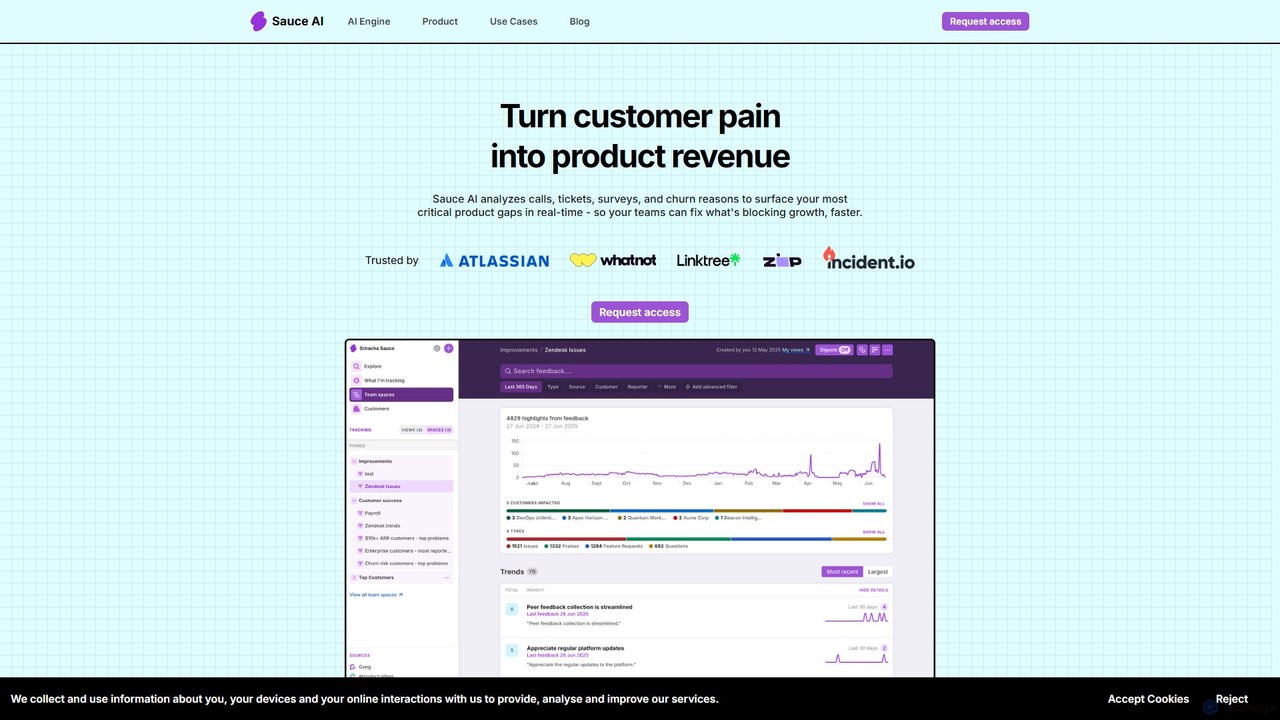
Sauce is an AI-powered platform that analyzes customer feedback from calls, tickets, surveys, and more. It automatically surfaces …
Sauce is an AI-powered platform that analyzes customer feedback from calls, tickets, surveys, and more. It automatically surfaces critical product gaps, feature requests, and churn risks in real-time. This enables product, sales, and support teams to prioritize effectively, accelerate growth, and build products that customers truly need.
About Feedback Analysis
Feedback Analysis tools are a specialized class of AI software designed to automatically interpret and categorize large volumes of qualitative customer feedback. Using Natural Language Processing (NLP) techniques like sentiment analysis and topic modeling, these tools transform unstructured text from reviews, surveys, and support tickets into structured, actionable insights. They enable businesses to quickly understand customer opinions, identify emerging trends, and pinpoint specific issues without manual reading. This process helps prioritize product improvements, enhance customer service, and make data-driven decisions based on the true voice of the customer.
Core Features
- Sentiment Analysis: Automatically classifies text as positive, negative, or neutral to gauge overall customer mood.
- Topic & Theme Detection: Identifies and groups recurring subjects or issues mentioned in feedback, such as 'pricing' or 'user interface'.
- Keyword Extraction: Pinpoints specific terms, features, or brand names frequently mentioned by users.
- Intent Recognition: Determines the underlying purpose of the feedback, distinguishing between questions, complaints, and suggestions.
- Trend Reporting: Visualizes how feedback topics and sentiment change over time, highlighting emerging problems or successes.
Use Cases
These tools are invaluable for product managers, customer support teams, marketers, and UX researchers. They are used to analyze app store reviews, support chat logs, social media comments, and Net Promoter Score (NPS) survey responses to guide product roadmaps and improve user satisfaction.
How to Choose
When selecting a tool, consider the data sources it supports (e.g., social media, CRM, survey platforms), the accuracy of its sentiment and topic analysis, its integration capabilities with your existing workflow, and its reporting and visualization features. Also, evaluate the pricing model based on feedback volume.

Feedback AnalysisUse Cases
Prioritize Product Features from User Feedback
A product manager for a SaaS application is overwhelmed by hundreds of weekly user comments from Intercom, Zendesk, and app store reviews. They use a Feedback Analysis tool to automatically aggregate and analyze all this data. The tool identifies that 'dark mode' and 'Google Calendar integration' are the most requested features. This data allows the manager to confidently prioritize these items on the product roadmap, backed by quantitative evidence of user demand.
Optimize Customer Support Knowledge Base
A customer support manager notices a high volume of repetitive tickets. By feeding support transcripts into a Feedback Analysis tool, they discover that 25% of all queries are related to 'password reset' and 'billing information.' The tool's topic modeling feature groups these conversations, revealing the most common points of confusion. The team then creates detailed help articles and a chatbot flow for these topics, reducing ticket volume by 15% within a month.
Monitor Brand Sentiment During a Campaign
A marketing team launches a new advertising campaign. They use a Feedback Analysis tool to monitor mentions of their brand and campaign hashtag on Twitter and Facebook in real-time. The tool's sentiment analysis dashboard shows an initial positive reaction, but also flags a growing negative theme related to a misleading claim in one of the ads. The team is able to quickly address the issue and adjust the ad copy, preventing a wider PR problem.
Uncover Insights from Open-Ended Surveys
A UX researcher conducts a survey with an open-ended question: 'What could we improve?' Instead of manually reading 2,000 text responses, they upload the data to a Feedback Analysis tool. The platform automatically identifies key themes like 'confusing navigation,' 'slow loading times,' and 'mobile app bugs.' This allows the researcher to quickly generate a data-backed report for the design and engineering teams, focusing on the most critical user pain points.
Analyze E-commerce Product Reviews
An e-commerce manager for an electronics brand wants to understand why a new headphone model has a lower rating than expected. They connect a Feedback Analysis tool to their Amazon and Shopify reviews. The analysis reveals a high frequency of negative comments mentioning 'poor battery life' and 'uncomfortable fit.' This specific, actionable insight is passed to the product development team to improve the next version of the product.
Improve Employee Experience with Survey Data
An HR department conducts an annual anonymous employee engagement survey. To ensure confidentiality and extract honest insights, they use a Feedback Analysis tool to process thousands of written comments. The tool identifies key concerns around 'work-life balance' and 'career development opportunities' without revealing individual identities. This helps HR leadership develop targeted programs to improve employee satisfaction and retention.