
Observe.AI
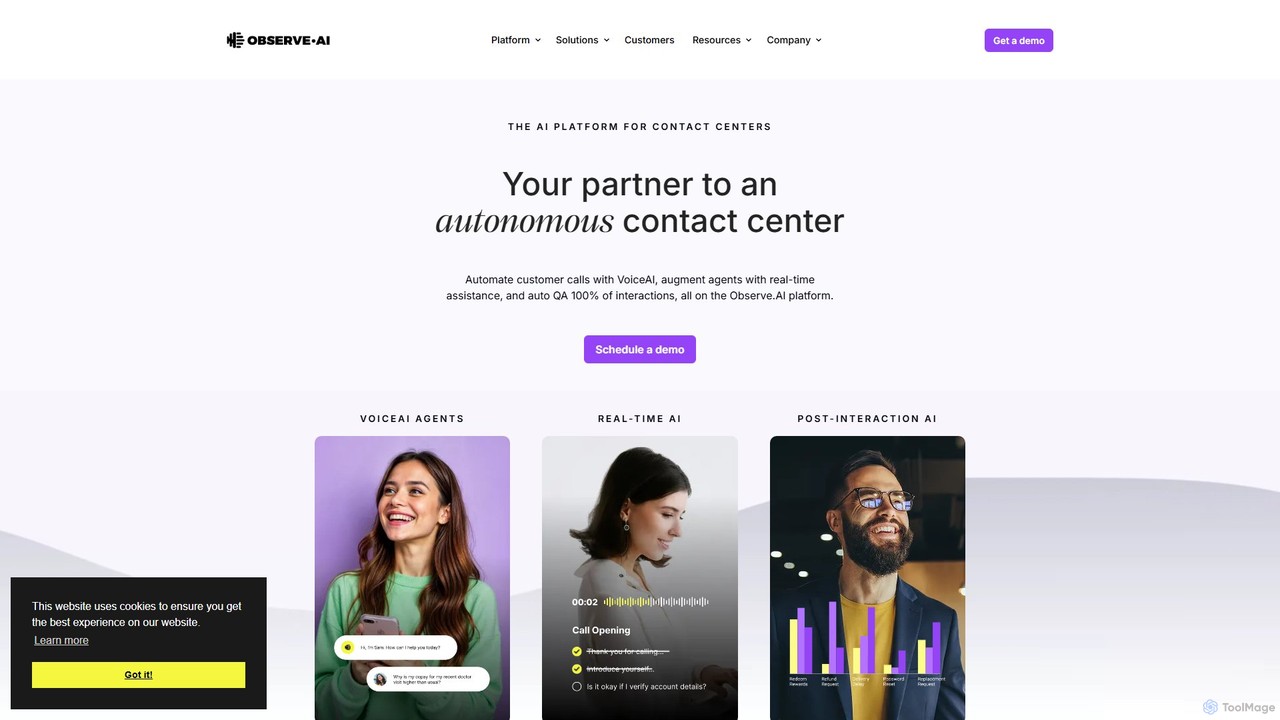
Observe.AI is a GenAI-powered conversation intelligence platform for contact centers. It automates customer interactions with VoiceAI, assists agents …
Observe.AI is a GenAI-powered conversation intelligence platform for contact centers. It automates customer interactions with VoiceAI, assists agents in real-time, and analyzes 100% of conversations for quality assurance, coaching, and business insights, helping businesses improve efficiency, compliance, and customer experience.
About Voice Of Customer
Voice of Customer (VoC) tools are AI-powered platforms that systematically capture, analyze, and report on customer feedback from various channels. Leveraging Natural Language Processing (NLP) and sentiment analysis, these tools process unstructured data like reviews, support tickets, and social media comments to extract actionable insights. They help businesses understand customer needs, identify product improvement opportunities, and monitor brand perception in real-time. Unlike general analytics tools that focus on 'what' happened, VoC tools reveal the 'why' behind customer behavior and sentiment.
Core Features
- Multi-Channel Data Aggregation: Gathers feedback from diverse sources like surveys, app stores, social media, and support systems into one unified view.
- Sentiment & Topic Analysis: Automatically identifies the emotional tone (positive, negative, neutral) and key themes within unstructured text.
- Root Cause Identification: Pinpoints recurring issues or the primary drivers of customer satisfaction and dissatisfaction.
- Feedback Tagging & Categorization: Organizes raw comments into structured, actionable categories for easier trend analysis.
- Insight Dashboards & Reporting: Visualizes trends, sentiment scores, and key customer concerns through interactive dashboards.
Applicable Scenarios
VoC tools are essential for product management teams to prioritize roadmap features based on user requests. Marketing teams use them to monitor brand health and campaign reception, while customer support teams identify recurring service issues to improve agent training and knowledge bases. They are widely used in SaaS, e-commerce, and enterprise companies focused on customer experience.
Selection Criteria
When choosing a Voice of Customer tool, evaluate its data source integration capabilities to ensure it connects to all your feedback channels. Assess the depth of its analytical features, such as the accuracy of its sentiment analysis and topic modeling. Consider its ability to integrate with other systems (like Jira or Slack) to create actionable workflows, and ensure it can scale with your growing volume of customer feedback.
Voice Of CustomerUse Cases
Prioritizing Product Roadmap with User Feedback
A Product Manager at a SaaS company is tasked with planning the next quarter's development cycle. Instead of relying on intuition, they use a Voice of Customer tool to aggregate feedback from Intercom chats, App Store reviews, and NPS survey comments. The tool's AI automatically categorizes thousands of comments, revealing that 'integration with accounting software' is the most requested feature and 'slow dashboard loading' is the most cited pain point. This data provides a clear, evidence-based justification for prioritizing these two items, ensuring development resources are allocated to what matters most to users.
Improving Customer Support with Trend Analysis
The Head of Customer Support at an e-commerce company notices a spike in ticket volume but is unsure of the root cause. By feeding support transcripts from Zendesk into a VoC platform, the system identifies a recurring theme related to 'failed payments at checkout'. The analysis shows a 300% increase in this topic over the past week. Armed with this specific insight, the support manager alerts the engineering team, who quickly discovers and fixes a bug in the payment gateway. This proactive approach not only reduces ticket volume but also prevents further lost sales and customer frustration.
Monitoring Brand Health After a Marketing Campaign
A marketing team launches a major rebranding campaign and needs to gauge public reaction. They set up a VoC tool to monitor brand mentions on Twitter, Reddit, and major news sites. The tool's sentiment analysis dashboard provides a real-time view of public perception, showing an initial 60% positive sentiment. It also surfaces key themes from conversations, highlighting that customers love the new logo but are confused by the new tagline. This allows the marketing team to quickly create clarifying content and adjust their messaging, turning potential confusion into a positive brand interaction.
Enhancing E-commerce Customer Experience
An e-commerce manager wants to understand why a specific product category has a high return rate. They use a VoC tool to analyze thousands of product reviews and return comments for that category. The AI-driven topic analysis uncovers that a significant portion of customers mention 'color not as expected' and 'sizing runs small'. Instead of a generic issue, the manager now has specific, actionable feedback. They work with the merchandising team to update product photos with more accurate color representation and add a sizing guide to the product pages, leading to a 15% reduction in returns for that category.
Validating New Feature Ideas Before Development
A UX researcher is exploring a new 'team collaboration' feature. Before committing design resources, they use a VoC platform to search through two years of historical support tickets and feature requests. They search for keywords like 'share', 'team', 'invite', and 'collaborate'. The tool returns over 500 distinct customer conversations related to this topic, providing rich context on the specific collaboration challenges users face. This data not only validates the need for the feature but also informs the design by highlighting the most critical use cases, saving weeks of speculative design work.
Analyzing NPS Comments to Drive Loyalty Initiatives
A Customer Experience (CX) manager collects thousands of Net Promoter Score (NPS) responses each month, but struggles to analyze the open-ended comments. By integrating their survey tool with a VoC platform, the comments are automatically analyzed. The platform correlates topics with scores, revealing that 'Promoters' (score 9-10) frequently mention 'excellent customer service', while 'Detractors' (score 0-6) often complain about 'complicated pricing'. This allows the CX manager to launch targeted initiatives: creating a recognition program for top support agents and tasking a team to simplify the pricing page, directly addressing the key drivers of loyalty and churn.