SurrealDB
SurrealDB is a next-generation, multi-model cloud database designed for modern applications. It simplifies backend development by unifying document, …
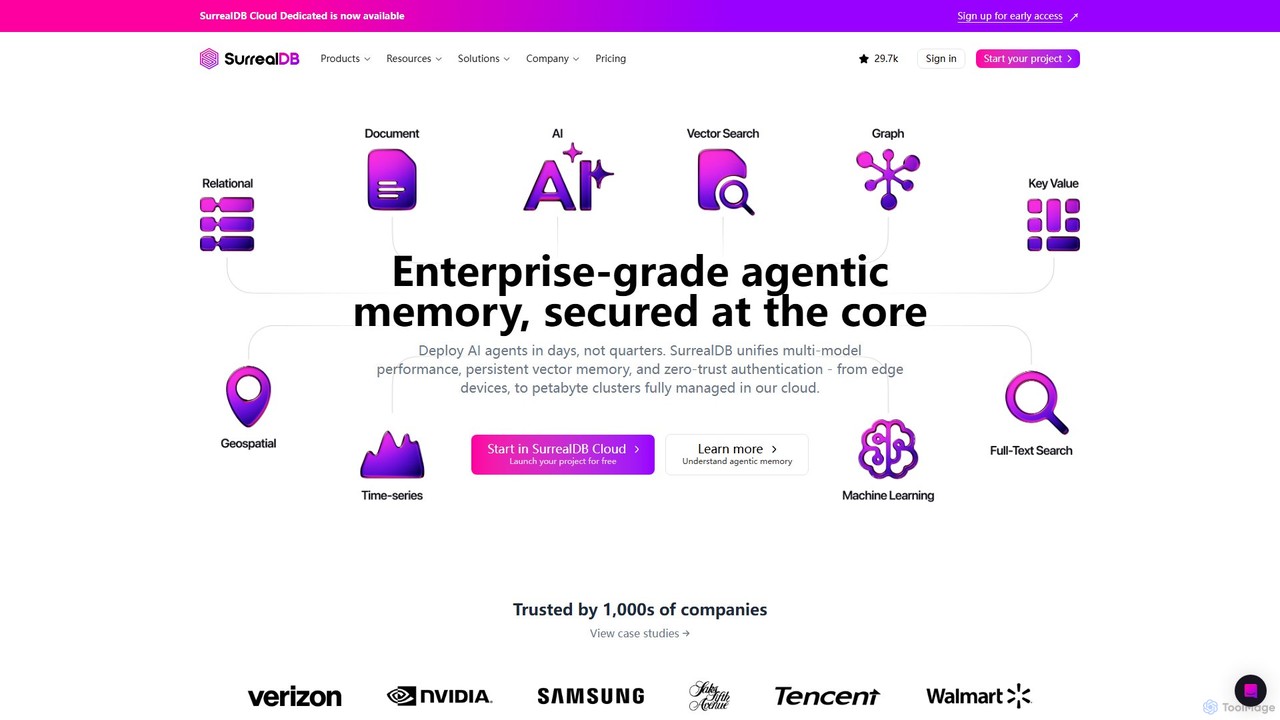
SurrealDB is a next-generation, multi-model cloud database designed for modern applications. It simplifies backend development by unifying document, relational, graph, and time-series models with built-in full-text search, vector search, and in-database machine learning. Built for scalability and real-time data, it empowers developers to build complex, AI-powered applications with unprecedented ease and speed.
About Backend
AI Backend tools are a class of platforms and services that use artificial intelligence to automate and accelerate the development, management, and scaling of server-side application logic. These tools leverage technologies like large language models (LLMs) for code generation and machine learning for performance analysis. They significantly reduce development time by automating repetitive tasks such as creating APIs, managing databases, and writing boilerplate code. This allows developers to focus on core business logic and high-level architecture rather than routine infrastructure setup.
Core Features
- AI-Powered Code Generation: Automatically creates source code for API endpoints, data models, and business logic from natural language prompts or specifications.
- Automated Database Management: Optimizes database queries, suggests indexing strategies, and automates schema design and migrations.
- Intelligent API Creation: Generates secure and documented REST or GraphQL APIs directly from data structures, simplifying data access.
- AI-Driven Performance Monitoring: Proactively identifies performance bottlenecks, analyzes logs, and suggests optimizations to improve application speed and reliability.
- Automated Deployment & Scaling: Simplifies the CI/CD process by automating builds, tests, and deployments to cloud infrastructure, with AI-assisted scaling recommendations.
Use Cases
These tools are widely used by startups to rapidly build and launch Minimum Viable Products (MVPs) by generating the entire backend infrastructure in a fraction of the usual time. Enterprises leverage them to standardize microservice development and accelerate digital transformation projects. Frontend developers also use them to build full-stack applications without deep backend expertise.
How to Choose
When selecting an AI Backend tool, consider its support for your preferred programming languages and frameworks (e.g., Python, Node.js, Go). Evaluate its integration capabilities with cloud providers like AWS, GCP, and Azure, as well as existing CI/CD pipelines. Assess the tool's scalability and performance benchmarks. Finally, determine the level of customization and control it offers over the generated code and infrastructure.
BackendUse Cases
Rapid Backend Development for MVPs
A startup founder with a strong frontend background needs to build a Minimum Viable Product (MVP) for a new social networking app. Instead of hiring a dedicated backend team or spending months learning, they use an AI Backend tool. By providing a simple schema definition and describing the required features in natural language—like 'user signup with email' and 'create posts with images'—the tool generates a complete Node.js backend with a secure REST API, user authentication, and a PostgreSQL database schema in a few hours. This accelerates their time-to-market by weeks, allowing them to test their business idea with real users much faster.
Automating Microservice Creation in Enterprises
An enterprise architecture team is tasked with standardizing the creation of microservices across multiple development teams to improve consistency and security. They adopt an AI Backend platform. Now, when a team needs a new service, they define its data model and business logic in a central repository. The AI tool automatically generates the entire microservice, complete with boilerplate code, API documentation (OpenAPI spec), containerization (Dockerfile), and CI/CD pipeline configurations. This ensures all new services adhere to company standards for logging, authentication, and error handling, reducing manual setup time from days to minutes and minimizing human error.
AI-Assisted Database Optimization
A database administrator (DBA) for a large e-commerce platform notices performance degradation during peak hours. Instead of manually sifting through thousands of slow query logs, they use an AI Backend tool with performance monitoring features. The tool ingests the logs and uses machine learning to analyze query patterns. It identifies several inefficient queries and automatically suggests creating specific database indexes to speed them up. It also highlights a poorly designed table schema and recommends a normalization strategy. By applying these AI-driven recommendations, the DBA improves query response times by over 50%, ensuring a smooth shopping experience for customers.
Generating GraphQL APIs from Databases
A frontend development team working on a complex data visualization dashboard needs a flexible API to avoid over-fetching or under-fetching data. Instead of manually writing a complex GraphQL server, they connect their existing PostgreSQL database to an AI Backend tool. The tool introspects the database schema, including tables, columns, and relationships. Within minutes, it generates a fully functional GraphQL API with corresponding queries, mutations, and subscriptions. This allows the frontend team to request exactly the data they need in a single API call, significantly improving the dashboard's performance and simplifying frontend state management.
Building AI-Powered Serverless Functions
A developer for a media company wants to create a serverless function that automatically generates a text summary and relevant tags whenever a new article is uploaded to their CMS. Using an AI Backend platform, they write a simple prompt: 'On new article upload, get the article content, summarize it into 100 words, and generate 5 relevant keywords.' The platform generates the Python code for a serverless function (e.g., AWS Lambda), including the logic to call a large language model for the summarization and tagging. It also handles the deployment and event triggers, creating a fully automated content enrichment pipeline without the developer needing to manage servers or complex AI model integrations.
Proactive Security Vulnerability Detection
A security engineer is responsible for maintaining the integrity of their company's backend services. They integrate an AI Backend tool into their CI/CD pipeline. Before any new code is deployed, the AI scans it for common security vulnerabilities like SQL injection, cross-site scripting (XSS), and insecure direct object references. The tool uses a model trained on vast datasets of code and vulnerabilities to identify potential threats that traditional static analysis tools might miss. When a vulnerability is found, it automatically blocks the deployment, creates a ticket with a detailed explanation of the issue, and suggests a specific code fix, enabling the team to address security issues proactively.