ToolMage
Sign in

Best 1 Summaries AI tools for Books

Popular Summaries AI tools in Books include befreed, helping you work more efficiently.

befreed
Freemium

befreed

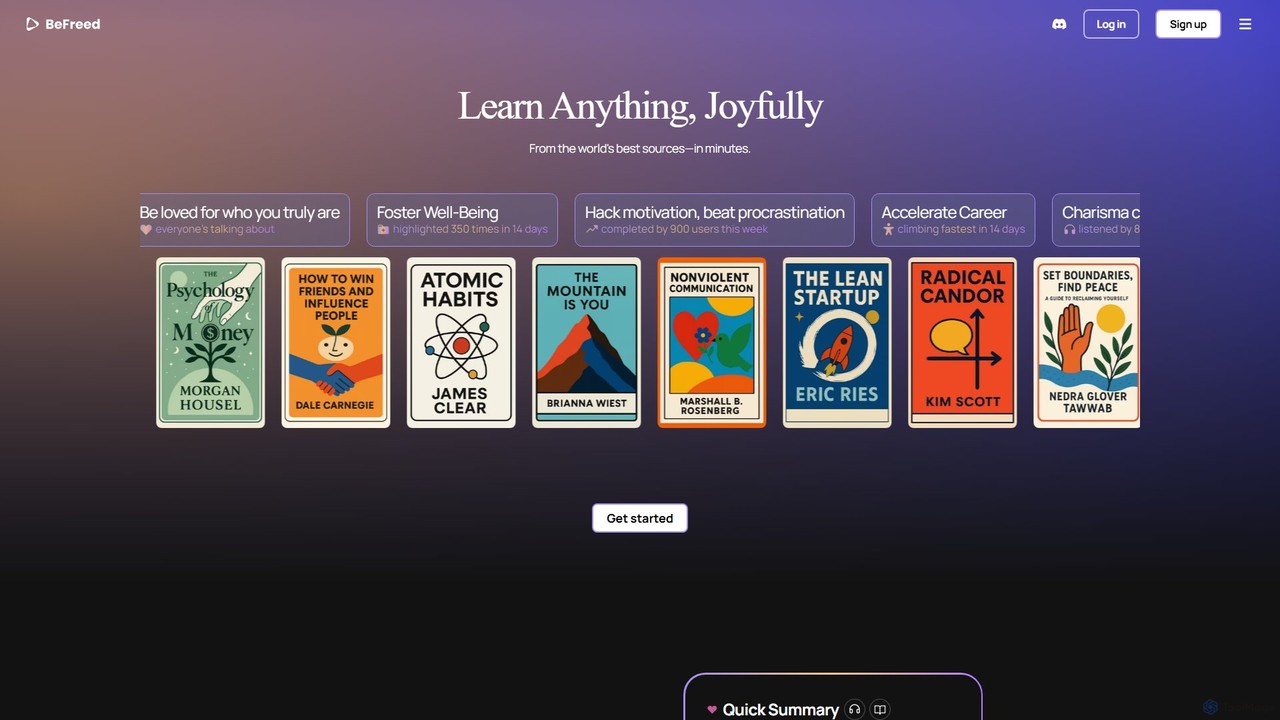
befreed is an AI-powered micro-learning app that transforms knowledge from the world's best books and sources into personalized, bite-sized content. Learn anything joyfully through engaging formats like audio podcasts, flashcards, and quick summaries, tailored to your unique learning style and pace.

Summaries
Visits 259.7KFavorites 130Likes 127

About Summaries

AI Summaries are intelligent tools designed to condense lengthy texts into concise, coherent summaries. Leveraging advanced Natural Language Processing (NLP) and machine learning algorithms, these tools identify and extract or generate the most critical information from various sources. They provide significant value by saving time, enhancing comprehension, and enabling rapid information consumption, especially for extensive documents like books, research papers, and reports.

Core Features

  • Abstractive Summarization: Generates new sentences to capture the main ideas, often paraphrasing the original text.
  • Extractive Summarization: Identifies and extracts key sentences or phrases directly from the source document.
  • Customizable Length & Density: Allows users to specify the desired summary length or information density.
  • Multi-Format Support: Processes various input types, including plain text, PDFs, web pages, and even audio transcripts.
  • Keyword & Key Phrase Extraction: Automatically identifies and highlights the most important terms and concepts.

Applicable Scenarios

These tools are invaluable for students needing to grasp complex academic papers, researchers reviewing extensive literature, and professionals who must quickly digest market reports or legal documents. They are also widely used by content creators for generating quick overviews and by busy executives for briefing on lengthy internal communications.

How to Choose

When selecting an AI summarization tool, consider its accuracy in capturing the main points, the flexibility of its summarization modes (abstractive vs. extractive), and its ability to handle diverse document types and lengths. Evaluate the customization options for summary length and style, language support, and potential integration with existing workflows or platforms.

Summaries use cases

1

Streamlining Academic Research

University students and researchers can use AI summarization tools to quickly review numerous academic papers, journals, and textbooks. By inputting lengthy articles, they receive concise summaries highlighting key findings, methodologies, and conclusions, significantly reducing the time spent on literature review and helping them identify relevant sources more efficiently for their studies or thesis.

2

Rapid Market Report Digest

Business analysts and strategists frequently deal with extensive market research reports, competitor analyses, and industry news. AI summarization tools enable them to quickly extract critical insights, trends, and data points from these documents. This allows for faster decision-making, identification of emerging opportunities, and efficient briefing of stakeholders without having to read every detail of voluminous reports.

3

Generating Quick Content Overviews

Content creators, bloggers, and social media managers often need to condense long-form articles, news pieces, or interviews into digestible snippets for their audience. Summarization tools help them generate engaging intros, social media posts, or email newsletters that capture the essence of the original content, saving time and ensuring consistent content output across various platforms.

4

Efficient Personal Study & Note-Taking

Individuals engaged in continuous learning or managing large personal knowledge bases can utilize summarization tools to create condensed versions of online articles, e-books, or lecture notes. This facilitates quicker revision, better retention of key information, and the ability to organize vast amounts of information into manageable summaries for future reference and study.

5

Condensing Meeting Transcripts

For professionals, AI summarization tools can transform lengthy meeting transcripts or recorded discussions into concise summaries of key decisions, action items, and discussion points. This ensures that all participants receive a clear overview of the meeting outcomes, facilitates follow-up tasks, and provides an efficient record without requiring manual note-taking or extensive review of full transcripts.

6

Expediting Legal Document Analysis

Legal professionals often face the daunting task of reviewing hundreds or thousands of pages of legal documents, contracts, and case files. AI summarization tools can quickly identify and highlight critical clauses, precedents, and relevant facts, allowing lawyers and paralegals to accelerate their initial review process, focus on pertinent sections, and prepare for cases more efficiently.

Summaries FAQ

What are AI summarization tools?

AI summarization tools are software applications that use artificial intelligence, specifically Natural Language Processing (NLP), to automatically condense long texts into shorter, coherent versions. They work by identifying the most important information and either extracting key sentences (extractive) or generating new sentences that convey the main ideas (abstractive), providing users with quick access to essential content.

How do AI summarization tools differ from manual summarization?

AI summarization offers speed and consistency, processing large volumes of text in seconds, which is impractical for humans. While manual summarization allows for nuanced interpretation and contextual understanding, AI tools excel in efficiency and objectivity. AI tools are ideal for initial drafts, large-scale content processing, and extracting factual information, whereas human summarization is better for highly subjective or creative content.

What's the difference between extractive and abstractive summarization?

Extractive summarization works by identifying and directly pulling the most important sentences or phrases from the original text to form a summary. The summary consists entirely of original content. Abstractive summarization, on the other hand, generates new sentences and phrases to convey the core meaning, often paraphrasing or rephrasing the original text, similar to how a human would summarize.

What types of content can AI summarization tools process?

AI summarization tools are versatile and can process a wide range of content types, including academic papers, news articles, blog posts, legal documents, financial reports, meeting transcripts, emails, and even entire books. Their effectiveness can vary based on the complexity, structure, and length of the input text, but most modern tools support various digital text formats.

Can AI summarization tools be used for summarizing entire books?

Yes, AI summarization tools can be used to summarize entire books, especially non-fiction, textbooks, or technical manuals. While they excel at extracting key themes and chapters, the quality of a book summary can depend on the book's structure and the tool's advanced capabilities. For fiction, they might capture plot points but miss the narrative nuances. They are highly effective for quickly grasping the main arguments and content of lengthy written works.