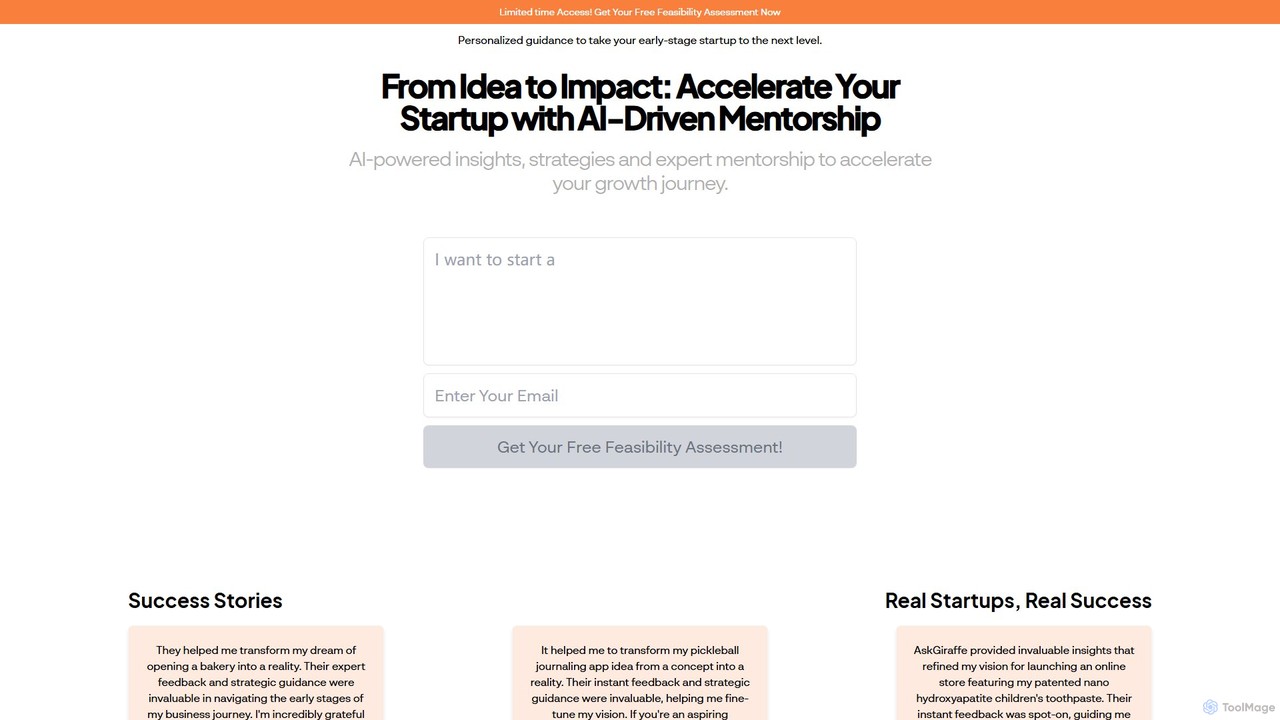
AskGiraffe
AskGiraffe is an AI-driven mentorship platform designed for early-stage entrepreneurs. It provides strategic guidance, AI-powered insights, and expert …
AskGiraffe is an AI-driven mentorship platform designed for early-stage entrepreneurs. It provides strategic guidance, AI-powered insights, and expert mentorship to help transform business ideas into viable startups. Users can receive free feasibility assessments and detailed execution plans to accelerate their growth journey.
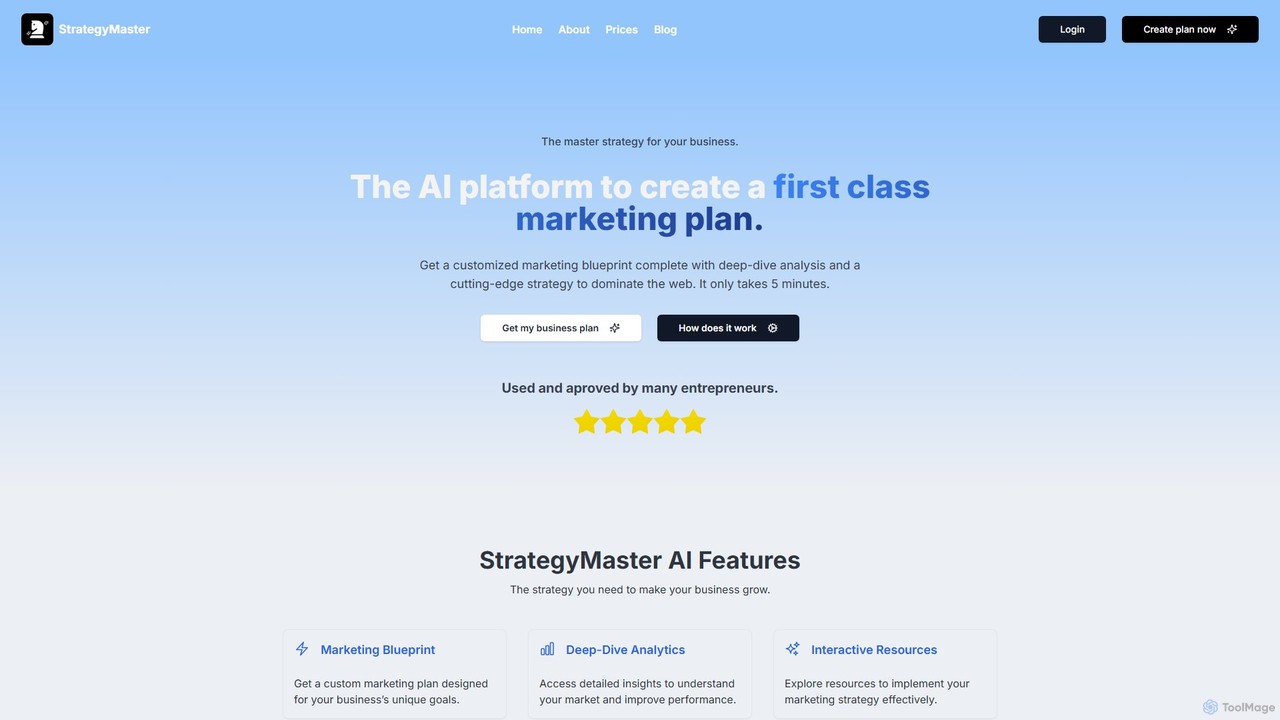
StrategyMasterAI
StrategyMasterAI is an AI-powered platform that generates comprehensive, customized marketing plans for businesses in just 5 minutes. By …
StrategyMasterAI is an AI-powered platform that generates comprehensive, customized marketing plans for businesses in just 5 minutes. By analyzing your business details, market, and competitors, it delivers a strategic blueprint complete with deep-dive analytics and actionable steps to enhance your online presence and drive growth.
About Business Planning
AI Business Planning tools are specialized platforms that leverage artificial intelligence to streamline the creation, analysis, and refinement of comprehensive business plans. They utilize natural language generation (NLG) and predictive analytics to automate content writing, financial forecasting, and market research. These tools empower entrepreneurs and managers to build data-driven strategies, identify potential risks, and generate professional documents for investors or internal stakeholders. Their key advantage lies in transforming complex data into actionable insights, significantly reducing the time and expertise required for strategic planning.
Core Features
- Automated Content Generation: Instantly drafts sections like executive summaries, market analysis, and marketing strategies based on key inputs.
- AI-Powered Financial Forecasting: Creates detailed financial projections, including cash flow, income statements, and balance sheets using predictive models.
- Market & Competitor Analysis: Gathers and synthesizes real-time data on industry trends, target audiences, and competitive landscapes.
- Risk Assessment & Mitigation: Identifies potential business risks and suggests data-backed strategies to address them.
- Scenario Modeling: Allows users to simulate different business scenarios, such as price changes or market downturns, to test the plan's resilience.
Use Cases
These tools are valuable for startups seeking venture capital, small businesses applying for loans, and established companies developing new market entry strategies. Corporate teams also use them for annual strategic planning and assessing the feasibility of new product launches.
How to Choose
When selecting a tool, consider the depth of its financial modeling capabilities, the quality of its AI-generated text, and its ability to integrate with other data sources. Also, evaluate the scope of its market research database and whether its pricing model aligns with your project's scale, from one-time plans to ongoing strategic management.
Business PlanningUse Cases
Creating a Data-Driven Plan for Investors
For startup founders, securing funding requires a compelling and professional business plan. AI Business Planning tools accelerate this process by automatically generating well-structured narratives and executive summaries. Users input their core business idea, target market, and revenue model, and the AI drafts coherent sections. More importantly, it creates data-backed financial projections, such as three-to-five-year forecasts for revenue, expenses, and profitability. This allows founders to present investors with a robust, credible plan that demonstrates market understanding and financial viability, often in a fraction of the time it would take manually.
Developing a Market Expansion Strategy
An established small or medium-sized enterprise (SME) looking to enter a new geographical market or product category faces significant uncertainty. AI Business Planning tools can serve as a strategic research assistant. By analyzing vast datasets, the AI identifies market size, growth trends, consumer demographics, and key competitors in the target area. It can help formulate a go-to-market strategy by suggesting optimal pricing, distribution channels, and marketing messages. This data-driven approach minimizes guesswork and helps the business allocate resources more effectively for a successful expansion.
Streamlining Internal Annual Strategic Planning
Corporate department managers are often tasked with creating annual strategic plans and budgets. This process can be time-consuming and prone to inconsistencies across teams. An AI Business Planning tool standardizes the process. Managers can use it to model different budget scenarios, forecast resource needs, and align departmental goals with overall company objectives. The AI can analyze historical performance data to provide more accurate forecasts and identify potential operational risks, enabling leadership to make more informed strategic decisions for the upcoming year.
Assessing New Product Launch Feasibility
Before investing heavily in development, product managers need to build a strong business case for a new product. AI Business Planning tools are ideal for conducting a rapid feasibility study. The AI can analyze market demand, estimate the potential addressable market, and model different pricing strategies to predict profitability. It helps in creating a detailed launch plan, outlining marketing costs, sales projections, and break-even analysis. This allows product teams to validate their ideas with solid data and present a clear ROI projection to stakeholders for approval.
Preparing a Professional Loan Application
Small business owners seeking a bank loan or SBA financing must provide detailed and accurate financial documents. AI Business Planning tools simplify this requirement. They guide users through creating compliant financial statements, including projected income statements, cash flow statements, and balance sheets that lenders expect. The AI ensures calculations are accurate and formats are professional. This not only increases the chances of loan approval but also helps the business owner gain a deeper understanding of their own financial health and obligations.
Crafting Compelling Non-Profit Grant Proposals
Non-profit organizations rely on grants to fund their operations and projects. A strong grant proposal requires a clear narrative, defined objectives, and a detailed budget. AI Business Planning tools can be adapted for this purpose. They help structure the proposal, articulate the organization's mission and impact, and outline the project's goals and expected outcomes. The financial forecasting features are particularly useful for creating a transparent and justifiable project budget, demonstrating to grantors that their funds will be managed responsibly and effectively.