DeepSky
DeepSky is an AI-powered business superagent for in-depth research and analysis. It leverages professional data sources like SEC …
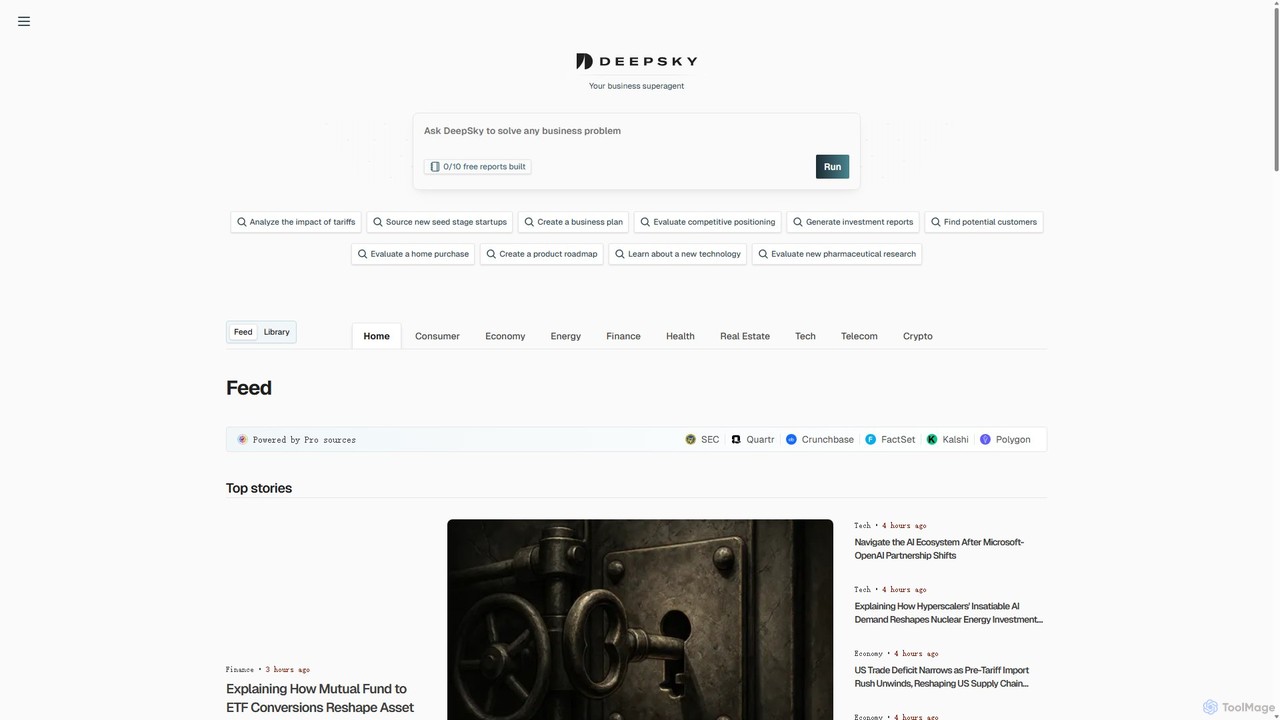
DeepSky is an AI-powered business superagent for in-depth research and analysis. It leverages professional data sources like SEC filings, Crunchbase, and FactSet to generate comprehensive reports on market trends, competitive positioning, and investment opportunities. Ideal for investors, analysts, and strategists, DeepSky automates complex research, enabling faster, data-driven decisions.
About Businessintelligence
AI Business Intelligence (BI) tools are advanced analytics platforms that use machine learning and natural language processing to transform raw data into actionable insights. Unlike traditional BI, which relies on manual report building, these tools automatically detect trends, patterns, and anomalies within datasets. They empower users to ask complex questions in plain language and receive immediate, context-aware answers and visualizations. This shifts the focus from descriptive analytics (what happened) to predictive and prescriptive analytics (what will happen and what to do), enabling faster and more accurate decision-making across the organization.
Core Features
- Automated Insights: Automatically surfaces significant changes, correlations, and outliers in your data without manual exploration.
- Natural Language Query (NLQ): Allows users to ask questions about data in conversational language, such as "What were our top 5 products by sales last quarter?"
- Predictive Analytics & Forecasting: Employs machine learning models to forecast future trends, sales, customer churn, and other key business metrics.
- Smart Data Visualization: Intelligently recommends the most effective chart or graph type to represent a specific data insight.
- Data Storytelling: Generates narrative summaries and explanations for data visualizations, making complex findings easy to understand.
Applicable Scenarios
AI BI tools are utilized across various industries, including e-commerce, finance, healthcare, and manufacturing. They are invaluable for business analysts, marketing managers, sales leaders, and executives who need to monitor performance, understand customer behavior, and optimize operations without deep technical expertise. For instance, a marketing team can use it to analyze campaign ROI in real-time, while an operations manager can predict supply chain disruptions.
Selection Criteria
When choosing an AI Business Intelligence tool, evaluate its data source connectivity to ensure it integrates with your existing databases and applications (e.g., CRM, ERP). Assess the sophistication of its natural language processing and the accuracy of its predictive models. Consider the user interface's ease of use for non-technical team members and the platform's scalability to handle growing data volumes and user loads.

BusinessintelligenceUse Cases
Automated Sales Performance Analysis
A sales manager needs to understand quarterly performance without spending days building reports. They connect their CRM and sales database to an AI BI tool. Using the Natural Language Query feature, they ask, "Compare sales growth by region for Q2 vs Q1 and highlight the top-performing sales reps." The tool instantly generates interactive charts and a summary. It reveals that the Northeast region grew by 15% driven by two specific reps, while the West region declined. This allows the manager to immediately recognize top performers and investigate issues in underperforming regions, saving significant analysis time.
Predictive Customer Churn Modeling
A marketing manager at a subscription-based service wants to proactively reduce customer churn. They upload historical customer data, including usage patterns and support ticket history, into an AI BI platform. The platform's predictive analytics feature builds a machine learning model to identify customers at high risk of churning. The model outputs a list of at-risk users, along with the key factors contributing to their risk score (e.g., decreased login frequency). The marketing team can then target this specific segment with personalized retention campaigns, such as special offers or proactive support outreach, to improve customer loyalty.
Dynamic Inventory Forecasting for E-commerce
An e-commerce operations manager struggles with stockouts of popular items and overstocking of slow-moving products. By integrating their sales platform with an AI BI tool, they can leverage its forecasting capabilities. The tool analyzes historical sales data, seasonality, promotional events, and even external factors like holidays. It generates a dynamic demand forecast for each product, recommending optimal reorder points and quantities. This helps the manager maintain ideal stock levels, reducing carrying costs from overstock and lost sales from stockouts, ultimately improving cash flow and customer satisfaction.
Root Cause Analysis of Production Bottlenecks
A manufacturing plant manager notices a decline in overall production efficiency. Instead of manual data digging, they use an AI BI tool connected to their factory's IoT sensors and production systems. The tool's automated insights feature analyzes machine uptime, cycle times, and error rates. It quickly identifies a specific machine on assembly line 3 as the primary bottleneck, showing that its average cycle time has increased by 20% over the past month. The system also correlates this with a recent raw material supplier change, suggesting a material quality issue. This allows the manager to address the root cause directly, rather than just treating the symptoms.
Optimizing Marketing Campaign Spend
A digital marketing team runs multiple campaigns across different channels (social media, search ads, email). To optimize their budget, they use an AI BI tool to consolidate data from Google Analytics, ad platforms, and their CRM. The analyst asks, "Which campaign generated the highest customer lifetime value per dollar spent?" The tool processes the data and visualizes the results, revealing that while search ads have a higher initial conversion rate, email campaigns lead to customers with a 30% higher lifetime value. Based on this insight, the team reallocates a portion of their search ad budget to expand their email marketing efforts, maximizing long-term ROI.
Financial Anomaly Detection for Auditing
An internal auditor for a large corporation needs to review thousands of expense reports for compliance and potential fraud. Manually checking each report is impossible. They use an AI BI tool to analyze all expense data. The tool's anomaly detection algorithms automatically flag unusual transactions, such as duplicate claims, expenses filed outside of business hours, or unusually high amounts for specific categories. The auditor receives a prioritized list of suspicious reports for manual review, allowing them to focus their efforts effectively and increase the accuracy of their audit process, identifying issues that would have otherwise been missed.