ToolMage
Sign in

Best 2 Marketanalysis AI tools for Finance

Popular Marketanalysis AI tools in Finance include Finalle and DeepSky, helping you work more efficiently.

Finalle
Freemium

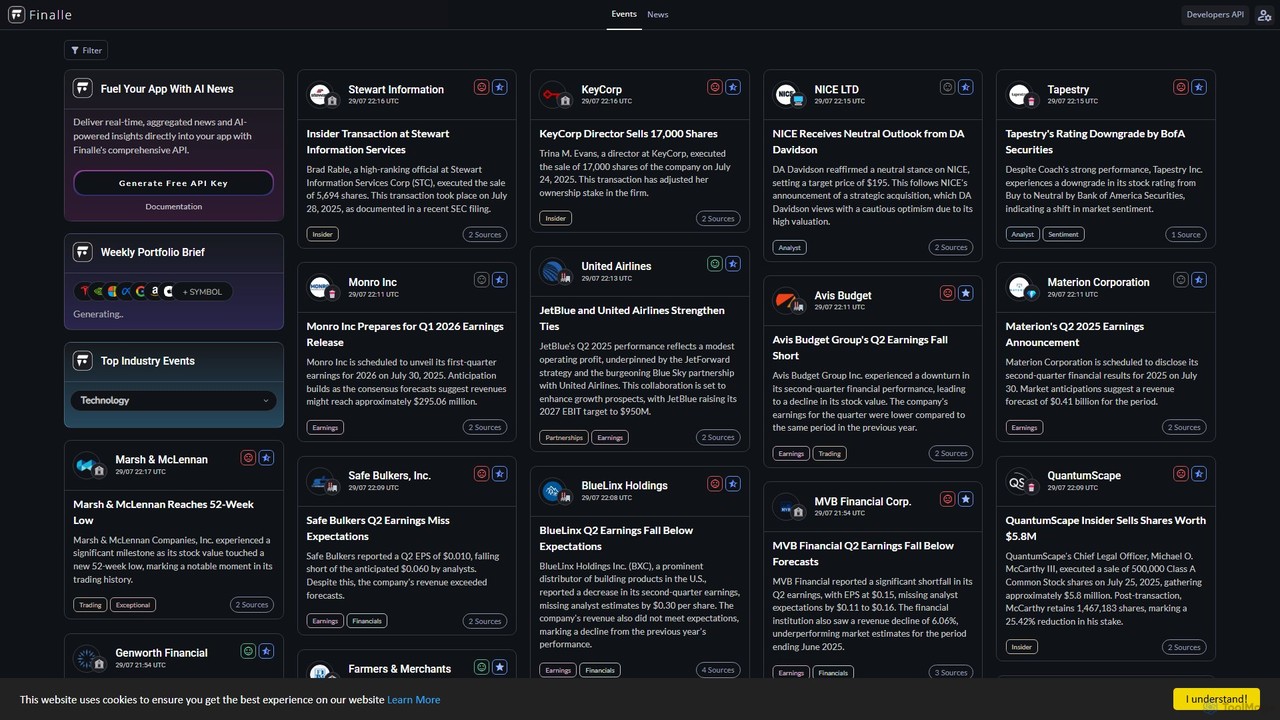
Finalle

Finalle is an AI-powered news API for developers and businesses. It delivers real-time, aggregated financial and business news, enriched with AI-driven insights like sentiment analysis, entity recognition, and event categorization. Integrate this comprehensive data stream directly into your applications to provide users with up-to-the-minute market intelligence.

Intelligence
Visits 5.6KFavorites 128Likes 125
DeepSky
Freemium

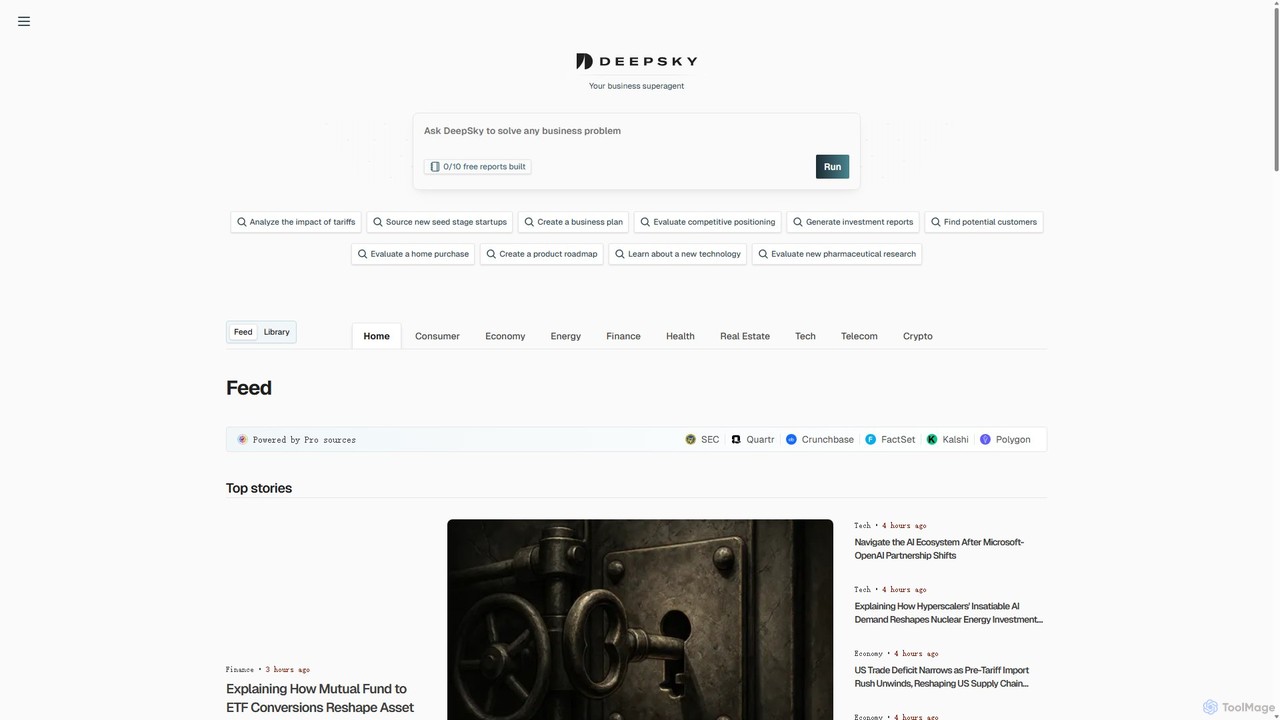
DeepSky

DeepSky is an AI-powered business superagent for in-depth research and analysis. It leverages professional data sources like SEC filings, Crunchbase, and FactSet to generate comprehensive reports on market trends, competitive positioning, and investment opportunities. Ideal for investors, analysts, and strategists, DeepSky automates complex research, enabling faster, data-driven decisions.

Businessintelligence
Visits 4.7KFavorites 107Likes 120

About Marketanalysis

AI Market Analysis tools are specialized platforms that automate the collection, processing, and interpretation of vast market data sets. These tools leverage machine learning and natural language processing (NLP) to identify emerging trends, monitor competitor activities, and gauge consumer sentiment. They provide businesses with actionable intelligence, enabling data-driven decisions for strategic planning, product development, and marketing campaigns. This focus on external market dynamics distinguishes them within the broader financial tools category.

Core Features

  • Trend Identification: Automatically detects and forecasts market trends by analyzing data from news, social media, and industry reports.
  • Competitor Monitoring: Tracks competitors' pricing, product launches, marketing campaigns, and customer feedback in real-time.
  • Consumer Sentiment Analysis: Uses NLP to analyze customer reviews, social media comments, and articles to understand public perception of a brand or product.
  • Automated Data Aggregation: Gathers and consolidates structured and unstructured data from diverse online sources into a unified dashboard.

Use Cases

These tools are essential for marketing teams, product managers, business strategists, and investment analysts. They are used to validate new product ideas by assessing market demand, to adjust marketing strategies based on competitor actions, and to identify potential investment opportunities by evaluating a company's competitive landscape.

How to Choose

When selecting an AI Market Analysis tool, consider the breadth and quality of its data sources (global vs. local), the depth of its analytical capabilities (e.g., predictive forecasting vs. sentiment analysis), its integration options with other business systems like CRM or BI tools, and the speed of its real-time data updates.

Marketanalysis use cases

1

Developing a Product Launch Strategy

A product manager for a tech startup is tasked with launching a new software-as-a-service (SaaS) product. They use an AI Market Analysis tool to scan thousands of online discussions, competitor press releases, and industry reports. The tool identifies a key feature gap in existing solutions and highlights a growing demand for better mobile integration. Based on these insights, the team prioritizes mobile-first development and crafts a marketing message that emphasizes their unique feature, leading to a more targeted and successful product launch.

2

Real-Time Competitor Benchmarking

A marketing team at an e-commerce company uses an AI tool to continuously monitor key competitors. The system automatically tracks competitors' pricing changes, new product listings, and social media campaigns. When a major competitor launches a surprise flash sale, the tool sends an instant alert. This allows the marketing team to quickly launch a counter-promotion, mitigating potential loss of market share and maintaining competitive parity during a critical sales period.

3

Assessing Investment Opportunities

An analyst at a venture capital firm evaluates a potential investment in a new fintech startup. They use a market analysis platform to gauge the startup's total addressable market (TAM), analyze the sentiment around its early product reviews, and benchmark its technology against established players. The AI-generated report shows a strong positive sentiment and a rapidly growing niche market, providing a crucial data point that supports the firm's decision to proceed with a due diligence process.

4

Managing Brand Reputation and PR Crises

A public relations team for a global consumer brand uses a market analysis tool for brand health monitoring. The system continuously scans social media, news sites, and forums for mentions of the brand. It detects a sudden spike in negative sentiment linked to a viral customer complaint video. The PR team is alerted within minutes, allowing them to quickly issue a public statement, address the customer's issue directly, and deploy a positive messaging campaign to control the narrative before the situation escalates into a major crisis.

5

Conducting a Market Entry Feasibility Study

A multinational corporation planning to expand into Southeast Asia uses an AI market analysis tool to assess viability. The tool aggregates data on local consumer spending habits, regulatory news, cultural nuances from social media, and the competitive landscape. It identifies Vietnam as a high-potential market due to rising disposable income and a less saturated competitive environment compared to neighboring countries. This data-backed analysis helps the executive team confidently allocate resources for the market entry.

6

Informing Content and SEO Strategy

A content marketing manager for a B2B software company wants to create content that ranks high in search results. They use a market analysis tool to identify trending topics and keywords in their industry. The tool analyzes top-performing articles and social media posts from competitors, revealing that 'AI-driven automation' is a high-interest topic. The manager then commissions a series of blog posts, a webinar, and an e-book focused on this theme, aligning their content strategy with proven market interest and improving their organic search visibility.

Marketanalysis FAQ

What are AI Market Analysis tools?

AI Market Analysis tools are software platforms that use artificial intelligence, particularly machine learning and natural language processing (NLP), to automatically gather and analyze public data from the internet. Their primary function is to transform vast amounts of unstructured data (like social media posts, news articles, and customer reviews) into structured, actionable insights about market trends, competitor behavior, and consumer sentiment. They help businesses make faster, more informed strategic decisions.

How to choose the right AI Market Analysis tool?

Choosing the right tool depends on your specific needs. Consider these factors:

  • Data Sources: Ensure the tool covers the regions, languages, and platforms (e.g., specific social media, news outlets) relevant to your market.
  • Analytical Features: Determine if you need basic sentiment analysis, trend forecasting, competitor tracking, or more advanced predictive analytics.
  • Integration: Check if it can integrate with your existing workflow tools, such as CRM, BI platforms, or project management software.
  • Usability and Reporting: Evaluate the user interface's intuitiveness and the quality of its dashboards and exportable reports. A tool should present complex data clearly.
What's the difference between Market Analysis and Financial Analysis tools?

The key difference lies in their focus. Market Analysis tools are externally focused; they analyze data about competitors, customers, industry trends, and public sentiment to inform business strategy. Financial Analysis tools are typically internally focused; they analyze a company's own financial data, such as revenue, expenses, and cash flow, to assess its health and performance. While both are part of the broader finance ecosystem, market analysis provides the external context for the internal numbers that financial analysis examines.

Who benefits most from AI Market Analysis tools?

A wide range of professionals benefit, but the primary users are typically in roles that require a deep understanding of the external business environment. This includes:

  • Marketing Teams: For competitor analysis, campaign planning, and brand monitoring.
  • Product Managers: To identify market needs, validate feature ideas, and guide product roadmaps.
  • Business Strategists & Executives: For strategic planning, market entry decisions, and identifying opportunities or threats.
  • Investment Analysts: To assess the competitive landscape and market potential of companies.
What kind of data do these tools analyze?

AI Market Analysis tools are designed to process a wide variety of both structured and unstructured data from public sources. Common data types include:

  • Social Media: Posts, comments, and trends from platforms like Twitter, Facebook, and Reddit.
  • News and Media: Articles, press releases, and reports from online news outlets and industry publications.
  • Customer Reviews: Feedback from e-commerce sites, app stores, and review platforms.
  • Financial Data: Public company filings, stock prices, and market reports.
  • Web Data: Competitor website changes, pricing information, and online forum discussions.