
ToolMage
Sign in

Best 1 Customer Support Automation AI tools for Business

Popular Customer Support Automation AI tools in Business include Swytchcode, helping you work more efficiently.

Swytchcode
Paid

Swytchcode

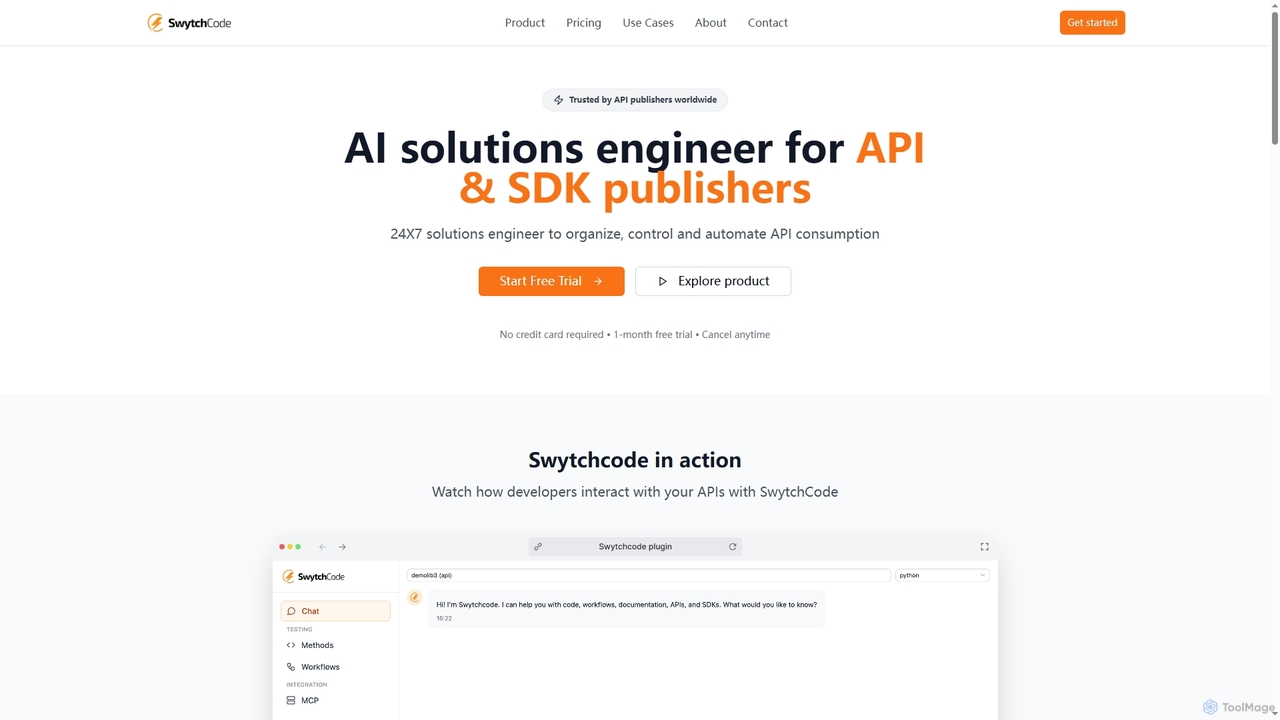
Swytchcode is an AI solutions engineer designed for API and SDK publishers to streamline API consumption. It automates code generation for 15+ languages, simplifies complex integrations, and reduces support overhead. Publishers can manage APIs, create interactive playgrounds, and enable AI-API communication, significantly boosting developer adoption and cutting costs.

Customer Support Automation
Visits 16.3KFavorites 141Likes 146

About Customer Support Automation

Customer Support Automation tools leverage artificial intelligence to streamline and enhance customer service operations. These solutions utilize technologies like natural language processing (NLP) and machine learning to automate routine inquiries, provide instant responses, and personalize customer interactions. By handling repetitive tasks, they free up human agents to focus on more complex issues, significantly improving efficiency and customer satisfaction within a business.

Core Features

  • AI Chatbots & Virtual Assistants: Provide instant, 24/7 support by answering FAQs and guiding users through processes.
  • Automated Ticket Routing: Intelligently categorize and assign support tickets to the most appropriate agent or department.
  • Sentiment Analysis: Analyze customer emotions in real-time to prioritize urgent cases and tailor responses.
  • Knowledge Base Integration: Automatically pull relevant information from internal knowledge bases to answer customer queries.
  • Personalized Communication: Deliver tailored responses and recommendations based on customer history and preferences.

Applicable Scenarios

E-commerce businesses use these tools to manage high volumes of order inquiries and product questions, providing instant support during peak seasons. SaaS companies deploy them to offer immediate technical assistance and onboarding guidance, reducing response times. Large enterprises leverage automation to handle first-line support across multiple channels, ensuring consistent service quality globally.

How to Choose

When selecting a Customer Support Automation tool, consider its integration capabilities with existing CRM and helpdesk systems to ensure seamless data flow. Evaluate the AI's natural language understanding (NLU) accuracy for your specific industry's jargon. Assess scalability to handle future growth in customer volume and the level of customization offered for branding and workflow adaptation. Finally, compare pricing models based on usage, features, and agent seats.

Customer Support Automation use cases

1

Automating First-Line Customer Inquiries

An e-commerce customer service team faces a high volume of repetitive questions about order status, shipping, and returns. By deploying an AI chatbot, they can automatically answer over 70% of these common inquiries instantly, 24/7. This reduces the workload on human agents, allowing them to focus on complex issues and improving overall response times for customers.

2

Personalizing Product Recommendations

A retail company wants to enhance the shopping experience and increase sales. They use an AI-powered virtual assistant that analyzes a customer's browsing history, past purchases, and expressed preferences during a chat. The assistant then proactively suggests relevant products or offers, creating a personalized shopping journey and boosting conversion rates.

3

Streamlining Technical Support for SaaS Products

A SaaS provider frequently receives technical support requests for common software issues and setup guides. Implementing an automated support system with a robust knowledge base integration allows customers to get immediate, step-by-step solutions. This significantly reduces the number of tickets reaching human support, improving customer satisfaction and agent efficiency.

4

Proactive Customer Engagement and Issue Resolution

A telecommunications company uses AI to monitor customer interactions across various channels, identifying potential issues or dissatisfaction early through sentiment analysis. The system can then proactively trigger automated messages or escalate critical cases to human agents, preventing churn and improving customer loyalty before problems escalate.

5

Efficiently Onboarding New Users

A new mobile app needs to guide users through its features and setup process. An AI-driven onboarding assistant provides interactive tutorials and answers common "how-to" questions in real-time. This ensures users quickly understand the app's value, reducing abandonment rates and the need for manual onboarding support.

6

Managing Multilingual Customer Support

An international travel agency serves customers globally and needs to provide support in multiple languages. AI customer support automation tools with built-in translation capabilities allow the agency to offer consistent, high-quality support in various languages without needing a large, diverse human support team, expanding their reach and improving global customer experience.

Customer Support Automation FAQ

What is Customer Support Automation?

Customer Support Automation refers to the use of artificial intelligence and related technologies to automate various aspects of customer service. This includes handling routine inquiries, providing instant answers, routing tickets, and personalizing interactions, ultimately aiming to improve efficiency, reduce operational costs, and enhance customer satisfaction.

How does AI enhance customer support beyond traditional methods?

AI enhances customer support by enabling 24/7 instant responses, understanding natural language for more complex queries, and personalizing interactions based on data. Unlike traditional rule-based systems, AI can learn and adapt, handle a wider range of issues, analyze sentiment, and proactively engage customers, leading to more dynamic and effective service.

What are the key benefits of implementing Customer Support Automation?

Implementing Customer Support Automation offers several key benefits, including reduced response times, 24/7 availability, lower operational costs by handling routine tasks, improved agent productivity, and enhanced customer satisfaction through consistent and personalized service. It also provides valuable data insights for continuous service improvement.

What's the difference between an AI chatbot and a traditional chatbot?

An AI chatbot uses natural language processing (NLP) and machine learning to understand user intent, context, and sentiment, allowing it to handle complex, varied conversations. A traditional chatbot, or rule-based chatbot, operates on predefined scripts and keywords, only responding to specific commands or questions. AI chatbots offer more flexibility and a human-like interaction.

Can Customer Support Automation completely replace human agents?

No, Customer Support Automation is designed to augment, not completely replace, human agents. It excels at handling repetitive, high-volume tasks and providing instant information. Human agents remain crucial for complex problem-solving, empathetic interactions, sensitive issues, and building long-term customer relationships. The goal is a hybrid model where AI handles the mundane, and humans focus on high-value interactions.