Taktile
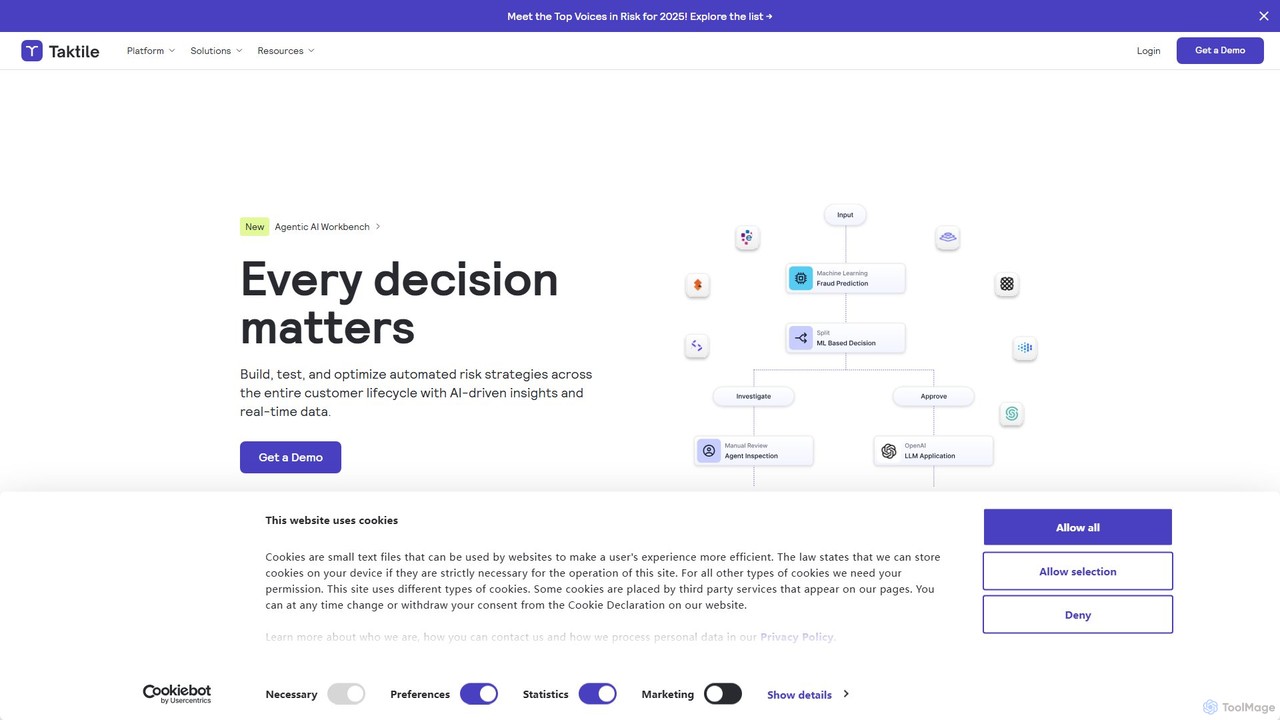
Taktile is a next-generation, no-code decision platform that empowers businesses, particularly in finance and insurance, to build, test, …
Taktile is a next-generation, no-code decision platform that empowers businesses, particularly in finance and insurance, to build, test, and deploy sophisticated decision workflows. It allows non-technical users to create and manage complex logic using rules, data, and machine learning models, dramatically accelerating time-to-market for new products and policies.
About Decision Management
Decision Management AI tools are specialized platforms that automate, optimize, and streamline complex decision-making processes within organizations. These tools leverage advanced algorithms, machine learning, and rule-based systems to analyze vast datasets, predict outcomes, and execute decisions with speed and consistency. By enhancing the accuracy and efficiency of operational and strategic choices, they significantly reduce human error and improve overall business performance, serving as a critical component within broader business intelligence strategies.
Core Features
- Automated Decision Rules: Define and execute complex business logic and policies automatically, ensuring consistent application across operations.
- Predictive Analytics: Utilize historical data and machine learning models to forecast future outcomes, informing proactive decision-making in areas like risk or demand.
- Real-time Data Integration: Connect seamlessly with various internal and external data sources to provide up-to-the-minute insights for dynamic decision execution.
- Scenario Modeling & Simulation: Allow users to test different decision paths and evaluate their potential impacts before implementation, optimizing strategies.
- Decision Workflow Automation: Streamline the entire decision lifecycle, from data ingestion and analysis to recommendation generation and automated action.
Applicable Scenarios
Decision Management AI is crucial for industries requiring rapid, data-driven choices. Financial institutions use it for automated loan approvals and fraud detection, while e-commerce platforms apply it for dynamic pricing and personalized customer offers. Logistics and manufacturing benefit from optimized supply chain and inventory management, ensuring efficient resource allocation and reduced operational costs.
How to Choose
When selecting a Decision Management AI tool, prioritize its integration capabilities with your existing IT infrastructure and data sources. Evaluate its scalability to handle growing data volumes and decision complexity, along with the flexibility to customize business rules and models. Consider compliance features, audit trails, and the level of technical expertise required for implementation and ongoing management to ensure a smooth adoption.
Decision ManagementUse Cases
Automated Loan Approval
Financial institutions utilize Decision Management AI to rapidly assess creditworthiness for loan applicants. By analyzing a multitude of data points such as credit history, income, and debt-to-income ratios, the AI automates the approval or rejection process, significantly reducing manual review time and ensuring consistent, objective decisions based on predefined risk policies.
Dynamic Pricing Optimization
E-commerce businesses deploy Decision Management AI to adjust product prices in real-time. The AI considers factors like current demand, competitor pricing, inventory levels, browsing behavior, and historical sales data to automatically set optimal prices that maximize revenue and profit margins, responding instantly to market fluctuations.
Fraud Detection and Prevention
Banks, insurance companies, and payment processors use Decision Management AI to identify and prevent fraudulent activities. The system continuously monitors transactions and claims for suspicious patterns, anomalies, or deviations from normal behavior, triggering alerts or automatically blocking high-risk transactions before they can cause financial loss.
Personalized Marketing Offers
Retailers and marketing teams leverage Decision Management AI to deliver highly personalized offers and recommendations to individual customers. By analyzing customer demographics, purchase history, browsing patterns, and engagement data, the AI determines the most relevant products, discounts, or content, optimizing conversion rates and customer loyalty.
Supply Chain Inventory Optimization
Manufacturing and logistics companies implement Decision Management AI to optimize inventory levels across their supply chains. The AI predicts future demand based on seasonal trends, market events, and historical data, then automatically adjusts ordering, production, and distribution plans to minimize carrying costs, prevent stockouts, and improve operational efficiency.
Customer Service Routing
Contact centers employ Decision Management AI to intelligently route incoming customer inquiries. The AI analyzes the customer's query, sentiment, and historical interactions to determine the best agent, department, or self-service option, ensuring customers are quickly connected with the most appropriate resource, improving resolution times and satisfaction.