Business Best in category 1 results Pricing Strategy AI Tool

Popular AI tools in the Pricing Strategy field of Business include Priceagent, etc., helping you quickly improve efficiency.

Priceagent

Priceagent

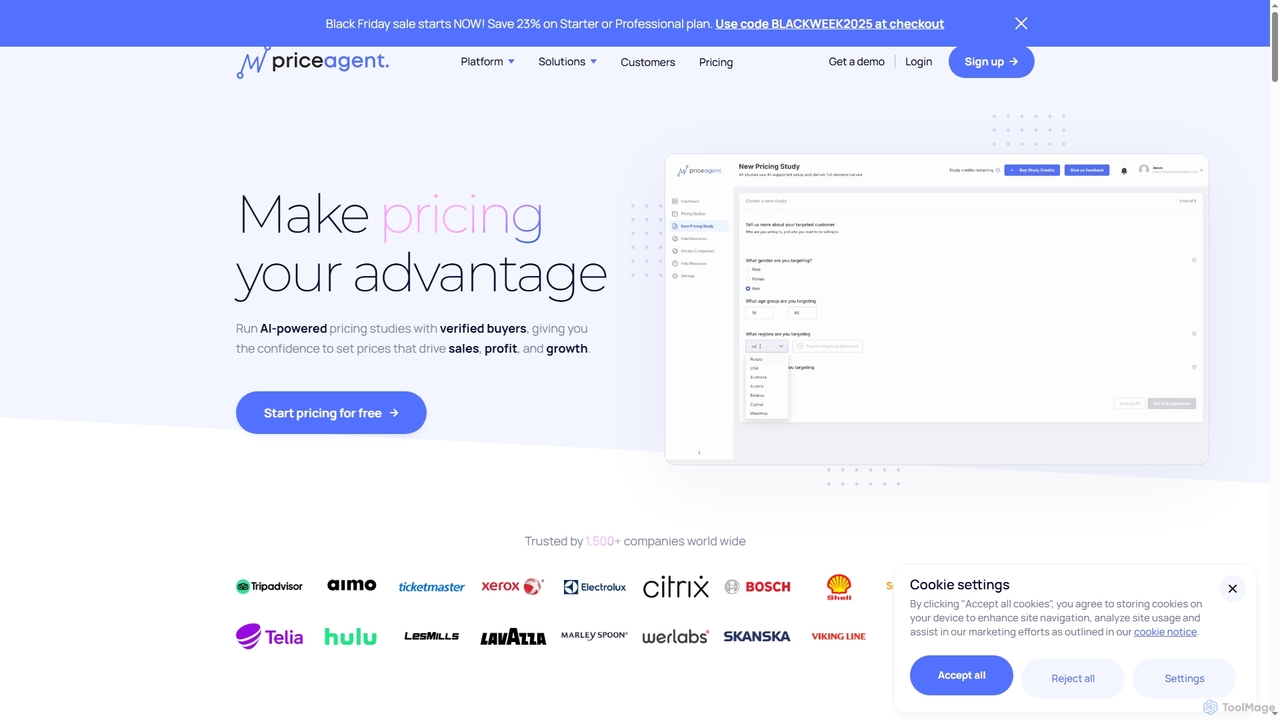
Priceagent is an AI-powered SaaS platform that enables businesses to confidently set optimal prices based on real-time customer …

6.5K

About Pricing Strategy

Pricing Strategy AI tools are a category of advanced business solutions that leverage artificial intelligence to optimize product and service pricing. These tools utilize sophisticated algorithms and machine learning models to analyze vast datasets, including market trends, competitor pricing, customer behavior, and demand elasticity. Their primary value lies in enabling businesses to implement dynamic pricing, personalize offers, and forecast optimal price points, ultimately maximizing revenue, profit margins, and market competitiveness within the broader business operations context.

Core Features

  • Dynamic Pricing Adjustment: Automatically adjusts prices in real-time based on market conditions, demand, and inventory.
  • Competitor Price Monitoring: Tracks and analyzes competitor pricing strategies to inform optimal positioning.
  • Customer Segmentation & Personalization: Identifies distinct customer groups to offer tailored pricing and promotions.
  • Demand Forecasting & Elasticity Analysis: Predicts future demand and how price changes impact sales volume.
  • Promotional Pricing Optimization: Determines the most effective discounts and timing for sales campaigns.

Use Cases

Businesses across various sectors utilize these tools to gain a competitive edge. E-commerce platforms employ them for real-time price adjustments, while SaaS companies optimize subscription tiers based on user value. Retailers leverage them to strategically plan promotions, ensuring maximum impact on sales and profitability.

How to Choose

When selecting a Pricing Strategy AI tool, consider its data integration capabilities with existing CRM or ERP systems, the sophistication of its predictive algorithms, and its flexibility to adapt to your specific business model and pricing rules. Evaluate its reporting and analytics features for actionable insights, and assess the level of customization available to meet unique market demands.

Pricing StrategyUse Cases

1

Optimizing E-commerce Product Pricing

An online retailer uses AI pricing tools to dynamically adjust prices for thousands of products based on real-time demand, competitor prices, and stock levels. This ensures competitive positioning while maximizing profit margins and reducing inventory holding costs. The system can automatically implement price changes, saving countless hours of manual adjustments and reacting instantly to market shifts.

2

E-commerce Dynamic Pricing Optimization

An online retailer uses AI pricing tools to automatically adjust product prices throughout the day based on real-time factors like website traffic, competitor stock levels, and current sales velocity. This ensures competitive pricing, maximizes conversion rates during peak hours, and liquidates slow-moving inventory efficiently, leading to increased daily revenue and improved profit margins without manual intervention.

3

Dynamic E-commerce Pricing

An online retailer uses AI pricing tools to automatically adjust product prices throughout the day based on competitor pricing, real-time demand, and current inventory levels. This ensures competitive positioning and maximizes sales volume and profit margins, especially during peak shopping seasons or flash sales.

4

E-commerce Dynamic Pricing

Online retailers leverage AI pricing tools to automatically adjust product prices in real-time. This involves analyzing factors like current demand, competitor pricing, inventory levels, and browsing behavior to maximize sales volume and profit margins, ensuring products are always competitively priced.

5

Implementing Dynamic Pricing for SaaS Subscriptions

A SaaS company employs pricing strategy tools to analyze feature usage, customer churn rates, and market benchmarks. This helps them optimize subscription tiers and pricing points, potentially offering personalized discounts to retain at-risk customers or upsell high-value features. The AI identifies optimal pricing structures that align with customer value and business growth objectives.

6

SaaS Subscription Tiering Optimization

A SaaS company employs AI to analyze user engagement data, feature usage patterns, and customer churn rates across different subscription tiers. The AI identifies optimal price points and feature bundles for new and existing plans, helping the company attract more users to higher-value tiers, reduce churn, and increase average revenue per user (ARPU) by aligning pricing with perceived value.

7

SaaS Subscription Optimization

A SaaS company employs pricing strategy AI to analyze user engagement data, feature usage, and customer churn rates. The tool recommends optimal pricing tiers, identifies opportunities for premium add-ons, and suggests personalized upgrade paths, leading to increased average revenue per user (ARPU) and reduced churn.

8

SaaS Subscription Optimization

SaaS companies utilize these tools to refine their subscription models and pricing tiers. By analyzing user engagement data, feature adoption rates, and customer lifetime value, they can identify optimal price points for different plans, reduce churn, and increase average revenue per user (ARPU).

9

Strategic Pricing for New Product Launches

A product manager utilizes AI pricing tools to simulate various pricing scenarios for a new product, considering target market segments, perceived value, and competitor offerings. This data-driven approach helps set an initial price that maximizes adoption and long-term revenue, reducing the risk associated with new market entries. The AI provides insights into optimal launch pricing strategies.

10

Airline Revenue Management

An airline leverages AI pricing algorithms to dynamically set ticket prices for flights. The system considers factors such as booking lead time, seat availability, historical demand for specific routes, and competitor pricing. This allows the airline to maximize revenue per flight by selling seats at the highest possible price point while ensuring sufficient occupancy, adapting instantly to market fluctuations.

11

Travel & Hospitality Revenue Management

Hotels and airlines leverage AI pricing to dynamically set room rates or ticket prices. The system considers factors like seasonality, booking lead times, competitor prices, and local events to optimize occupancy and revenue, ensuring maximum profitability for each available unit.

12

Retail Promotional Planning

Retail chains deploy AI pricing strategies to determine the most effective timing, duration, and discount percentages for sales promotions. The tools predict how various promotional scenarios will impact sales uplift and profitability, allowing for data-driven campaign execution that avoids margin erosion.

13

Personalized Offers in Retail

A brick-and-mortar retailer integrates AI pricing with their loyalty program to offer personalized discounts or promotions to individual customers based on their purchase history and browsing behavior. This enhances customer engagement and drives repeat purchases, as the AI identifies the most effective offers for each customer segment, leading to higher conversion rates and customer lifetime value.

14

New Product Market Entry Pricing

A consumer electronics brand utilizes AI pricing tools during a new product launch. By analyzing market data, competitor product features, and consumer willingness-to-pay from surveys, the AI recommends an optimal introductory price. This strategy helps the brand achieve rapid market penetration, establish a strong initial sales volume, and position the product effectively against rivals.

15

Retail Markdown & Promotion Strategy

A large retail chain uses AI to determine the optimal timing and depth of discounts for slow-moving inventory or seasonal items. The tool predicts the impact of markdowns on sales velocity and profitability, minimizing losses and clearing stock efficiently without cannibalizing full-price sales.

16

Travel & Hospitality Revenue Management

Airlines, hotels, and car rental companies use AI to dynamically price their services. This involves continuously adjusting rates based on booking patterns, seasonality, competitor rates, remaining capacity, and demand forecasts to maximize occupancy and revenue per available unit.

17

Revenue Management for Hospitality and Travel

Hotels and airlines use dynamic pricing algorithms to adjust room rates or ticket prices in real-time. Factors like booking patterns, seasonal demand, competitor pricing, and special events are analyzed to maximize occupancy and revenue per available room/seat. The AI continuously optimizes pricing to capture maximum value from fluctuating demand and market conditions, significantly boosting profitability.

18

Promotional Campaign Optimization

A retail chain uses AI to identify which products and customer segments are most responsive to specific types of promotions (e.g., percentage discounts, buy-one-get-one offers). The AI predicts the impact of different promotional strategies on sales volume and profitability, enabling the marketing team to design highly targeted and effective campaigns that maximize ROI and clear seasonal stock.

19

New Product Launch Pricing

A manufacturing company utilizes pricing AI to analyze market demand, production costs, and competitor offerings for a new product. The tool helps simulate various pricing points and their potential impact on market penetration and profitability, guiding the initial launch price decision.

20

Manufacturing & B2B Contract Pricing

Manufacturers and B2B suppliers employ AI pricing tools to set competitive and profitable contract prices for complex deals. These tools consider factors such as raw material costs, production capacity, customer relationship value, and market conditions to optimize long-term agreements.

21

Competitive Price Monitoring and Response

A business in a highly competitive market uses pricing strategy tools to continuously monitor competitor prices across various channels. The tool automatically alerts them to significant price changes and suggests optimal responses, maintaining market competitiveness without manual oversight. This proactive approach ensures the business remains agile and responsive to market shifts, protecting its market share and profitability.

22

B2B Contract Negotiation Support

A B2B software vendor integrates AI pricing insights into its sales process. For large enterprise contracts, the AI analyzes the client's industry, historical purchasing behavior, perceived value of the software, and competitor bids. This provides sales representatives with data-backed pricing recommendations, empowering them to negotiate more confidently and secure profitable deals that reflect the true value delivered.

23

Personalized Offer Generation

A telecommunications provider uses AI pricing to create personalized service bundles and offers for individual customers. By analyzing customer usage patterns, loyalty, and willingness to pay, the tool generates tailored promotions that increase customer retention and lifetime value.

24

Subscription Box Personalization

Companies offering curated subscription boxes use AI to personalize pricing and bundle offers for individual customer segments. By understanding customer preferences and willingness to pay, they can create tailored promotions that enhance perceived value, improve retention, and attract new subscribers.

Pricing StrategyFrequently Asked Questions