Business Best in category 2 results Startup Planning AI Tool

Popular AI tools in the Startup Planning field of Business include LaunchPad AI、LaunchOwl, etc., helping you quickly improve efficiency.

LaunchOwl

LaunchOwl

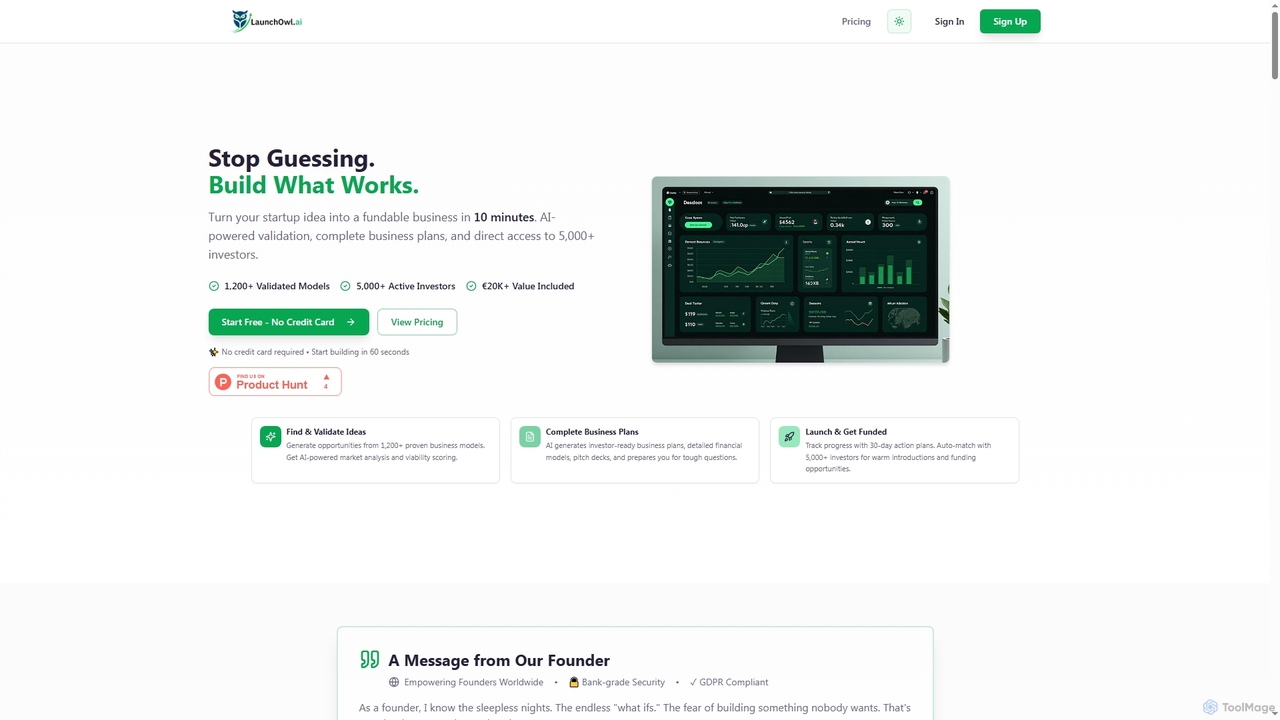
LaunchOwl is an AI-powered platform designed to help founders transform startup ideas into fundable businesses. It offers comprehensive …

3.0K
Free
LaunchPad AI

LaunchPad AI

LaunchPad AI is an innovative AI-powered tool designed to transform your business idea into a comprehensive launch plan …

3.1K

About Startup Planning

Startup Planning AI tools are designed to assist entrepreneurs and businesses in navigating the complex journey of launching and growing a new venture. These tools leverage artificial intelligence to automate market research, generate business plans, forecast financials, and refine pitch decks. They provide data-driven insights and structured frameworks, significantly streamlining the initial phases of business development and strategic decision-making.

Core Features

  • Market Research & Analysis: Automate data collection and analysis to identify market trends, competitor landscapes, and target audience insights.
  • Business Plan Generation: Generate comprehensive business plans, including executive summaries, company descriptions, and operational strategies, often with customizable templates.
  • Financial Modeling & Forecasting: Create detailed financial projections, revenue models, and expense analyses to assess viability and attract investment.
  • Pitch Deck Creation: Assist in designing compelling pitch decks with AI-generated content, visual suggestions, and storytelling frameworks.
  • Idea Validation & Feasibility: Evaluate business ideas against market demand, potential risks, and resource requirements to assess viability.

Use Cases

Entrepreneurs and small business owners utilize Startup Planning AI tools to quickly validate new business ideas, develop robust strategies, and prepare investor-ready documents. They are invaluable for accelerating the initial planning phase, reducing manual research, and ensuring a data-backed approach to launching a venture.

How to Choose

When selecting Startup Planning AI tools, consider the specific stage of your startup (idea, pre-seed, seed), the depth of features required (e.g., advanced financial modeling vs. basic business plan generation), integration capabilities with other business software, and the accuracy of AI-generated insights. Evaluate the tool's ease of use, customization options, and the quality of its data sources.

Startup PlanningUse Cases

1

Validating a New Business Idea

An aspiring entrepreneur uses AI to analyze market demand, identify potential competitors, and assess the feasibility of a novel product concept, receiving data-backed insights on its viability before significant investment. This process helps refine the value proposition and target audience, minimizing risks associated with launching an unproven idea.

2

Generating a Comprehensive Business Plan

A startup founder leverages an AI tool to automatically draft sections of their business plan, including market analysis, operational strategies, and executive summary, saving weeks of manual writing and research. This ensures a consistent, professional document that covers all essential components required by investors and stakeholders.

3

Creating Investor-Ready Financial Projections

A pre-seed startup utilizes AI to build detailed financial models, forecast revenue streams, and project expenses for the next three to five years, presenting a credible financial outlook to potential investors. The AI can incorporate various scenarios, helping founders understand potential risks and opportunities.

4

Designing a Persuasive Pitch Deck

A founder employs AI to generate compelling content, suggest visual layouts, and refine the narrative for their investor pitch deck, ensuring it effectively communicates their vision and value proposition. This accelerates the creation of a polished presentation that captures investor attention and clearly articulates the business opportunity.

5

Conducting Competitor Analysis

A new venture uses AI to monitor and analyze competitors' strategies, pricing models, and market positioning, gaining strategic insights to differentiate their offering and identify competitive advantages. This helps in formulating a robust go-to-market strategy and anticipating market shifts.

6

Identifying Target Market Segments

A marketing team for a new product uses AI to process demographic and behavioral data, segmenting potential customers and identifying the most promising target markets for their initial launch. This data-driven approach ensures marketing efforts are focused on the most receptive audiences, optimizing resource allocation.

Startup PlanningFrequently Asked Questions