Business Best in category 1 results Voice Solutions AI Tool

Popular AI tools in the Voice Solutions field of Business include rain, etc., helping you quickly improve efficiency.

rain

rain

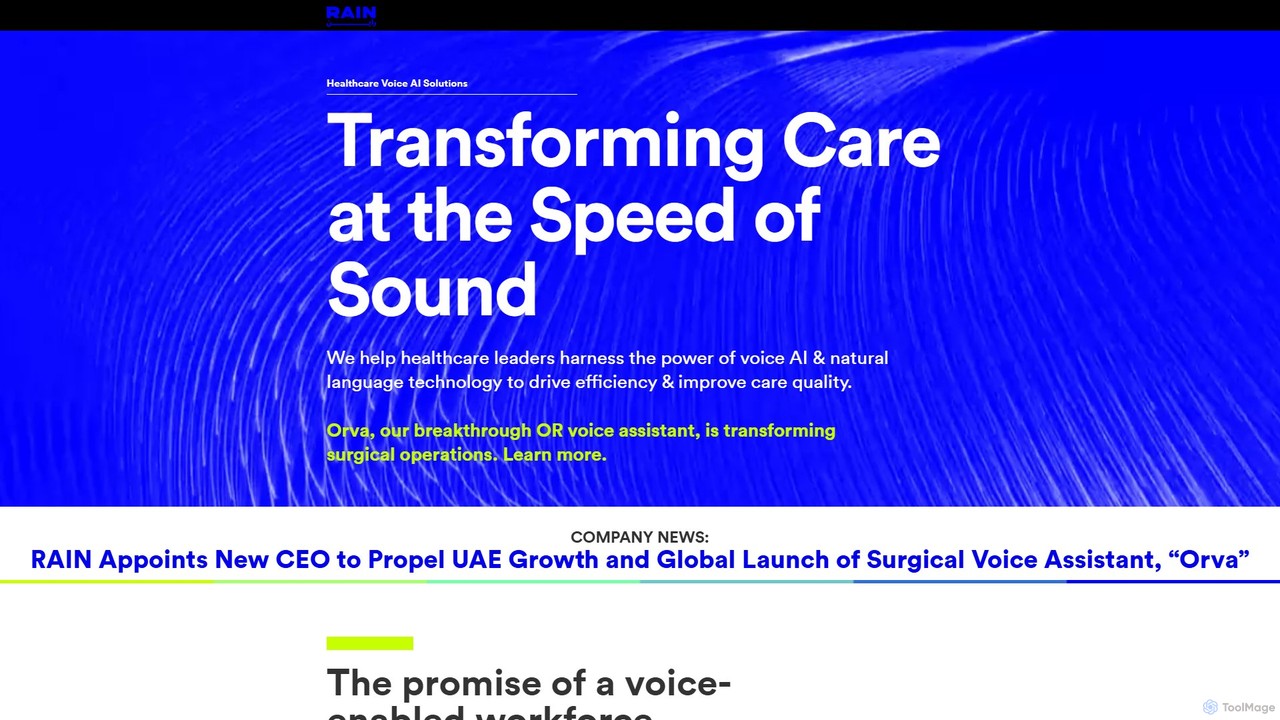
RAIN is a leading voice and conversational AI agency that designs and builds custom AI-powered solutions for enterprises. …

3.2K

About Voice Solutions

Voice Solutions are AI-powered systems designed to automate, analyze, and enhance voice-based interactions within a business context. Leveraging technologies like Natural Language Processing (NLP), speech-to-text, and text-to-speech, these tools can understand and respond to human speech conversationally. They are primarily used to improve customer service efficiency, gain deep insights from call data, and create more accessible, voice-enabled user interfaces. This includes applications from intelligent IVR systems and voicebots to real-time call transcription and sentiment analysis.

Core Features

  • Speech-to-Text (STT) Transcription: Accurately converts spoken language from audio streams or files into written text for analysis and record-keeping.
  • Natural Language Understanding (NLU): Interprets user intent, entities, and context from spoken queries, enabling complex conversational interactions.
  • Automated Voice Response: Powers intelligent voicebots and conversational IVR systems to handle customer inquiries 24/7 without human agents.
  • Voice Analytics: Analyzes call recordings to identify customer sentiment, topic trends, agent performance, and compliance adherence.
  • Voice Biometrics: Authenticates users based on their unique voiceprint, providing a secure and frictionless method for identity verification.

Use Cases

Voice Solutions are widely adopted in industries with high call volumes, such as customer service centers, financial services, healthcare, and telecommunications. Common applications include automating Tier-1 support queries, analyzing sales call effectiveness to coach teams, providing secure voice-based account access, and streamlining appointment scheduling systems.

How to Choose

When selecting a Voice Solution, consider its integration capabilities with your existing CRM and telephony systems. Evaluate the accuracy of its speech recognition and NLU for your specific industry jargon and languages. Assess its scalability to handle peak call volumes and the depth of its analytics features, such as sentiment tracking and keyword spotting, to ensure it meets your business intelligence needs.

Voice SolutionsUse Cases

1

Automate Customer Support with an AI Voicebot

A customer service manager at an e-commerce company facing high call volumes for simple queries like 'order status' or 'return policy' can deploy an AI voicebot. This solution uses Natural Language Understanding to handle these Tier-1 inquiries conversationally, 24/7. It integrates with the company's database to provide real-time, accurate information. This automation can reduce agent workload by up to 40%, cut customer wait times significantly, and free up human agents to focus on more complex, high-value customer issues.

2

Analyze Sales Call Performance for Coaching

A sales team lead can use a voice analytics tool to improve team performance. The system automatically transcribes and analyzes all sales calls, identifying key metrics like talk-to-listen ratio, keywords used by top performers, and moments of positive or negative customer sentiment. These data-driven insights allow the lead to provide targeted, objective feedback to individual reps, refine sales scripts based on successful conversations, and standardize best practices across the entire team, ultimately leading to higher conversion rates.

3

Enhance Security with Voice Biometrics

An IT security manager at a financial institution can deploy a voice biometrics system to combat fraud and improve customer experience. Instead of relying on knowledge-based questions ('What was your first pet's name?'), the system authenticates customers based on their unique voiceprint during the first few seconds of a call. This creates a passive, frictionless verification process that is more secure than traditional methods. It significantly speeds up call times, reduces agent handling time spent on verification, and provides a stronger defense against account takeover attempts.

4

Streamline Healthcare Appointment Scheduling

A clinic administrator can implement an AI-powered voice solution to manage patient appointments. Patients can call a dedicated number anytime to book, reschedule, or cancel appointments through a conversational interface. The system integrates directly with the clinic's calendar, ensuring real-time availability and preventing double-bookings. This frees up reception staff from hours of phone calls, allowing them to focus on in-person patient care, reduces human scheduling errors, and offers patients a convenient 24/7 self-service option.

5

Provide Real-time Agent Assistance in Call Centers

For a call center agent handling complex technical support, a real-time agent assist tool can be invaluable. As the agent speaks with a customer, the voice solution transcribes the conversation live. Based on keywords and the customer's described issue, the tool automatically searches the knowledge base and pushes relevant articles, troubleshooting steps, and policy information directly to the agent's screen. This reduces average handling time, improves first-call resolution rates, and ensures agents provide consistent and accurate information without placing customers on hold to search for answers.

6

Conduct Automated Market Research Surveys

A market researcher needing to gather feedback from a large customer base can use a conversational AI voice solution to automate phone surveys. Instead of costly and time-consuming manual calling, the system can dial thousands of participants and conduct a natural-language survey. It can understand open-ended responses, transcribe them for analysis, and adapt questions based on previous answers. This method drastically reduces the cost and time required for large-scale phone surveys, eliminates interviewer bias, and provides structured, easily analyzable data much faster than traditional approaches.

Voice SolutionsFrequently Asked Questions