Third
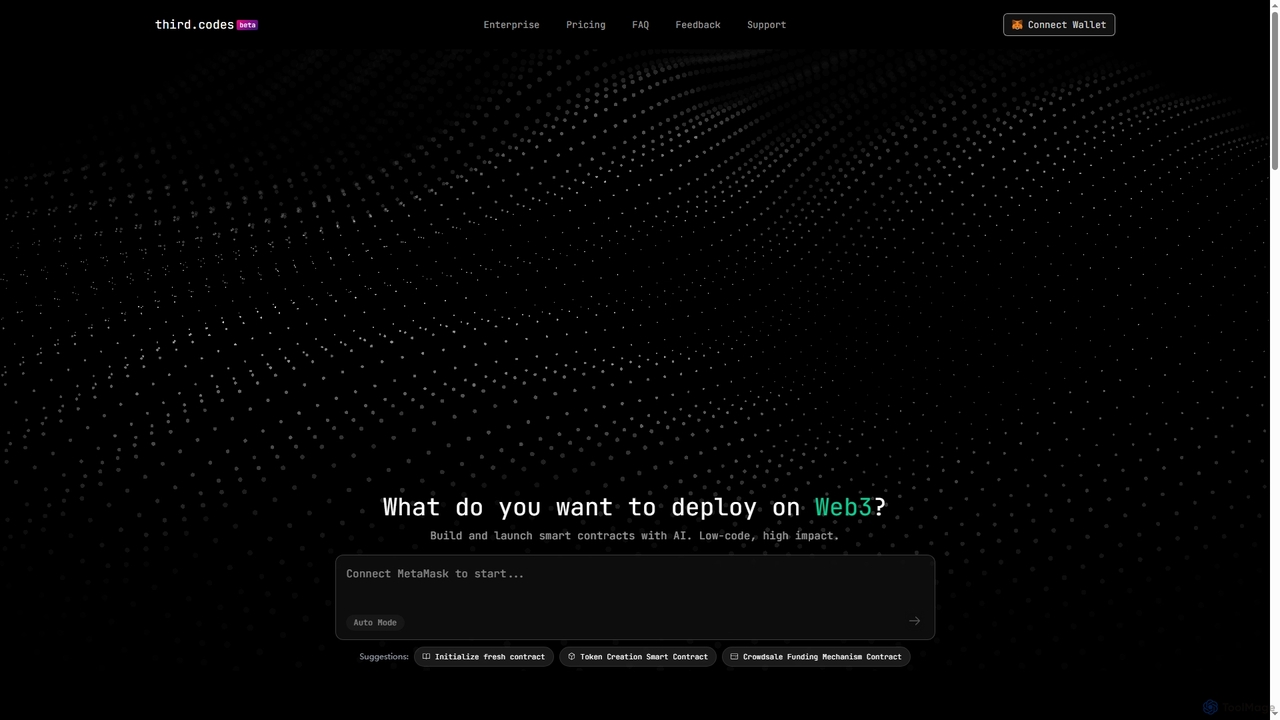
Third is an AI-powered platform for instantly generating, debugging, and deploying Solidity smart contracts across all EVM-compatible blockchains. …
Third is an AI-powered platform for instantly generating, debugging, and deploying Solidity smart contracts across all EVM-compatible blockchains. It simplifies Web3 development, allowing users to create complex contracts like ERC20 tokens, NFTs, DAOs, and DEXs from simple prompts, with one-click deployment.
About Code Assistant
Code Assistants are AI-powered tools that significantly enhance the software development process. Leveraging advanced machine learning and natural language processing, these tools provide intelligent suggestions, automate repetitive coding tasks, and help identify potential errors. They are designed to boost developer productivity, improve code quality, and accelerate project delivery by acting as a smart co-pilot throughout the coding lifecycle.
Core Features
- Intelligent Code Completion: Predicts and suggests code snippets, functions, and variables as developers type, reducing keystrokes and errors.
- Automated Code Generation: Generates entire functions, classes, or even complex algorithms from natural language descriptions or existing code patterns.
- Debugging and Error Detection: Identifies potential bugs, security vulnerabilities, and performance bottlenecks, often suggesting immediate fixes.
- Code Refactoring Suggestions: Proposes improvements to code structure, readability, and maintainability, aligning with best practices.
- Unit Test Generation: Automatically creates relevant unit tests for functions and modules, ensuring comprehensive code coverage.
Use Cases
Code Assistants are invaluable across various development stages and roles. Software engineers utilize them for rapid prototyping and boilerplate code generation, while data scientists leverage them for scripting and data analysis tasks. They are also highly beneficial for junior developers learning new languages or frameworks, providing real-time guidance and examples.
How to Choose
When selecting a Code Assistant, consider its integration capabilities with your preferred IDE (e.g., VS Code, IntelliJ), the range of programming languages it supports (e.g., Python, Java, JavaScript), and the accuracy and relevance of its suggestions. Evaluate its data privacy policies, especially for proprietary code, and compare pricing models to ensure it aligns with your team's budget and security requirements.
Code AssistantUse Cases
Automating Boilerplate Code Generation
A backend developer needs to create multiple CRUD (Create, Read, Update, Delete) API endpoints for a new service. Instead of manually writing repetitive setup code for each endpoint, the code assistant can generate the basic function structure, including database interactions and request parsing, from a simple prompt. This significantly reduces the time spent on boilerplate, allowing the developer to focus on core business logic and accelerating feature delivery.
Enhancing Code Quality and Refactoring
An experienced software engineer is reviewing a large legacy codebase that needs modernization. The code assistant analyzes the code for common anti-patterns, inefficient algorithms, and areas of high complexity. It then suggests specific refactoring opportunities, such as extracting methods, simplifying conditional logic, or improving variable naming, helping to enhance the code's readability, maintainability, and overall performance without extensive manual effort.
Accelerating Debugging and Error Resolution
A junior developer encounters a cryptic error message during testing a new feature. Instead of spending hours manually tracing the code, the code assistant can analyze the error logs, stack trace, and surrounding code context. It quickly identifies the most probable cause of the bug and provides concrete suggestions for a fix, often including a corrected code snippet, drastically reducing debugging time and frustration for less experienced team members.
Generating Comprehensive Unit Tests
A quality assurance (QA) engineer is responsible for ensuring the robustness of a critical new module. Manually writing unit tests for every function and edge case can be time-consuming. The code assistant can analyze the module's source code and automatically generate a comprehensive suite of unit tests, covering various inputs, expected outputs, and error conditions. This ensures higher test coverage and helps catch regressions early in the development cycle.
Facilitating Learning of New Technologies
A developer transitioning to a new programming language or framework (e.g., moving from Python to Go, or learning React). The code assistant acts as an interactive tutor, providing context-aware examples, explaining unfamiliar syntax, and suggesting idiomatic ways to solve problems in the new environment. This accelerates the learning curve, allowing the developer to become productive much faster than relying solely on documentation or trial and error.
Streamlining Code Documentation
A project lead needs to ensure that all newly developed functions and classes are properly documented for future maintenance and onboarding. Manually writing detailed docstrings or inline comments can be tedious. The code assistant can analyze the function's purpose, parameters, and return values, then automatically generate clear, concise, and accurate documentation. This ensures consistent documentation standards across the project and saves developers valuable time.