Development Best in category 1 results Smart Contract Generation AI Tool

Popular AI tools in the Smart Contract Generation field of Development include Third, etc., helping you quickly improve efficiency.

Free
Third

Third

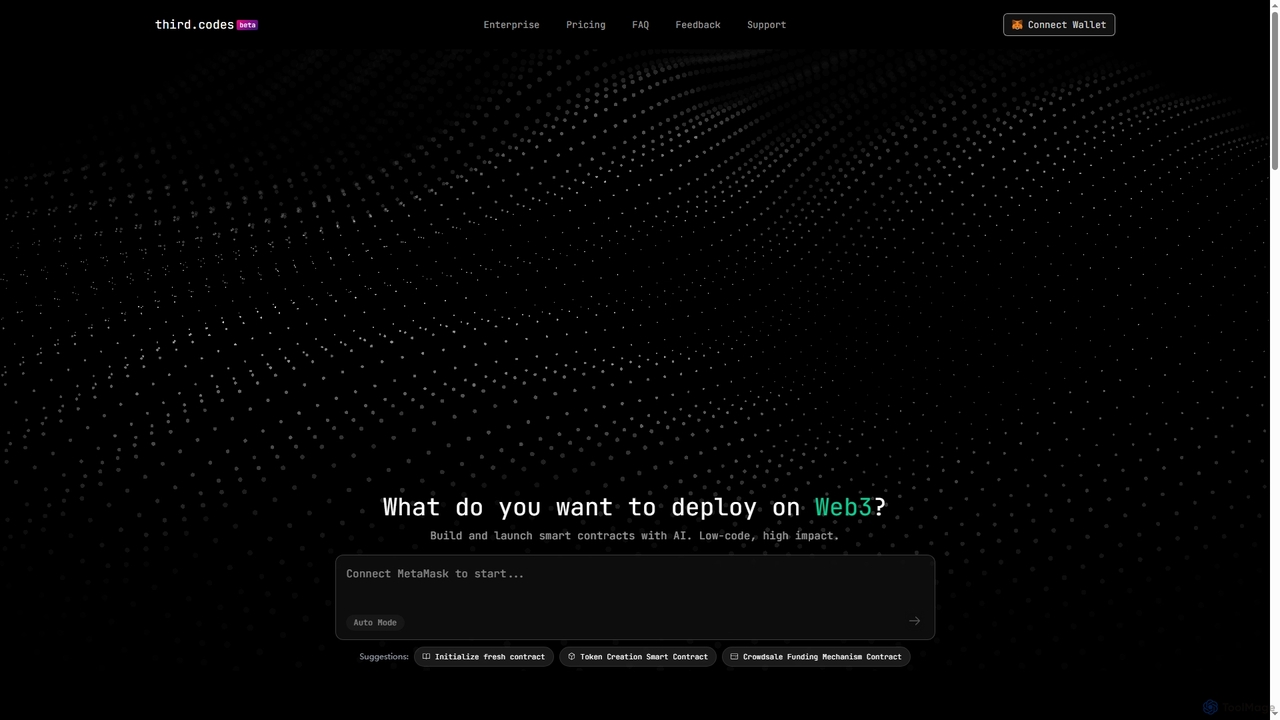
Third is an AI-powered platform for instantly generating, debugging, and deploying Solidity smart contracts across all EVM-compatible blockchains. …

1.8K

About Smart Contract Generation

Smart Contract Generation tools are AI-powered platforms designed to automate the creation of blockchain-based smart contracts. Leveraging advanced natural language processing and code synthesis, these tools enable developers and businesses to rapidly design, generate, and deploy secure, functional smart contracts without extensive manual coding. They significantly streamline the development workflow within the broader Development category, reducing time-to-market for decentralized applications (dApps) and Web3 solutions by abstracting away complex coding.

Core Features

  • Automated Code Generation: Converts high-level specifications or natural language descriptions into executable smart contract code (e.g., Solidity, Vyper) for various blockchain platforms.
  • Security Auditing & Vulnerability Detection: Integrates AI-driven analysis to identify potential security flaws, bugs, and common vulnerabilities in generated code, enhancing contract reliability.
  • Template & Library Integration: Provides access to pre-built, audited contract templates and reusable code libraries for common functionalities like ERC-20 tokens, NFT standards, or DeFi protocols.
  • Parameter Customization: Allows users to easily configure contract parameters, variables, and business logic through intuitive graphical user interfaces or guided prompts.
  • Deployment & Testing Support: Offers features to assist with the deployment of generated contracts to testnets or mainnets, often including integrated testing environments.

Applicable Scenarios

These tools are invaluable for blockchain developers, Web3 startups, and established enterprises looking to accelerate their decentralized application development. They are particularly useful for rapidly prototyping new DeFi protocols, creating custom token standards for various use cases, automating escrow services, or establishing complex governance mechanisms for decentralized autonomous organizations (DAOs) with specific rule sets.

How to Choose

When selecting a Smart Contract Generation tool, consider its supported blockchain networks (e.g., Ethereum, Polygon, BSC), the range of contract types it can generate (e.g., tokens, NFTs, DAOs), the robustness of its integrated security auditing features, and its integration capabilities with existing development environments like IDEs or version control systems. Evaluate the clarity of its user interface, the quality of its generated code for readability and maintainability, and the community support or documentation available.

Smart Contract GenerationUse Cases

1

Rapidly Generate ERC-20 Token Contracts

A blockchain startup needs to launch a new utility token for its platform. Using a Smart Contract Generation tool, the team can input token name, symbol, supply, and specific functionalities (e.g., mintable, burnable, pausable) through a guided interface. The AI then generates the complete, audited ERC-20 Solidity code, significantly reducing development time from days to minutes and ensuring compliance with established standards.

2

Prototype DeFi Lending Protocols

A DeFi developer wants to quickly test various lending and borrowing protocol configurations. Instead of writing complex Solidity code from scratch for each iteration, they use an AI smart contract generator. By defining parameters like collateral types, interest rate models, and liquidation thresholds, the tool generates different contract versions for rapid deployment to testnets, accelerating the experimentation and validation phase.

3

Create Secure NFT Marketplace Contracts

An artist collective aims to launch its own NFT marketplace with unique royalty structures and minting capabilities. A Smart Contract Generation platform allows them to specify these custom requirements, including multi-signature wallets for treasury management and specific royalty percentages for secondary sales. The AI generates the secure and optimized smart contracts, minimizing the risk of vulnerabilities in complex NFT logic.

4

Automate Supply Chain Tracking Contracts

An enterprise wants to implement blockchain for transparent supply chain tracking. They utilize a Smart Contract Generation tool to define contracts that automatically record product origin, movement, and ownership changes. By specifying data fields, trigger conditions, and participant roles, the AI generates immutable contracts that enhance transparency and traceability without requiring deep blockchain coding expertise from the logistics team.

5

Design Custom DAO Governance Contracts

A decentralized autonomous organization (DAO) needs a highly customized governance structure with specific voting mechanisms and proposal thresholds. A Smart Contract Generation tool enables the DAO members to define these intricate rules, such as weighted voting, time-locked proposals, or specific quorum requirements. The AI then synthesizes the complex governance contracts, ensuring all rules are accurately encoded and executable on-chain.

6

Educational Tool for Smart Contract Learning

Students and aspiring blockchain developers can use Smart Contract Generation tools to understand contract architecture and functionality. By experimenting with different inputs and observing the generated code, they gain practical insights into how various parameters translate into Solidity or Vyper. This hands-on approach demystifies complex blockchain concepts, making learning more interactive and accessible without the burden of syntax errors.

Smart Contract GenerationFrequently Asked Questions