ToolMage
Sign in

Best 2 Ai Development Tools for Development

Popular Ai Development Tools in Development include Mathify and Dream Chat, helping you work more efficiently.

Mathify
Freemium

Mathify

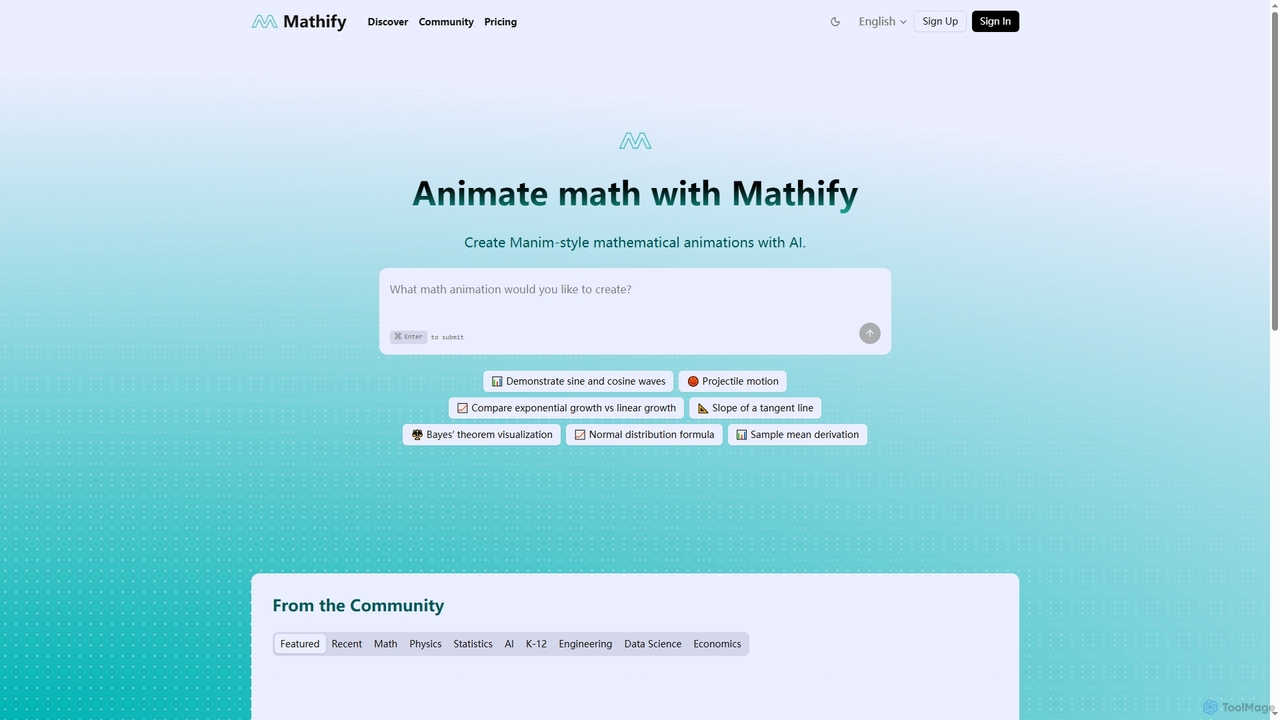
Mathify is an AI-powered tool that simplifies the creation of Manim-style mathematical animations. It enables users to visualize complex mathematical and scientific concepts, making abstract ideas more accessible for education, research, and content creation.

Ai Development Tools
Visits 7.8KFavorites 122Likes 115
Dream Chat
Paid

Dream Chat

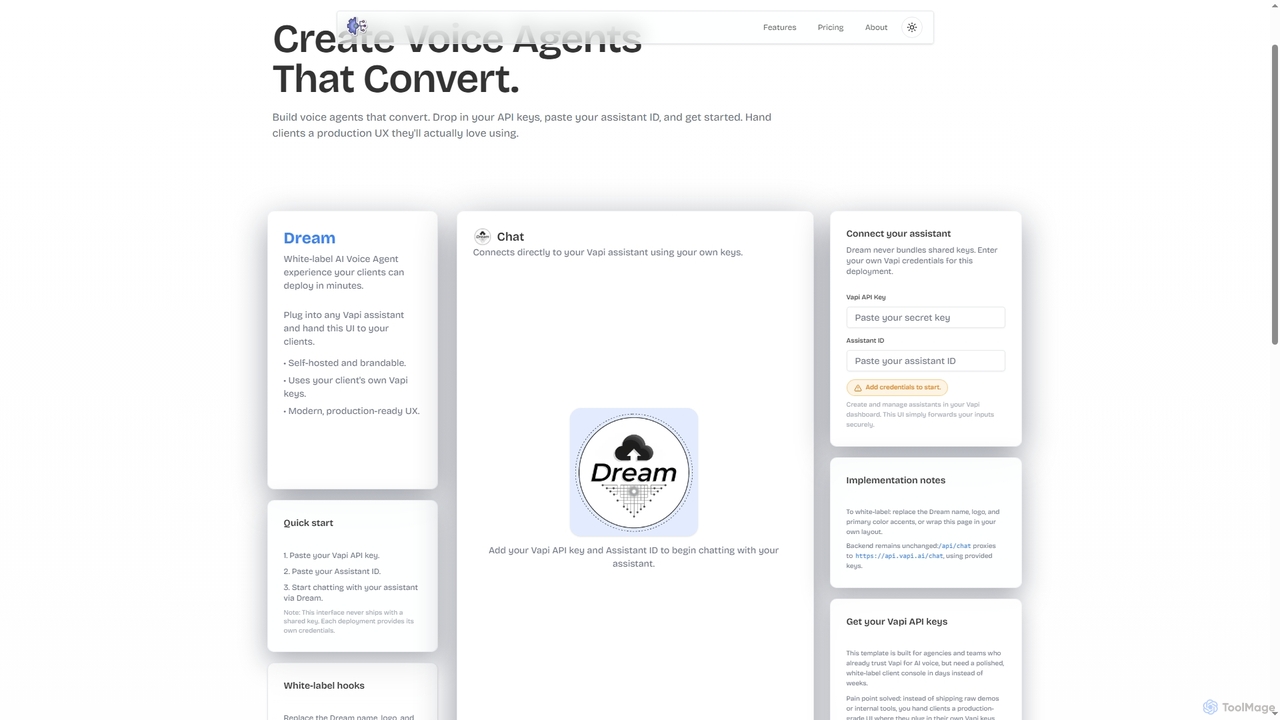
Dream Chat is a white-label AI Voice Agent interface designed for agencies and teams to rapidly deploy production-ready, branded AI voice experiences. It allows clients to connect their Vapi assistants using their own API keys, offering a modern, self-hosted, and fully customizable user experience without extensive frontend development.

White Label Solutions
Visits 6.6KFavorites 144Likes 164

About Ai Development Tools

AI Development Tools are specialized software and platforms designed to streamline the entire lifecycle of artificial intelligence projects, from data preparation and model training to deployment and monitoring. These tools leverage advanced algorithms and computational frameworks to empower developers, data scientists, and researchers to build, test, and optimize AI models efficiently. They significantly reduce the complexity and time required for developing sophisticated AI applications, enabling faster innovation and integration of intelligent capabilities into various systems.

Core Features

  • Data Management & Preprocessing: Tools for collecting, cleaning, transforming, and labeling large datasets essential for AI model training.
  • Model Training & Optimization: Environments and libraries for building, training, and fine-tuning machine learning and deep learning models.
  • Experiment Tracking & Versioning: Features to manage different model versions, track experiment parameters, and compare performance metrics.
  • Model Deployment & Serving: Capabilities to package, deploy, and serve trained AI models as APIs or integrated services for real-time inference.
  • Performance Monitoring & Explainability: Tools to monitor model performance in production, detect drift, and provide insights into model decisions.

Applicable Scenarios

AI Development Tools are crucial for data scientists building predictive models, machine learning engineers deploying intelligent systems, and researchers experimenting with novel AI algorithms. They are widely used in industries like healthcare for diagnostic AI, finance for fraud detection, and e-commerce for recommendation engines, accelerating the development of robust and scalable AI solutions.

How to Choose

When selecting AI Development Tools, consider the specific AI tasks (e.g., NLP, computer vision), the required programming languages and frameworks, scalability needs for data and models, integration capabilities with existing infrastructure, and the level of technical support. Evaluate ease of use, community support, and cost-effectiveness for your team's expertise and project budget.

Ai Development Tools use cases

1

Accelerating Machine Learning Model Training

Data scientists often spend significant time on iterative model training and hyperparameter tuning. AI Development Tools provide integrated environments with GPU acceleration, automated machine learning (AutoML) features, and experiment tracking, allowing them to rapidly train multiple model architectures, compare performance metrics, and identify the most effective model for tasks like fraud detection or customer churn prediction, drastically reducing development cycles.

2

Streamlining AI Model Deployment to Production

Machine Learning Engineers face challenges in deploying trained models reliably into production environments. AI Development Tools offer robust deployment pipelines, containerization support (e.g., Docker, Kubernetes), and API generation capabilities. This enables engineers to package models, manage dependencies, and expose them as scalable web services, ensuring seamless integration into applications for real-time inference, such as image recognition in mobile apps or personalized content recommendations.

3

Managing and Versioning Large Datasets for AI

AI researchers and data engineers frequently work with vast and evolving datasets. Specialized AI Development Tools provide data versioning, lineage tracking, and collaborative data labeling features. This allows teams to manage different versions of datasets, ensure data quality, and maintain reproducibility across experiments, which is critical for training robust models in areas like medical imaging analysis or autonomous driving.

4

Developing Custom Deep Learning Architectures

Deep learning researchers and advanced developers often need to design and implement novel neural network architectures. AI Development Tools offer flexible programming interfaces (APIs) for popular frameworks like TensorFlow and PyTorch, along with powerful debugging and visualization tools. This empowers them to build custom layers, define complex network topologies, and experiment with cutting-edge models for tasks such as natural language generation or advanced computer vision.

5

Monitoring and Maintaining AI Models in Production

After deployment, AI models can degrade due to data drift or concept drift. MLOps-focused AI Development Tools include features for continuous model monitoring, performance alerting, and explainable AI (XAI). Operations teams can track key metrics, identify when models need retraining, and understand why a model made a particular prediction, ensuring sustained accuracy and trustworthiness in applications like credit scoring or predictive maintenance.

6

Building and Integrating AI-Powered Chatbots

Developers creating conversational AI applications require tools for natural language understanding (NLU) model training, dialogue management, and integration with messaging platforms. AI Development Tools provide SDKs, pre-trained NLU models, and framework support to build sophisticated chatbots. This allows them to quickly develop and deploy intelligent agents for customer service, virtual assistants, or internal knowledge bases, enhancing user interaction and automating support.

Ai Development Tools FAQ

What are AI Development Tools?

AI Development Tools are software platforms and libraries designed to facilitate the creation, training, deployment, and management of artificial intelligence models and applications. They provide comprehensive environments for data scientists and developers to work with machine learning, deep learning, and other AI techniques, simplifying complex tasks like data preprocessing, model optimization, and production deployment. These tools are essential for building intelligent systems across various domains.

How do AI Development Tools differ from traditional software development tools?

While both aim to build software, AI Development Tools are specifically tailored for the unique lifecycle of AI projects. They emphasize data management, model training (often with specialized hardware like GPUs), experiment tracking, and MLOps (Machine Learning Operations) for deployment and monitoring. Traditional tools focus more on general code compilation, debugging, and software architecture, lacking the specialized features for handling data-centric, iterative, and probabilistic nature of AI model development.

What are the key components of an AI development workflow that these tools support?

AI Development Tools support several key components:

  • Data Preparation: Cleaning, labeling, and transforming raw data.
  • Model Building & Training: Selecting algorithms, coding models, and training them on prepared data.
  • Evaluation & Optimization: Assessing model performance and fine-tuning hyperparameters.
  • Deployment: Integrating models into applications or services.
  • Monitoring & Management: Tracking model performance in production and updating as needed.

Who primarily uses AI Development Tools?

AI Development Tools are primarily used by data scientists, machine learning engineers, AI researchers, and software developers who are integrating AI capabilities into their products. Data scientists leverage them for model experimentation and training, while ML engineers focus on deployment, scalability, and MLOps. Researchers use them for developing novel algorithms, and developers integrate pre-trained models or build custom AI features into their applications.

What should I consider when choosing an AI Development Tool for my project?

When choosing an AI Development Tool, consider your project's specific needs:

  • AI Task: Is it computer vision, NLP, or predictive analytics?
  • Scalability: Can it handle your data volume and model complexity?
  • Integration: Does it integrate with your existing tech stack?
  • Framework Support: Does it support your preferred ML frameworks (e.g., TensorFlow, PyTorch)?
  • Team Expertise: Is it user-friendly for your team's skill level?
  • Cost: Evaluate pricing models, including compute and storage costs.