ToolMage
Sign in

Best 1 Implementation Services AI tools for Consulting

Popular Implementation Services AI tools in Consulting include OptiGenius, helping you work more efficiently.

OptiGenius
Freemium

OptiGenius

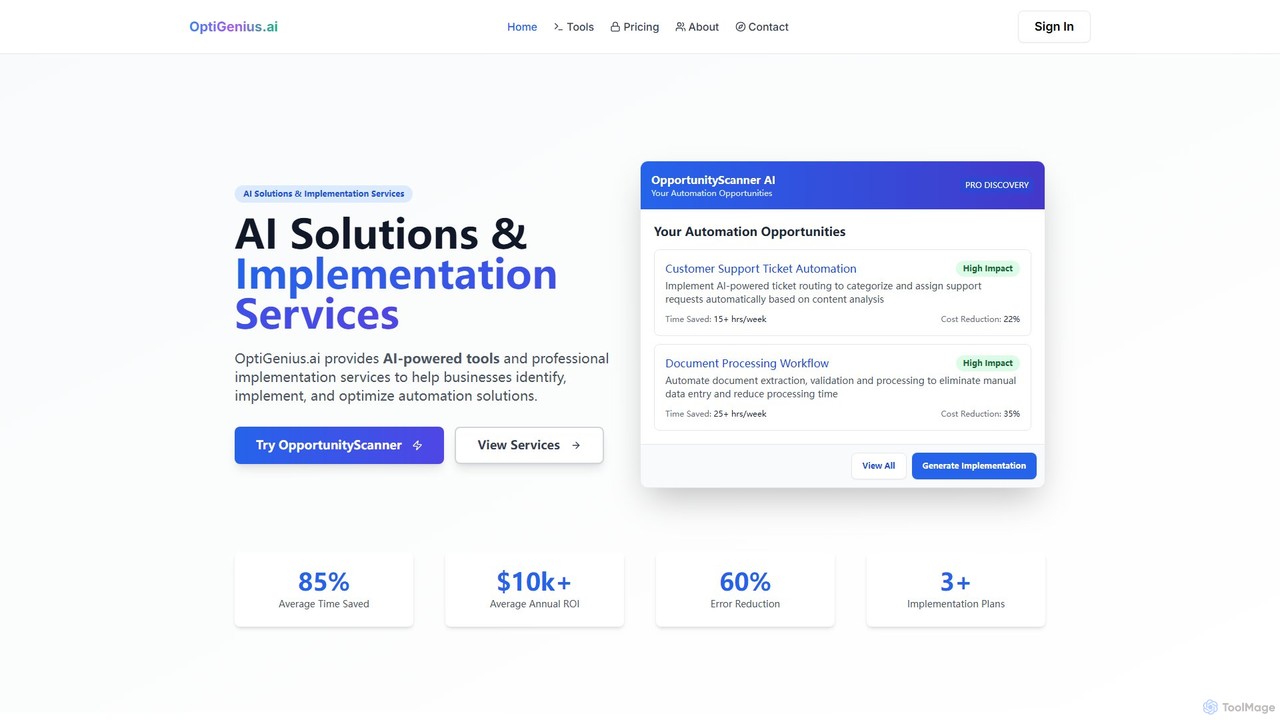
OptiGenius is an AI-powered platform offering tools and implementation services to help businesses identify, analyze, and implement high-ROI automation opportunities. Its flagship tool, OpportunityScanner, analyzes business processes or websites to provide a prioritized roadmap for automation, complete with ROI calculations and implementation plans.

Automation
Visits 3.4KFavorites 103Likes 105

About Implementation Services

Implementation Services are professional offerings focused on the practical integration and deployment of artificial intelligence solutions into existing business operations. As a specialized area within consulting, these services bridge the gap between AI strategy and real-world application by handling the technical complexities of system integration, workflow automation, and data migration. They ensure that AI tools are not just acquired but are fully functional, customized, and adopted within an organization. This hands-on approach is critical for translating AI investments into tangible business value and operational efficiency.

Core Features

  • Technical Integration: Connecting AI platforms with existing enterprise software like CRM, ERP, and databases for seamless data flow.
  • Workflow Customization: Tailoring AI-powered processes and models to fit unique business rules and operational needs.
  • Data Migration & Preparation: Managing the transfer and cleansing of data to ensure the AI system functions accurately and effectively.
  • User Training & Onboarding: Developing and delivering training programs to ensure staff can confidently and effectively use the new AI tools.
  • Performance Monitoring & Optimization: Setting up dashboards and protocols to track the AI system's performance and make necessary adjustments post-launch.

Use Cases

These services are vital for medium to large enterprises across sectors like finance, healthcare, and retail that are adopting complex AI systems. They are particularly useful when internal IT teams lack specialized AI deployment skills or when a rapid, expert-led rollout is required to achieve a competitive advantage and ensure a high return on investment.

How to Choose

When selecting an Implementation Service provider, evaluate their technical expertise with your specific tech stack (e.g., AWS, Azure, Salesforce). Assess their proven experience in your industry, their project management methodology (e.g., Agile, Scrum), and the scope of their post-implementation support. Reviewing their portfolio of similar successful projects is also crucial to gauge their capability and reliability.

Featured tool rankings

Implementation Services use cases

1

Enterprise CRM AI Integration

A sales department in a large corporation wants to leverage AI for lead scoring and sales forecasting. They hire an Implementation Service to integrate a specialized AI analytics tool into their existing Salesforce CRM. The service provider handles the API connections, customizes the data models to match the company's sales stages, and builds automated workflows that update lead scores in real-time. They also train the sales team on how to interpret the AI-driven insights, leading to a 25% increase in lead conversion rates within six months.

2

Deploying an Automated Customer Support System

A retail business aims to provide 24/7 customer support without significantly increasing staff. An Implementation Service is tasked with deploying an AI-powered chatbot and ticketing system. The project involves integrating the chatbot with the company's e-commerce platform (e.g., Shopify) to access order history and product information. The service configures complex conversational flows, sets up automated ticket routing to the correct human agents for escalated issues, and ensures a seamless handover. This implementation reduces average response time from hours to seconds for common queries.

3

Custom AI Model Deployment in Production

A tech startup has developed a proprietary machine learning model for image recognition but lacks the DevOps expertise to deploy it at scale. They engage an Implementation Service specializing in MLOps. The service provider packages the model into a container (e.g., Docker), sets up a scalable serving infrastructure on a cloud platform like AWS SageMaker or Google AI Platform, and creates a CI/CD pipeline for automated testing and redeployment of new model versions. This ensures the model is highly available, scalable, and easy to maintain.

4

Upgrading HR Systems with AI Recruitment Tools

An HR department wants to streamline its hiring process by using an AI tool for resume screening and candidate matching. An Implementation Service is brought in to integrate the new AI platform with the company's existing Applicant Tracking System (ATS) like Workday or Greenhouse. The service ensures that data flows correctly between the two systems, customizes the AI's matching algorithms based on the company's specific job roles and criteria, and trains recruiters on the new, more efficient workflow. The project aims to reduce time-to-hire by 30%.

5

Implementing AI for Supply Chain Demand Forecasting

A manufacturing company struggles with inaccurate demand forecasting, leading to inventory issues. They partner with an Implementation Service to deploy an AI-powered forecasting platform. The service provider integrates the platform with the company's ERP and historical sales data sources. They configure the AI models to account for seasonality, market trends, and promotional activities. The final implementation provides the logistics team with more accurate, automated forecasts, helping to optimize stock levels and reduce carrying costs by 15%.

6

Setting Up an AI-Powered Marketing Automation Platform

A marketing team adopts a new, complex AI marketing automation platform (like HubSpot or Marketo) to personalize customer journeys. An Implementation Service helps them migrate contact data from their old system, set up lead scoring rules based on AI-driven behavioral analysis, and build dynamic email campaigns that adapt to user actions. The service also integrates the platform with the company's website analytics and social media accounts, providing a unified view of customer engagement and improving marketing ROI.

Implementation Services FAQ

What are AI Implementation Services?

AI Implementation Services are specialized professional services that handle the technical and operational deployment of AI solutions within a business. Unlike general consulting which focuses on strategy, these services execute the plan by integrating AI tools with existing systems, customizing workflows, managing data, and training users. Their primary goal is to ensure a new AI technology becomes a fully functional and adopted part of a company's daily operations.

What's the difference between AI Consulting and AI Implementation Services?

The key difference lies in their focus. AI Consulting is strategic; it helps businesses identify opportunities for AI, choose the right technologies, and create a roadmap (the 'what' and 'why'). AI Implementation Services are tactical and operational; they take that roadmap and execute it, handling the technical integration, customization, and deployment to make the AI solution work in a real-world environment (the 'how'). Implementation is the hands-on follow-through of the consulting phase.

How do you choose the right AI Implementation Service provider?

Choosing the right provider involves evaluating several key factors. First, assess their technical expertise and experience with your specific technology stack (e.g., cloud platforms, programming languages, CRM systems). Second, look for proven industry experience relevant to your business. Third, understand their project management methodology and communication processes. Finally, review their portfolio, case studies, and client references to verify their track record of successful deployments and inquire about their post-implementation support options.

What does a typical AI implementation process involve?

A typical AI implementation process follows several stages. It usually begins with a discovery and planning phase to define goals and requirements. This is followed by technical setup, which includes system integration and data preparation. Next is the core development or configuration phase, where the AI solution is customized. After that, rigorous testing and validation are performed. The final stages involve user training and deployment (go-live), followed by a period of post-launch monitoring and optimization to ensure the solution delivers the expected value.

Who needs AI Implementation Services?

Companies that typically need AI Implementation Services are those that have decided on an AI strategy but lack the in-house technical expertise or resources to execute it. This includes medium to large enterprises adopting complex platforms (like AI-powered CRMs or ERPs), startups needing to deploy custom machine learning models at scale, or any organization that wants to ensure a fast, efficient, and successful rollout of a new AI technology to maximize their return on investment.