
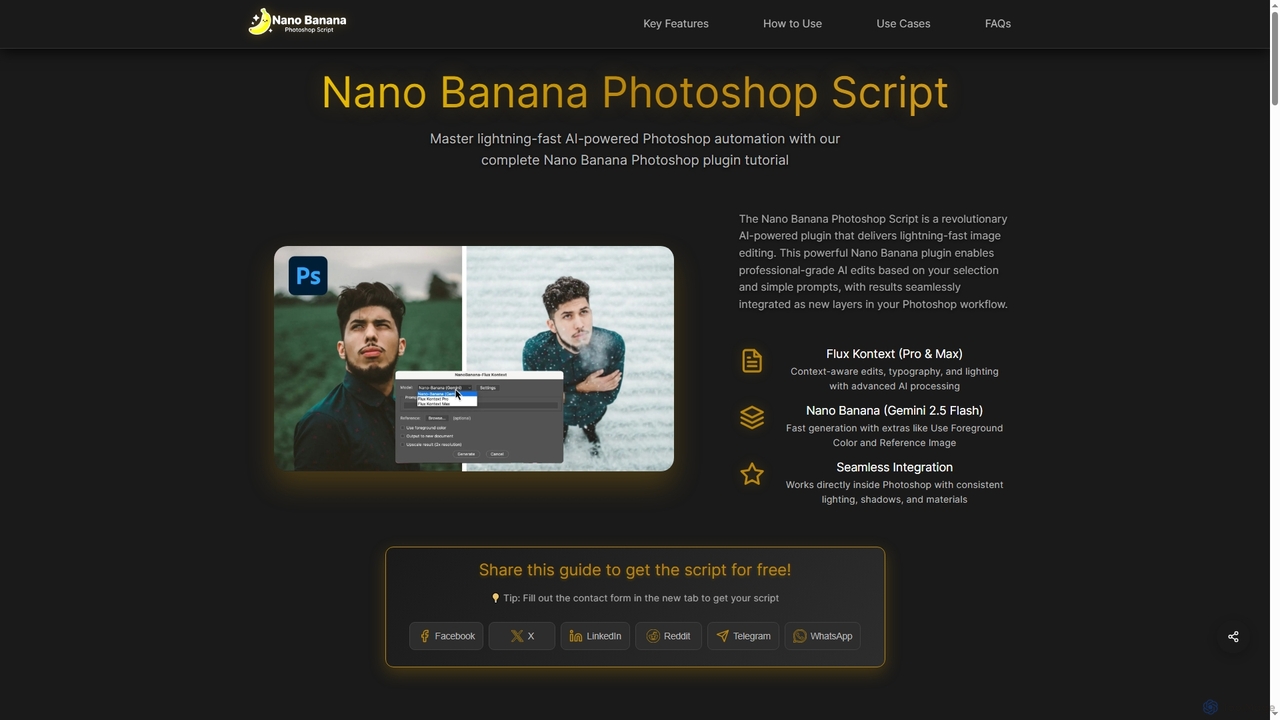
Nano Banana Photoshop Script
Nano Banana Photoshop Script is a revolutionary AI-powered plugin that integrates seamlessly with Adobe Photoshop, offering lightning-fast image …
Nano Banana Photoshop Script is a revolutionary AI-powered plugin that integrates seamlessly with Adobe Photoshop, offering lightning-fast image editing and automation. It enables professional-grade AI edits based on selections and simple prompts, delivering results as new layers within your workflow.
About Generative Ai
Generative AI is a class of artificial intelligence capable of creating new, original content, such as text, images, music, and code. These tools operate by learning patterns and structures from vast datasets and then using that knowledge to produce novel outputs that mimic the training data. As a core component of creative automation, this technology enables the rapid production of diverse creative assets for marketing, design, and content creation. Unlike traditional automation that executes predefined tasks, Generative AI introduces genuine novelty and variation into the creative process.
Core Features
- Multi-modal Content Creation: Generate diverse content types including text, images, audio, and video from simple prompts.
- Contextual Understanding: Interpret complex instructions and adapt outputs based on specified style, tone, and constraints.
- Iterative Refinement: Allow users to progressively refine and build upon generated content through conversational feedback and adjustments.
- Pattern Synthesis: Analyze existing data to synthesize entirely new, coherent, and plausible creations that go beyond simple replication.
Applicable Scenarios
Generative AI is widely used across various industries. Marketing teams use it to generate ad copy and social media posts at scale. Designers and artists leverage it for concept art and visual brainstorming, while developers employ it for code generation and debugging assistance. It is also valuable in entertainment for creating scripts and music.
Selection Criteria
When choosing a Generative AI tool, consider the output quality and your level of control over the final result. Evaluate whether you need a general-purpose model or one specialized for a specific task (e.g., music or 3D models). Also, assess its integration capabilities via APIs and carefully review its data privacy policies and the usage rights for generated content.
Generative AiUse Cases
Automated Blog Post and Article Drafting
Content marketers and SEO specialists often need to produce a steady stream of high-quality, optimized articles. Using a Generative AI text tool, they can input a topic, target keywords, and a basic outline. The AI then generates a comprehensive draft, complete with headings, paragraphs, and meta descriptions. This process significantly reduces research and initial writing time, often by over 70%, allowing creators to focus on higher-value tasks like editing, fact-checking, and strategic content planning.
Generating Visual Concepts for Marketing Campaigns
Art directors and graphic designers can accelerate the brainstorming phase for new campaigns using text-to-image Generative AI. Instead of spending days sketching, they can input descriptive prompts like 'a minimalist perfume bottle on a block of ice, studio lighting, photorealistic'. The tool can produce dozens of unique visual concepts in minutes. This allows for rapid exploration of creative directions, facilitates better client communication with concrete visuals, and frees up designers to focus on refining the best ideas rather than starting from scratch.
Prototyping Code and Generating Functions
Software developers can use Generative AI as a powerful coding assistant. When building a new feature, they can describe a function's purpose in natural language, such as 'write a Python function to parse a CSV and return a JSON object'. The AI generates a working code snippet that can be used directly or as a starting point. This is particularly useful for automating boilerplate code, learning new programming languages or libraries, and quickly prototyping solutions, thereby accelerating the development lifecycle and reducing time spent on repetitive tasks.
Creating Personalized Email Marketing Sequences
Email marketers can leverage Generative AI to create highly personalized email campaigns at scale. By providing the AI with data about a specific customer segment (e.g., new subscribers, cart abandoners) and the campaign's objective, it can draft a series of emails with tailored subject lines, body copy, and calls-to-action. This automates the time-consuming process of manual copywriting for each segment, enabling marketers to deploy more sophisticated, multi-touch campaigns that resonate better with audiences and can lead to higher engagement and conversion rates.
Composing Royalty-Free Background Music for Videos
Video creators and social media managers often need custom background music without risking copyright infringement. Using a Generative AI music tool, they can specify a genre (e.g., cinematic, lo-fi), mood (e.g., uplifting, suspenseful), and desired duration. The AI then composes a unique, royalty-free audio track that fits these parameters perfectly. This provides an almost infinite library of custom-fit music, saving significant costs on stock music licenses and eliminating the hours spent searching through vast libraries for the right track.
Developing Synthetic Datasets for AI Model Training
Data scientists and machine learning engineers often face challenges with insufficient or imbalanced real-world data for training models. Generative AI, particularly models like Generative Adversarial Networks (GANs), can create new, synthetic data points that mimic the statistical properties of the original dataset. This process, known as data augmentation, helps to enrich the training set, especially for rare events or edge cases. The result is a more robust and accurate machine learning model, developed without compromising the privacy associated with using sensitive real-world data.