ToolMage
Sign in

Best 1 Call Center Optimization AI tools for Customer Support

Popular Call Center Optimization AI tools in Customer Support include Afiniti, helping you work more efficiently.

Afiniti
Paid

Afiniti

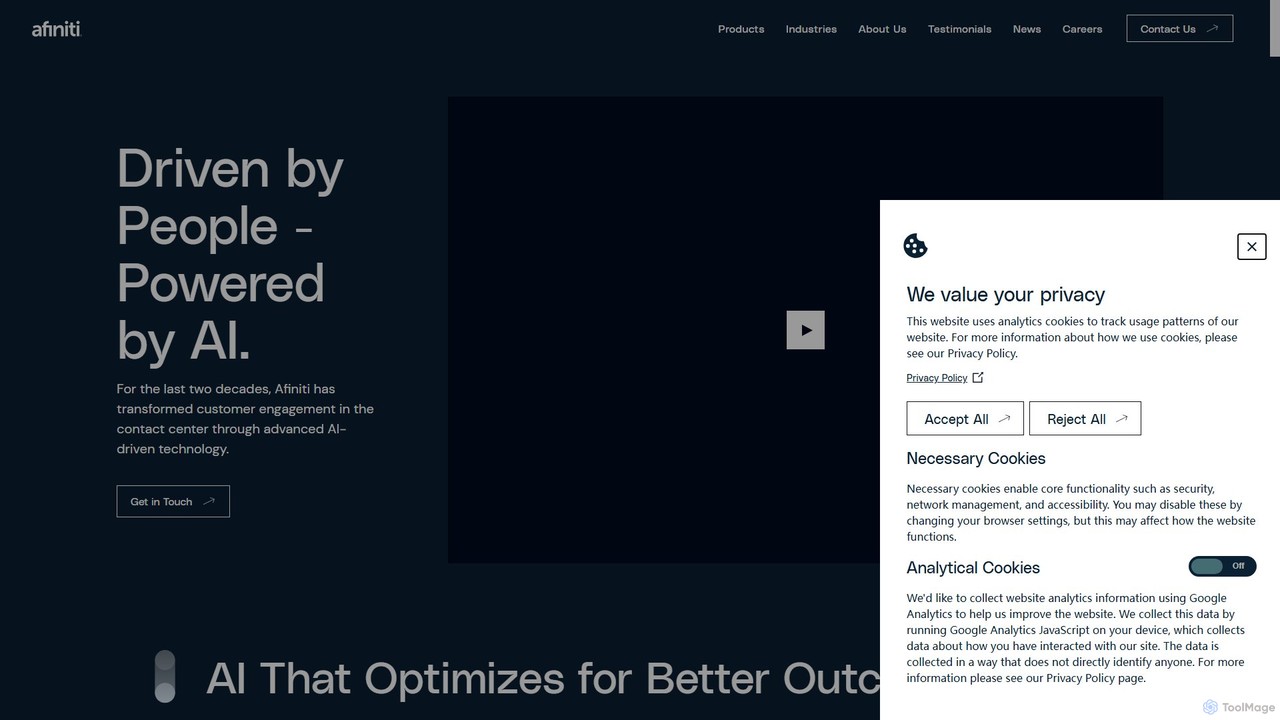
Afiniti is an enterprise AI platform that revolutionizes contact centers using patented behavioral pairing technology. It analyzes customer and agent data to create optimal pairings in real-time, significantly boosting revenue, improving customer satisfaction, and reducing service costs without changing existing workflows. Trusted by global leaders, Afiniti delivers measurable business outcomes.

Analytics
Visits 42.1KFavorites 112Likes 133

About Call Center Optimization

Call Center Optimization tools are a specialized category of AI software designed to analyze and improve the performance of voice-based customer interactions. They leverage technologies like speech recognition, natural language processing (NLP), and sentiment analysis to provide real-time insights and automate post-call tasks. This enhances agent productivity, ensures quality assurance, and elevates the overall customer experience. Unlike general customer support platforms, these tools focus specifically on optimizing the efficiency and effectiveness of human agents within a contact center.

Core Features

  • Real-time Agent Assist: Provides live guidance, script adherence prompts, and knowledge base suggestions to agents during calls.
  • Automated Quality Assurance (QA): Automatically scores and analyzes 100% of calls for compliance, script adherence, and sentiment.
  • Speech & Sentiment Analysis: Transcribes calls and analyzes customer and agent tone, emotion, and key topics to identify trends.
  • AI-Powered Coaching: Identifies agent skill gaps from call data and suggests personalized training modules.
  • Post-Call Automation: Generates automatic call summaries, categorizes issues, and updates CRM records to reduce manual work.

Use Cases

These tools are primarily used in industries with high-volume call centers, such as finance, telecommunications, healthcare, and retail. Team leads, QA managers, and operations directors use them to monitor performance, ensure regulatory compliance, reduce agent training time, and uncover deep customer insights from conversations.

How to Choose

When selecting a Call Center Optimization tool, evaluate its real-time assistance capabilities, the accuracy of its transcription and sentiment analysis, and its integration with your existing CRM and telephony systems. Also, consider the depth of its analytics and its ability to provide actionable coaching insights for agent development.

Featured tool rankings

Call Center Optimization use cases

1

Automating Quality Assurance and Compliance Checks

A quality assurance manager in a financial services company needs to ensure agents follow strict regulatory scripts. Instead of manually listening to a small 2% sample of calls, they use an AI tool to analyze 100% of recordings. The system automatically flags non-compliant phrases, measures customer sentiment, and scores each interaction against a predefined rubric. This provides comprehensive oversight, reduces compliance risk, and frees up managers to focus on strategic coaching rather than tedious auditing.

2

Providing Real-Time Assistance to New Agents

A telecommunications company is onboarding new support agents. During live calls, an AI tool listens in and provides real-time, on-screen prompts. If a customer asks about a complex billing issue, the system automatically pulls up the relevant knowledge base article. It also detects customer frustration and suggests de-escalation phrases, helping new agents handle difficult conversations confidently and reducing their ramp-up time by over 40%.

3

Identifying Root Causes of Customer Churn

A subscription-based service is experiencing high customer churn. The operations team uses a call center optimization tool to analyze thousands of 'cancellation' calls. The speech analytics feature identifies recurring keywords and topics, such as 'price increase,' 'poor service,' and 'competitor offer.' This data reveals the primary drivers of churn, allowing the product and marketing teams to address the core issues directly instead of relying on anecdotal feedback.

4

Personalizing Agent Coaching and Training

A call center manager wants to move beyond generic, one-size-fits-all training. The AI platform analyzes each agent's performance across all their calls, identifying specific areas for improvement, such as talking too fast, using too much jargon, or failing to show empathy. The system then generates personalized coaching scorecards and suggests targeted micro-learning modules, making training more effective and relevant to individual needs.

5

Reducing Average Handle Time (AHT) with Automation

In a busy e-commerce support center, agents spend several minutes after each call on manual data entry, summarizing the conversation and updating the CRM. An AI optimization tool automates this 'after-call work.' It generates a concise, accurate summary of the call, extracts key entities like order numbers, and automatically logs the interaction in the CRM system. This reduces AHT by 15-20%, allowing agents to handle more calls per day.

6

Enhancing Sales Performance in Outbound Teams

An outbound sales team needs to improve its conversion rates. The AI tool analyzes successful sales calls to identify the talk patterns, questions, and value propositions used by top-performing agents. This insight is used to refine sales scripts and create a 'best practice' playbook. The real-time assist feature then guides all agents to follow these successful patterns during live calls, leading to a measurable increase in closed deals.

Call Center Optimization FAQ

What are AI Call Center Optimization tools?

AI Call Center Optimization tools are software solutions that use artificial intelligence to analyze and improve agent performance and operational efficiency in contact centers. They primarily focus on voice interactions, using technologies like speech analytics and NLP to provide real-time agent guidance, automate quality assurance, and extract insights from conversations. Unlike chatbots that replace agents, these tools empower them to be more effective.

How do these tools differ from standard CRM software?

Standard CRM software is a system of record for customer data and interaction history. AI Call Center Optimization tools are systems of intelligence that analyze the content of those interactions. While a CRM tells you that a call happened, an optimization tool tells you what was said, how it was said (sentiment), whether compliance was met, and how the agent could improve. They often integrate with CRMs to enrich the customer record with conversational intelligence.

Who should use Call Center Optimization tools?

These tools are ideal for businesses with medium to large-scale call centers, particularly in regulated industries like finance, insurance, and healthcare. Key users include call center managers, quality assurance teams, compliance officers, and training departments. Any organization looking to improve agent productivity, ensure consistent service quality, and gain deep insights from customer conversations can benefit.

What are the key features to look for in a Call Center Optimization tool?

When choosing a tool, prioritize the following features:

  • Real-time Agent Assist: Live guidance and script prompts during calls.
  • Accurate Transcription & Speech Analytics: High-quality transcription and the ability to analyze keywords, topics, and sentiment.
  • Automated QA & Scoring: Customizable scorecards to automatically evaluate 100% of calls.
  • Actionable Coaching Insights: Dashboards that pinpoint specific agent skill gaps and track improvement over time.
  • Strong Integration Capabilities: Seamless connection with your existing telephony, UCaaS, and CRM platforms.
Can these tools analyze calls in multiple languages?

Yes, many leading Call Center Optimization platforms support multiple languages and dialects. They use language-specific models for transcription and natural language understanding (NLU) to accurately analyze conversations from global customer bases. When evaluating a tool, it is crucial to verify its specific language coverage and the accuracy of its analysis for each language relevant to your operations.