
ToolMage
Sign in

Best 1 Contact Center Solutions AI tools for Customer Support

Popular Contact Center Solutions AI tools in Customer Support include Collab, helping you work more efficiently.

Collab
Paid

Collab

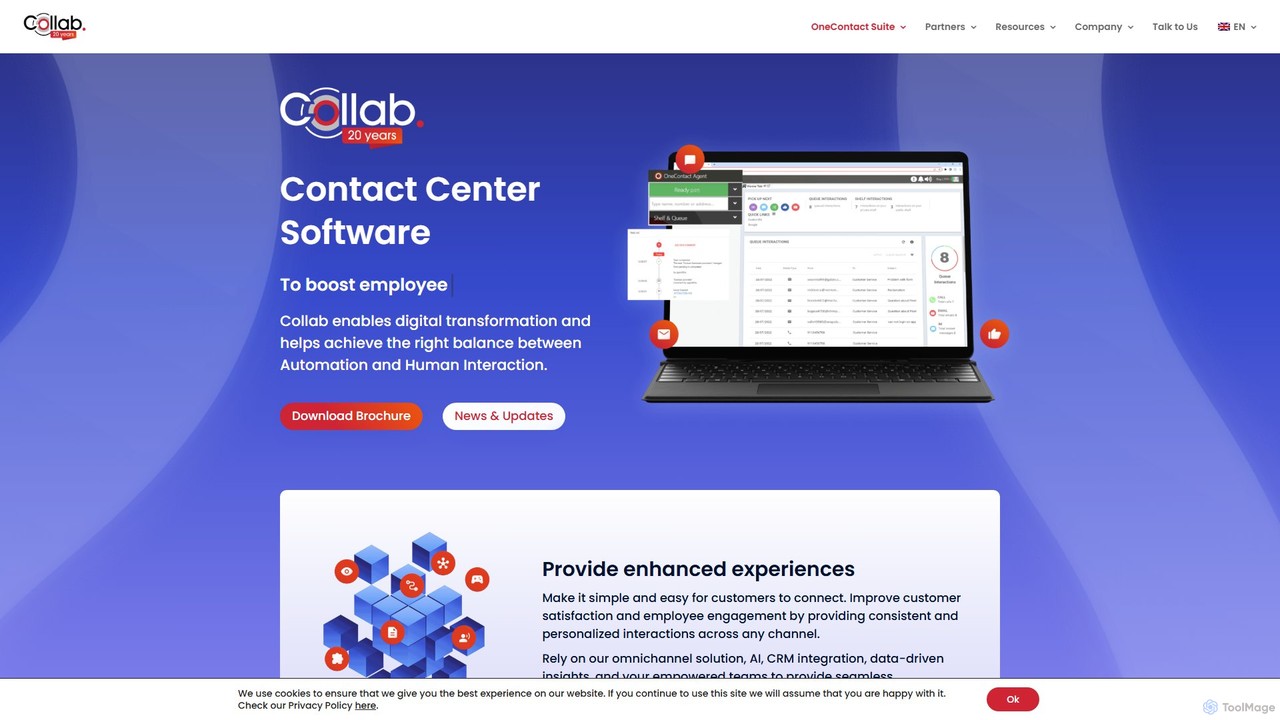
Collab provides the OneContact Suite, an AI-powered omnichannel contact center software. It enhances customer experience by balancing automation and human interaction. Key features include AI-driven speech analytics, CRM integration, and data insights. Designed for businesses of all sizes, it offers flexible cloud or on-premises deployment to improve customer satisfaction and agent performance.

Customer Relationship Management
Visits 36.8KFavorites 117Likes 113

About Contact Center Solutions

AI-powered Contact Center Solutions are comprehensive platforms designed to manage and optimize customer interactions across all communication channels. These systems leverage technologies like Automatic Call Distribution (ACD), AI-driven chatbots, and sentiment analysis to intelligently route inquiries and automate responses. They serve as a central hub for customer service operations, enabling businesses to deliver consistent, personalized support at scale. By unifying data and workflows, these solutions enhance agent productivity and significantly improve the overall customer experience.

Core Features

  • Omnichannel Routing: Unifies and intelligently directs customer interactions from voice, email, chat, and social media to the best-suited agent.
  • AI-Powered Self-Service: Deploys conversational IVR and chatbots to resolve common queries 24/7, freeing up human agents for complex issues.
  • Workforce Optimization (WFO): Includes tools for agent scheduling, performance tracking, quality assurance, and real-time coaching.
  • Advanced Analytics & Reporting: Provides deep insights into key metrics like handle time, resolution rates, and customer satisfaction (CSAT).
  • CRM Integration: Seamlessly connects with Customer Relationship Management systems to provide agents with a complete customer history.

Use Cases

These solutions are vital for industries with high customer interaction volumes, such as retail, banking, telecommunications, and healthcare. They are used to manage everything from technical support and billing inquiries to sales outreach and appointment scheduling, ensuring a seamless customer journey.

How to Choose

When selecting a solution, consider the channels you need to support, the level of AI and automation required, and its ability to integrate with your existing CRM and other business tools. Also, evaluate the platform's scalability to grow with your business and the depth of its analytics capabilities.

Contact Center Solutions use cases

1

Streamline E-commerce Customer Service

An e-commerce manager for a growing online fashion brand uses a contact center solution to handle a surge in holiday season inquiries. The platform automatically routes emails about order status to a specific queue, while live chat requests about sizing are directed to product specialists. An AI chatbot handles common 'Where is my order?' questions 24/7, deflecting up to 40% of incoming queries. This allows the human support team to focus on complex issues like returns and exchanges, reducing average response time from hours to minutes and boosting customer satisfaction scores.

2

Enhance Financial Services Support Compliance

A customer support team lead at a regional bank implements a contact center solution to improve security and efficiency. The system's IVR authenticates callers using voice biometrics before connecting them to an agent. All calls are automatically recorded and transcribed for compliance auditing. Skill-based routing ensures that queries about mortgages are sent directly to loan specialists, bypassing general support. This reduces transfer rates and handle times, while providing a secure and compliant environment for sensitive financial discussions.

3

Optimize Healthcare Patient Communication

A hospital administration team uses a contact center solution to manage patient communications. The system automates appointment reminders via SMS and allows patients to confirm or reschedule with a simple reply. Inbound calls are routed through an intelligent IVR that directs billing questions to the finance department and clinical questions to nursing staff. This centralized, HIPAA-compliant platform reduces no-show rates by 15% and ensures patients quickly reach the correct department, improving the overall patient experience.

4

Manage Technical Support for a SaaS Company

A technical support manager for a software-as-a-service (SaaS) company leverages a contact center solution to provide tiered support. The integrated knowledge base allows Tier 1 agents to quickly resolve common issues via chat and email. More complex technical problems are automatically escalated to Tier 2 engineers with a full transcript of the initial interaction. The platform's analytics track bug report frequency and resolution times, providing valuable feedback to the product development team and helping to prioritize fixes.

5

Centralize a Corporate IT Helpdesk

An IT director for a large corporation deploys a contact center solution to serve as the internal helpdesk for employees. Requests submitted via email, a self-service portal, or phone are consolidated into a single ticketing system. An AI-powered chatbot on the company intranet can instantly resolve common issues like password resets or software access requests. This frees up IT staff to handle critical system maintenance and complex hardware problems, reducing employee downtime and improving internal service levels.

6

Power Proactive Outbound Sales Campaigns

A sales manager for a B2B services firm uses the outbound capabilities of a contact center solution to run a lead generation campaign. The platform's progressive dialer automatically calls numbers from a pre-loaded list, connecting agents only when a live person answers. The system integrates with the CRM to display lead information on the agent's screen instantly. Campaign performance, including connection rates and conversion metrics, is tracked in real-time on a central dashboard, allowing the manager to optimize scripts and strategies on the fly.

Contact Center Solutions FAQ

What are AI-powered Contact Center Solutions?

AI-powered Contact Center Solutions are integrated platforms that use artificial intelligence to manage and optimize all customer communications. They centralize interactions from channels like phone, email, chat, and social media. Key AI features include intelligent routing to direct customers to the right agent, chatbots and voicebots for 24/7 self-service, and sentiment analysis to gauge customer emotion. Their main purpose is to increase efficiency, personalize customer experiences, and provide actionable data for service improvement.

How do I choose the right Contact Center Solution for my business?

To choose the right solution, first assess your specific needs. Consider the following factors:

  • Channels: Which communication channels do your customers prefer (voice, email, chat, social)? Ensure the platform supports them all natively.
  • Scalability: Will the solution grow with your team and call volume? Look for flexible pricing and infrastructure.
  • Integrations: Does it connect seamlessly with your existing CRM, helpdesk, or other business software?
  • AI & Automation: Evaluate the level of AI capabilities you need, from simple chatbots to advanced analytics and workforce optimization.

What's the difference between a Contact Center Solution and a CRM or Helpdesk?

The primary difference lies in their core focus. A CRM (Customer Relationship Management) system is designed to manage customer data and sales pipelines. A Helpdesk is typically focused on managing support tickets, usually from email or a web portal. A Contact Center Solution is a more comprehensive communication hub that actively manages real-time and asynchronous interactions across multiple channels (especially voice). It includes features like intelligent call routing (ACD), IVR, and workforce management, which are generally absent in standard CRMs and helpdesks.

What key metrics can be improved with a Contact Center Solution?

Contact Center Solutions are designed to track and improve critical customer service metrics. Key performance indicators (KPIs) you can expect to enhance include:

  • First Contact Resolution (FCR): Solving customer issues on the first attempt.
  • Average Handle Time (AHT): Reducing the time agents spend on each interaction.
  • Customer Satisfaction (CSAT): Directly measuring customer happiness through surveys.
  • Agent Occupancy: Ensuring agents are utilized efficiently without being overloaded.
  • Service Level: Answering a specific percentage of calls within a target timeframe.

Are these solutions suitable for small businesses?

Yes, many modern Contact Center Solutions are cloud-based (CCaaS - Contact Center as a Service) and offer scalable pricing models, making them accessible to small and medium-sized businesses (SMBs). SMBs can benefit from features like a unified inbox for all channels, basic IVR, and simple reporting without the high cost of traditional on-premise systems. These solutions allow smaller teams to provide a professional, organized level of customer service that was once only possible for large enterprises.