
Freemium
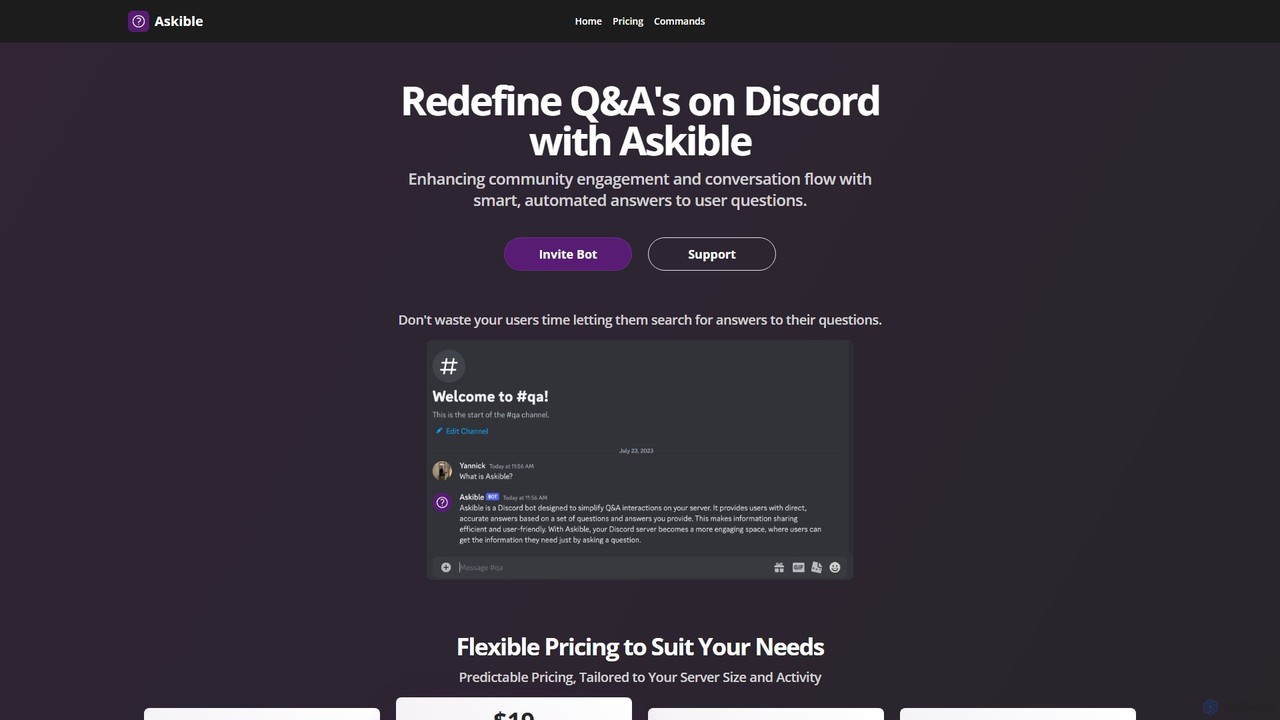
Popular Faq AI tools in Customer Support include Askible, helping you work more efficiently.
AI Faq tools are a class of software that automates the creation, management, and optimization of Frequently Asked Questions content. These tools utilize Natural Language Processing (NLP) to analyze existing documents, support tickets, or user queries to identify common questions and generate clear answers. They help businesses reduce repetitive support inquiries, improve customer self-service, and keep help documentation current. Unlike static text editors, these AI-powered systems can proactively suggest new Q&A pairs based on emerging trends in user data.
These tools are particularly valuable for SaaS companies, e-commerce platforms, and large enterprises with extensive product documentation or high volumes of customer inquiries. Roles such as customer support managers, knowledge base administrators, and technical writers use them to streamline the creation and maintenance of help centers, reducing manual effort and improving information accuracy.
When selecting an AI Faq tool, consider its integration capabilities with your existing systems (e.g., CRM, helpdesk). Evaluate the quality and accuracy of its question and answer generation. Assess the user-friendliness of its content management features and the depth of its analytics. Finally, consider its deployment options, such as standalone pages, embeddable widgets, or API access for chatbot integration.
A product manager at a SaaS company is preparing for a new feature launch. Instead of manually writing dozens of potential user questions, they upload the technical documentation and release notes into an AI Faq tool. The tool analyzes the content and automatically generates a list of 20+ relevant questions and draft answers, such as 'How do I enable the new integration?' and 'What are the limitations of the beta feature?'. The manager then reviews, edits, and publishes the new FAQ section in under an hour, a process that previously took a full day.
An e-commerce store manager notices a high volume of support tickets about shipping policies and return procedures. They connect their helpdesk software to an AI Faq tool, which analyzes thousands of past customer conversations. The tool identifies the five most frequently asked questions that are not clearly answered on the website. It then generates concise, easy-to-understand answers for each. The manager adds these to a prominent FAQ section on the site, leading to a 30% reduction in related support tickets within the first month.
An HR department in a large corporation wants to reduce the time spent answering repetitive employee questions. They use an AI Faq tool to scan hundreds of internal documents, including the employee handbook, IT policies, and benefits guides. The system generates a comprehensive internal FAQ portal. Now, when an employee has a question about parental leave or setting up their VPN, they can find an instant, approved answer through a simple search, freeing up HR and IT staff to focus on more complex issues.
A customer support manager uses the analytics dashboard of their AI Faq tool. They notice a recurring search term, 'data export formats', that consistently returns no results. This insight reveals a gap in their existing documentation. The manager tasks a technical writer to create a detailed article on this topic. They then feed the new article into the AI tool, which generates several Q&A pairs for the FAQ page. This proactive approach, driven by data, helps them address customer needs before they even need to file a support ticket.
A marketing team wants to reduce bounce rates on their complex pricing page. They embed a dynamic AI Faq widget onto the page. The tool, without needing pre-written questions, analyzes the page content and common user navigation patterns. It then proactively displays context-sensitive questions like 'Is there a discount for annual plans?' or 'What payment methods are accepted?'. This immediate access to information helps clarify user doubts directly on the page, increasing their confidence and improving conversion rates for plan sign-ups.
A company has a decade-old, disorganized FAQ page with hundreds of entries. A knowledge manager uses an AI Faq tool to import all the existing content. The AI automatically identifies and merges duplicate questions, flags outdated information by cross-referencing it with new product docs, and suggests rephrasing for unclear answers. It also categorizes all entries into a logical structure. This transforms a chaotic page into a streamlined, accurate, and user-friendly knowledge base in a fraction of the time it would take to do manually.
AI Faq tools are applications that use artificial intelligence, primarily Natural Language Processing (NLP), to automate the creation and management of Frequently Asked Questions content. Instead of manually writing Q&A pairs, these tools can analyze data sources like product documentation, support tickets, and customer chat logs to automatically identify common questions and draft accurate answers. Their main purpose is to reduce manual effort, keep knowledge bases up-to-date, and improve customer self-service efficiency.
To choose the right AI Faq tool, evaluate these key factors:
A standard knowledge base is essentially a content management system (CMS) where humans manually write, edit, and organize articles. An AI Faq tool automates the content creation process *for* a knowledge base. It analyzes data to suggest what questions to answer and even drafts the answers. In short, a knowledge base is the destination for the content, while an AI Faq tool is the engine that helps create that content intelligently and efficiently, often integrating with and publishing to a knowledge base platform.
AI Faq tools perform best with large volumes of text-based data that reflect user questions and official answers. Common data sources include:
While many can benefit, the primary beneficiaries are organizations with a high volume of customer inquiries or extensive product documentation. Key user groups include: