
Customer Support Best in category 1 results Voice Support AI Tool

Popular AI tools in the Voice Support field of Customer Support include MyClony, etc., helping you quickly improve efficiency.

MyClony

MyClony

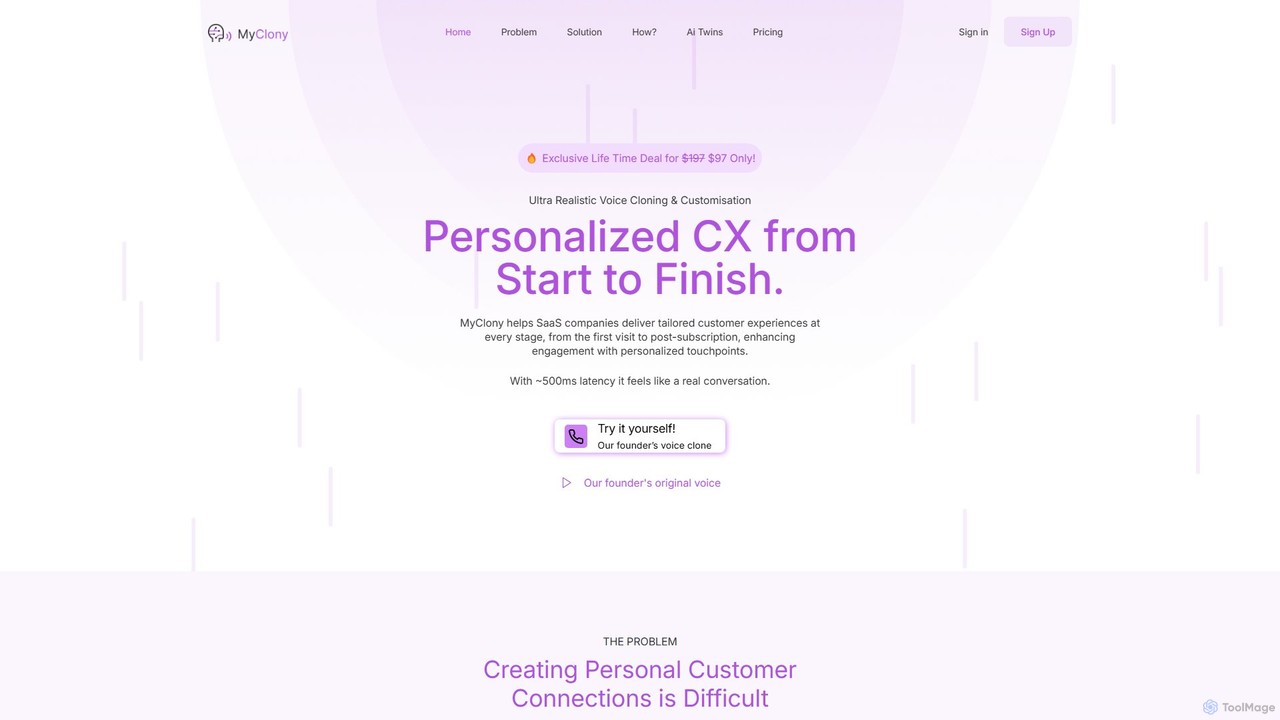
MyClony is an AI-powered platform that enhances customer experience (CX) by enabling businesses to create personalized voice interactions. …

2.7K

About Voice Support

Voice Support tools are AI-powered solutions designed to enhance customer service interactions through spoken language. These tools leverage advanced Natural Language Processing (NLP), Speech-to-Text (STT), and Text-to-Speech (TTS) technologies to understand, process, and respond to customer voice queries. They aim to automate routine inquiries, provide instant assistance, and improve the overall efficiency and personalization of customer support operations.

Core Features

  • AI Voicebots & Virtual Agents: Automate inbound and outbound calls, answer frequently asked questions, and intelligently route customers to the appropriate department or human agent.
  • Speech Analytics: Analyze call recordings in real-time or post-call to identify customer sentiment, key topics, compliance issues, and agent performance trends.
  • Real-time Agent Assist: Provide human agents with instant, relevant information, suggested responses, or knowledge base articles during live customer conversations.
  • Voice Biometrics: Securely authenticate customer identities using unique voice patterns, reducing fraud and streamlining verification processes.
  • Multilingual Voice Processing: Offer voice support in multiple languages, enabling businesses to serve a diverse global customer base efficiently.

Use Cases

Voice Support tools are crucial for modern call centers and helpdesks, automating initial customer contact and resolving common issues without human intervention. They are also used in self-service portals where customers prefer voice commands, and for analyzing vast amounts of spoken data to gain insights into customer needs and service quality.

How to Choose

When selecting a Voice Support solution, prioritize the accuracy of its speech recognition and NLP capabilities for your target languages. Evaluate its integration potential with existing CRM and contact center systems, scalability to handle fluctuating call volumes, and customization options for specific business needs. Security features, especially for voice biometrics, and robust analytics dashboards are also critical considerations.

Voice SupportUse Cases

1

Automated Customer Service Hotline

A large e-commerce company implements an AI voicebot to handle its customer service hotline. The voicebot automatically answers common questions about order status, returns, and product information 24/7, significantly reducing call wait times and freeing up human agents for more complex issues. Customers receive instant, accurate responses without needing to navigate complex IVR menus.

2

Real-time Agent Guidance in Call Centers

A financial services call center uses AI Voice Support to assist its human agents. During live calls, the system listens to the conversation, transcribes it in real-time, and suggests relevant policy documents, product details, or compliance scripts to the agent's screen. This ensures agents provide consistent, accurate information and reduces training time for new hires.

3

Proactive Customer Outreach for Service Updates

A utility company uses outbound AI voice calls to proactively inform customers about scheduled maintenance, service outages, or payment reminders. The AI system can personalize messages based on customer data and handle simple interactive responses, ensuring timely communication and reducing inbound calls related to these events.

4

Enhancing In-Car Infotainment Systems

Automotive manufacturers integrate Voice Support AI into vehicle infotainment systems. Drivers can use natural voice commands to control navigation, music, climate, and make calls, improving safety and user experience by minimizing manual interaction with controls. The system understands diverse accents and commands, providing a seamless interface.

5

Voice-Activated Self-Service for Technical Support

A software company deploys a voice-activated self-service portal for technical support. Users can describe their technical issues verbally, and the AI system guides them through troubleshooting steps, provides links to relevant knowledge base articles, or schedules a callback from a human expert if the issue requires further assistance. This empowers users to resolve problems independently.

6

Multilingual Support for Global Businesses

A multinational travel agency utilizes AI Voice Support to offer customer service in over ten languages without needing a large, diverse human agent team. The AI voicebot can understand and respond in the customer's preferred language, providing consistent service quality globally and expanding market reach without significant operational overhead.

Voice SupportFrequently Asked Questions