Braintrust
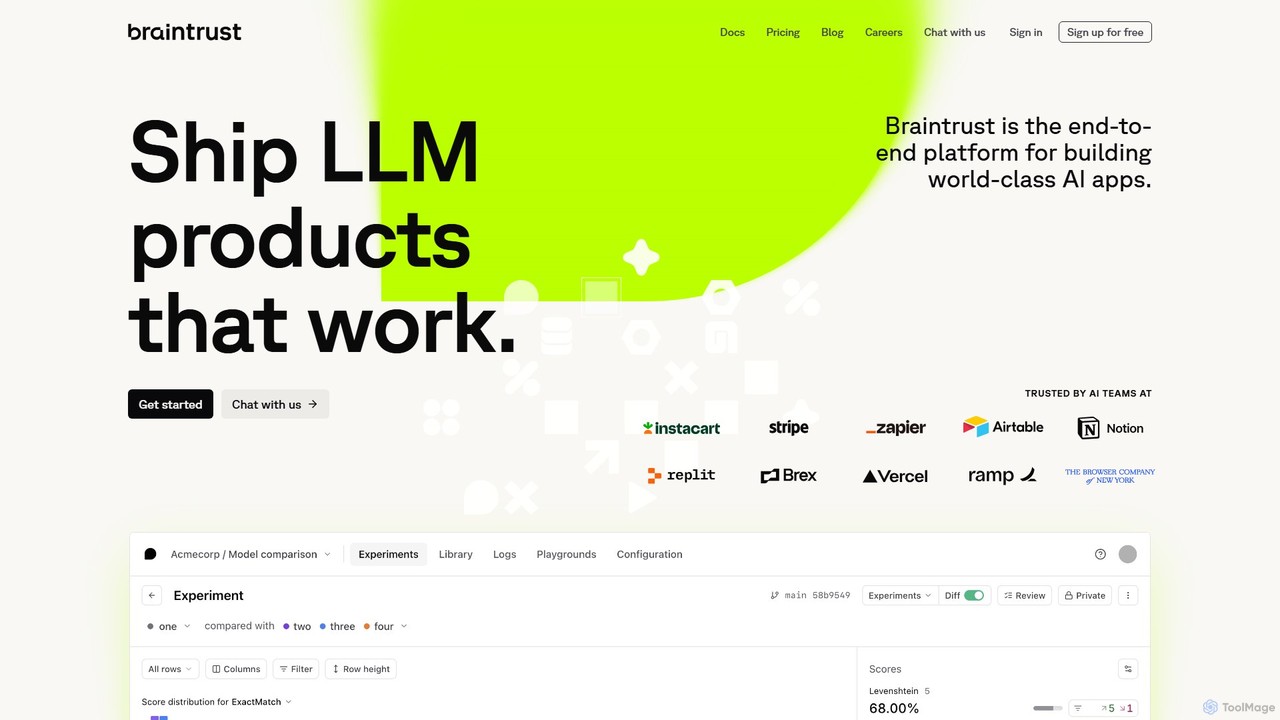
Braintrust is an end-to-end platform for developing, evaluating, and deploying robust LLM applications. It provides a comprehensive suite …
Braintrust is an end-to-end platform for developing, evaluating, and deploying robust LLM applications. It provides a comprehensive suite of tools for prompt engineering, model evaluation, real-time tracing, and production monitoring. Designed for both technical and non-technical team members, Braintrust helps streamline the AI development lifecycle, ensuring that AI products are reliable, effective, and ready for production.
About Evaluation & Testing
Evaluation & Testing tools are AI-powered platforms designed to rigorously assess the performance, reliability, and fairness of AI models and systems. These tools leverage advanced analytics and statistical methods to validate model outputs, detect biases, and ensure robustness. They are essential for data scientists, MLOps engineers, and AI developers to ensure AI applications are trustworthy, compliant, and perform optimally before and after deployment.
Core Features
- Model Performance Metrics: Calculate and visualize key metrics like accuracy, precision, recall, F1-score, and AUC for various AI tasks.
- Bias Detection & Mitigation: Identify and quantify unfair biases in model predictions or training data across different demographic groups.
- Adversarial Robustness Testing: Evaluate model resilience against malicious input attacks designed to trick or degrade performance.
- Data & Concept Drift Monitoring: Continuously track changes in input data distribution or underlying relationships that can impact model performance.
- Explainable AI (XAI): Provide insights into why an AI model made a particular decision, enhancing transparency and trust.
Applicable Scenarios
These tools are crucial for validating new AI models before production release, ensuring they meet performance and fairness benchmarks. They also enable continuous monitoring of deployed models to detect performance degradation or data drift in real-time. Furthermore, they support responsible AI development by identifying and mitigating biases, ensuring ethical and compliant AI systems.
How to Choose
When selecting Evaluation & Testing tools, consider their compatibility with your existing AI frameworks (e.g., TensorFlow, PyTorch). Evaluate the breadth and depth of their performance metrics, bias detection capabilities, and explainability features. Look for seamless integration with MLOps pipelines for automated testing and continuous monitoring, and assess their scalability for your data and model volumes.
Evaluation & TestingUse Cases
Validate New Model Performance Before Deployment
MLOps engineers use these tools to run comprehensive tests on a newly trained fraud detection model. They ensure the model meets accuracy and false positive rate thresholds across different customer segments, validating its readiness for production release and minimizing risks of erroneous decisions in live systems.
Detect & Mitigate Bias in Loan Application Models
Data scientists employ bias detection features to identify if a credit scoring model unfairly discriminates against certain demographic groups (e.g., based on gender or ethnicity). The insights gained help them adjust the model or retrain it with debiased data, ensuring fair and ethical lending practices.
Monitor Production AI Models for Data Drift
An AI operations team continuously monitors a retail company's recommendation engine. When data drift is detected (e.g., a sudden change in customer purchasing patterns or product trends), the evaluation tool alerts them, prompting a timely model retraining or update to maintain recommendation relevance and business performance.
Assess Robustness Against Adversarial Attacks
Cybersecurity researchers use adversarial testing tools to probe a facial recognition system, identifying vulnerabilities where small, imperceptible changes to an image could trick the model into misclassifying an identity. This helps strengthen the model's security and reliability against sophisticated attacks.
Explain AI Decisions for Regulatory Compliance
A financial institution uses Explainable AI (XAI) tools to generate clear, understandable explanations for individual loan approval/denial decisions made by an AI. This provides transparency to customers, helps satisfy regulatory requirements like GDPR or fair lending laws, and builds trust in automated processes.
Benchmark Multiple AI Models for Optimal Selection
A development team evaluates several different natural language processing (NLP) models for a sentiment analysis task. Using standardized metrics and datasets provided by evaluation tools, they objectively compare their performance, resource consumption, and robustness to choose the best-performing and most cost-effective model for deployment.