Data Management Best in category 1 results Data Integration AI Tool

Popular AI tools in the Data Integration field of Data Management include Well, etc., helping you quickly improve efficiency.

Well

Well

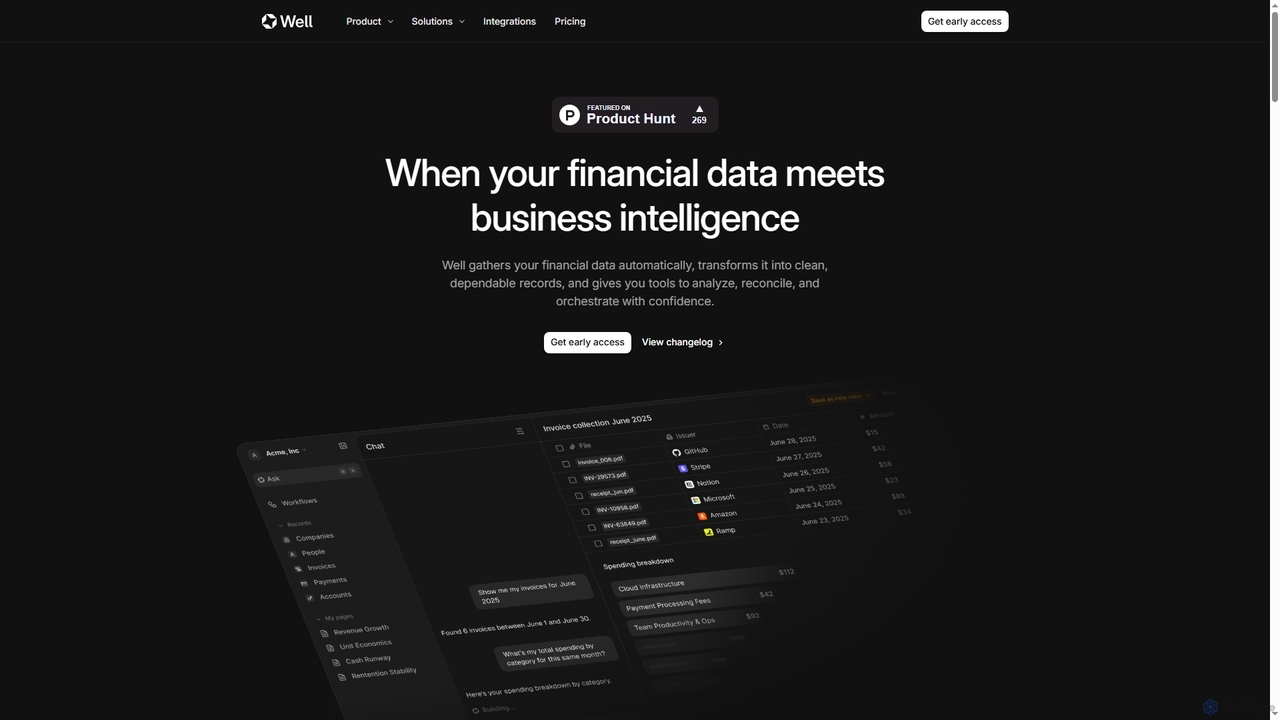
Well is an AI-native business intelligence platform designed for SMBs, automating financial data gathering, transformation, and analysis. It …

7.2K

About Data Integration

Data Integration tools are platforms designed to consolidate data from various disparate sources into a single, unified, and valuable dataset. Leveraging AI, these tools automate complex processes such as data mapping, transformation, and quality checks, significantly reducing manual effort and potential for error. They are crucial for creating a single source of truth, enabling comprehensive business intelligence, advanced analytics, and machine learning applications. As a specialized area within Data Management, they focus specifically on the movement, combination, and preparation of data for analysis.

Core Features

  • Automated Data Mapping: AI algorithms suggest and automate connections between source and target data fields, accelerating pipeline development.
  • Intelligent Data Transformation: Automatically converts data formats, structures, and values based on context, supporting both simple and complex logic.
  • AI-Powered Data Quality: Proactively identifies, cleanses, and standardizes data by detecting anomalies, duplicates, and inconsistencies.
  • Extensive Connector Library: Offers a wide range of pre-built connectors for databases, SaaS applications, APIs, and data warehouses.
  • Real-time & Batch Processing: Supports various data processing needs, from large-volume batch jobs to low-latency, real-time data streaming.

Use Cases

Data Integration tools are essential for data engineers, BI analysts, and data scientists across industries like finance, e-commerce, and healthcare. Common applications include building a 360-degree customer view by combining CRM and marketing data, migrating legacy systems to a cloud data warehouse, or feeding clean, consolidated data into BI platforms like Tableau for accurate reporting.

How to Choose

When selecting a Data Integration tool, consider the breadth of its connector ecosystem to ensure it supports your sources and destinations. Evaluate its scalability to handle your current and future data volumes. Assess the user interface—whether it's a low-code/no-code platform for business users or a code-centric environment for engineers. Finally, examine its data governance and security features to ensure compliance with industry standards.

Data IntegrationUse Cases

1

Building a Customer 360-Degree View

Marketing and sales teams often struggle with fragmented customer data spread across CRM, e-commerce platforms, support desks, and analytics tools. A Data Integration tool automates the process of consolidating this information. It connects to each source, extracts relevant customer data (like purchase history, support tickets, and website interactions), transforms it into a consistent format, and loads it into a central data warehouse or a Customer Data Platform (CDP). This unified view allows teams to personalize marketing campaigns, improve customer service, and accurately calculate metrics like customer lifetime value.

2

Automating Cloud Data Warehouse Migration

For IT and data engineering teams, migrating data from on-premise legacy systems (like Oracle or SQL Server) to a modern cloud data warehouse (like Snowflake, BigQuery, or Redshift) is a complex task. Data Integration platforms streamline this by providing pre-built connectors for both source and target systems. They manage the entire ETL/ELT process, handling schema conversion, data type mapping, and large-volume data transfers efficiently. AI features can automatically detect schema drift and adapt pipelines, ensuring a smooth and reliable migration with minimal downtime and manual intervention.

3

Powering Real-time Business Intelligence (BI)

Business analysts rely on up-to-date data for accurate reporting and decision-making. Data Integration tools with real-time capabilities, often using Change Data Capture (CDC), can stream data from operational databases (like PostgreSQL or MySQL) and SaaS apps directly into an analytical data store. This ensures that BI dashboards in tools like Tableau or Power BI reflect business operations in near real-time. Instead of waiting for nightly batch jobs, decision-makers can monitor key performance indicators (KPIs) as they change, enabling faster responses to market trends or operational issues.

4

Preparing Data for Machine Learning Models

Data scientists require large volumes of clean, well-structured data to train effective machine learning models. Data Integration tools are fundamental in this preparation phase (often called feature engineering). They can pull raw data from diverse sources like application logs, IoT sensors, and third-party APIs. The platform is then used to cleanse, normalize, aggregate, and transform this data into a feature-rich dataset suitable for training. By automating this data pipeline, data scientists can spend less time on data wrangling and more time on model development and experimentation.

5

Synchronizing Data Across SaaS Applications

Modern businesses rely on a suite of SaaS applications (e.g., Salesforce for sales, Marketo for marketing, Zendesk for support). Keeping data consistent across these platforms is a major challenge. Data Integration tools act as a central hub to synchronize this data. For example, when a new lead is created in Marketo, an integration pipeline can automatically create a corresponding lead in Salesforce. This ensures that all teams are working with the same information, eliminates manual data entry, reduces errors, and enables seamless cross-departmental workflows.

6

Enabling Data Governance and Compliance

For organizations in regulated industries like finance or healthcare, data governance is critical. Data Integration platforms provide a centralized point of control for managing data pipelines. They offer features like data lineage tracking, which shows the origin, movement, and transformation of data. This is essential for audits and for complying with regulations like GDPR and HIPAA. Administrators can set access controls, mask sensitive data (PII), and monitor data quality, ensuring that all data movement across the organization is secure, documented, and compliant.

Data IntegrationFrequently Asked Questions