Plat.AI
Plat.AI is an automated predictive analytics platform for businesses. It transforms existing company data into real-time, actionable insights …
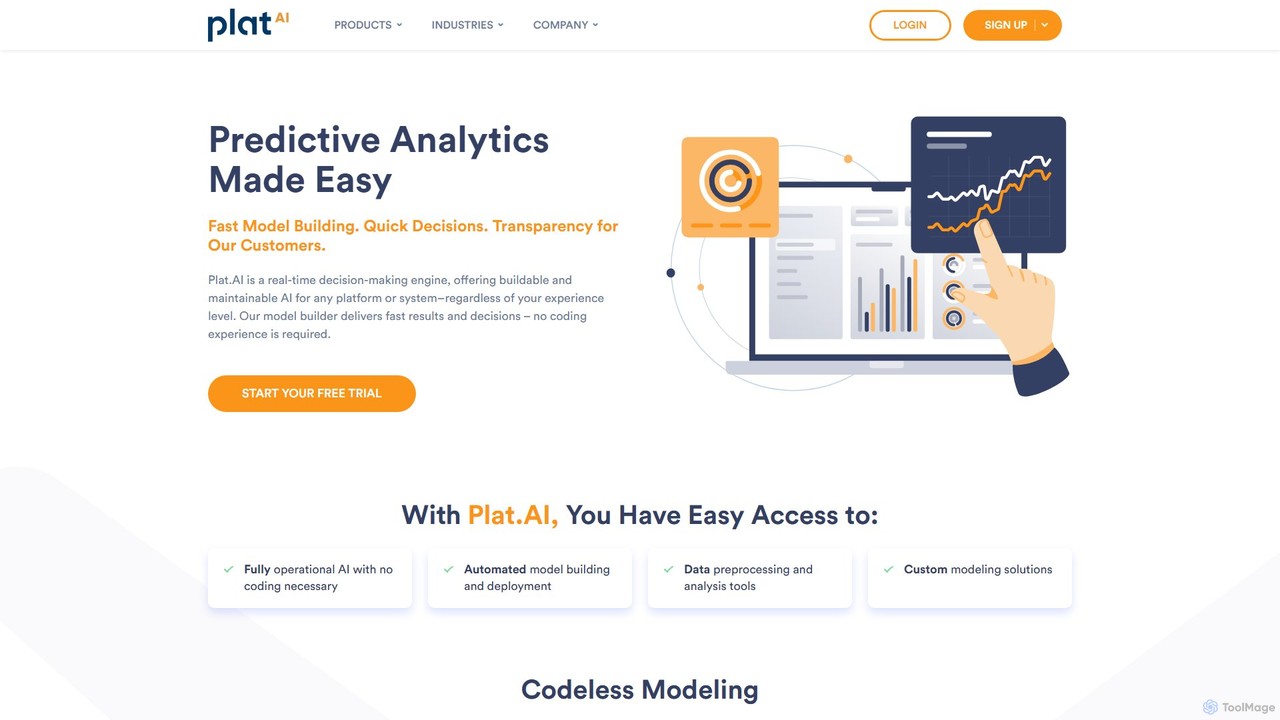
Plat.AI is an automated predictive analytics platform for businesses. It transforms existing company data into real-time, actionable insights using machine learning and deep learning models. The platform offers a self-service or server-based solution, focusing on speed, transparency, and security. It helps companies in sectors like finance and marketing to reduce risk, detect fraud, and make smarter, data-driven decisions through custom-built, maintained, and compliant predictive models.
About Machine Learning Platforms
Machine Learning Platforms are integrated software environments designed to manage the entire lifecycle of machine learning models. They provide a unified interface for data preparation, model training, validation, deployment, and monitoring (MLOps). These platforms empower data science teams to build, scale, and maintain production-grade AI applications more efficiently than using disparate, individual tools. By abstracting away complex infrastructure management, they accelerate the path from an experimental model to real-world business value.
Core Features
- Integrated Development Environment (IDE): Offers collaborative notebooks and coding environments for model development and experimentation.
- Automated Machine Learning (AutoML): Automates repetitive tasks like feature engineering, model selection, and hyperparameter tuning to speed up development.
- Model Deployment & Serving: Simplifies the process of deploying trained models as scalable APIs for easy integration into applications.
- MLOps & Monitoring: Provides tools for versioning datasets and models, tracking experiments, and monitoring model performance in production to detect drift or degradation.
- Data Management & Preprocessing: Includes features for connecting to various data sources, cleaning data, and transforming it into a format suitable for training.
Use Cases
Machine Learning Platforms are widely used across industries. In finance, they power fraud detection and credit scoring models. E-commerce companies use them for recommendation engines and demand forecasting. In healthcare, they assist in medical image analysis and patient risk stratification. These platforms are essential for data scientists, ML engineers, and even business analysts who need to operationalize machine learning.
How to Choose
When selecting a Machine Learning Platform, consider its support for various ML frameworks (e.g., TensorFlow, PyTorch), its integration capabilities with your existing data infrastructure, and the level of automation (AutoML) required. Evaluate its scalability for production workloads, MLOps features for governance, and whether its user interface suits your team's technical skill level (code-first vs. low-code).

Machine Learning PlatformsUse Cases
Build a Customer Churn Prediction Model
A data scientist at a telecom company needs to identify customers likely to cancel their service. Using a machine learning platform, they connect to customer data sources, preprocess features like call duration and plan type, and train several classification models. The platform's experiment tracking helps compare model performance, and its AutoML feature can find the optimal model automatically. The final model is deployed as a scalable API, allowing the marketing system to target at-risk customers with retention offers, aiming to reduce churn.
Automate Defect Detection in Manufacturing
An ML engineer at a factory aims to replace manual product inspection with an automated system. They use an ML platform to upload and manage a labeled dataset of product images. The platform's environment is used to train a computer vision model (e.g., a CNN) to identify defects. The platform manages GPU resources and tracks all training runs. Once the best model is identified, it's deployed to an edge device on the production line, providing real-time defect alerts and significantly increasing inspection throughput and accuracy.
Develop a Personalized Recommendation Engine
An e-commerce development team wants to enhance the user experience by showing relevant product recommendations. They use an ML platform to ingest user browsing history and purchase data. Within the platform's collaborative notebooks, they build and train a collaborative filtering model. The platform's MLOps features are then used to deploy the model as a low-latency API and set up A/B testing to compare its performance against the old system, ultimately leading to increased user engagement and higher average order value.
Manage the Lifecycle of Multiple ML Models (MLOps)
An MLOps engineer in a large enterprise is tasked with managing dozens of production models. Using a machine learning platform, they establish a central model registry for versioning and governance. They create automated CI/CD pipelines for retraining and redeployment whenever new data is available. The platform's central dashboard is used to monitor all models for performance drift, latency, and resource usage, ensuring that all models remain accurate, compliant, and efficient over time.
Enable Citizen Data Scientists with AutoML
A business analyst in a marketing department wants to forecast campaign performance without deep coding knowledge. They use an ML platform's no-code AutoML interface to upload a CSV file with historical campaign data. By simply specifying the target variable (e.g., conversion rate), the platform automatically preprocesses the data, tries hundreds of different models and configurations, and presents the best-performing one. This empowers the analyst to generate reliable forecasts and make data-driven decisions independently.
Streamline Financial Fraud Detection Systems
A FinTech data science team needs to build and maintain a system that flags suspicious transactions in real-time. They use an ML platform to process millions of transaction records efficiently. Within the platform, they train an anomaly detection model that learns normal transaction patterns. The platform's deployment tools are used to serve the model as a low-latency API, which is then integrated with the payment processing system. The MLOps features ensure the model can be easily retrained and updated to adapt to new fraud patterns.