Browser Cash
Browser Cash is a decentralized AI browser network that allows users to earn rewards by contributing their browser's …
Browser Cash is a decentralized AI browser network that allows users to earn rewards by contributing their browser's idle capacity. It powers AI agents to perform real web tasks, research, and data collection in a secure, private, and anonymized environment, fostering a new AI browser economy.
Eco-AI
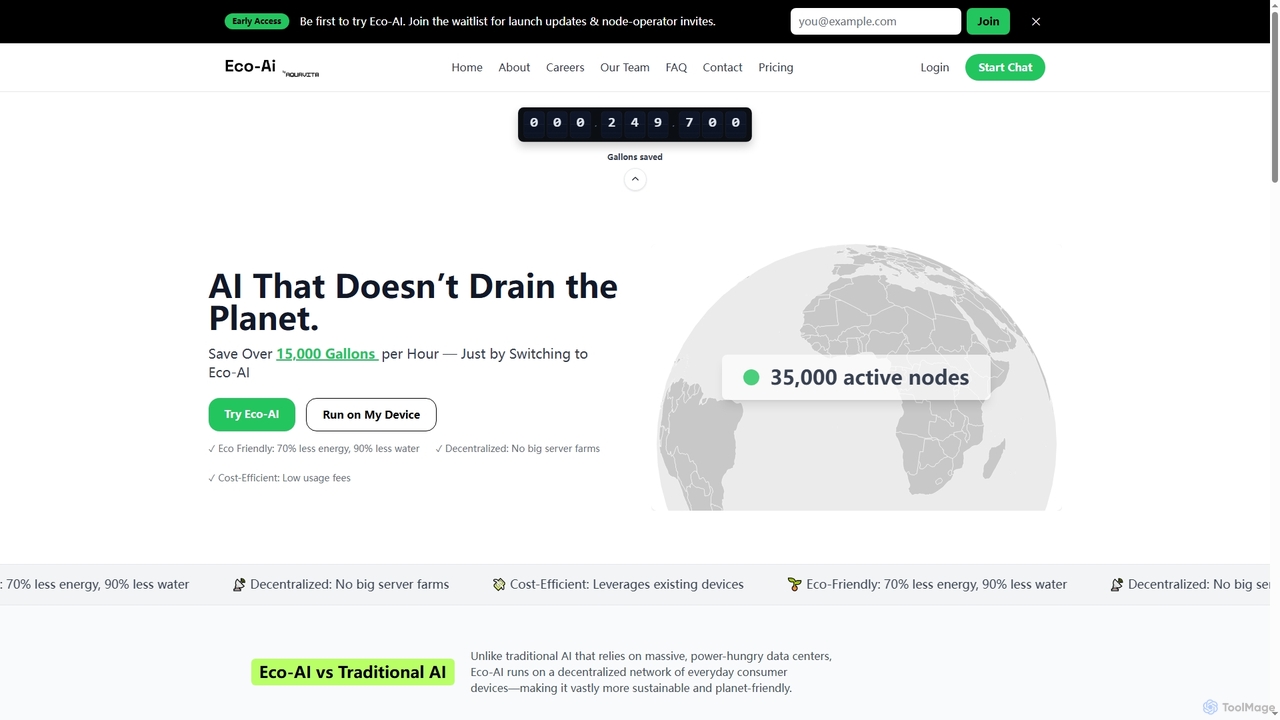
Eco-AI is a pioneering decentralized artificial intelligence platform designed for sustainability, significantly reducing energy and water consumption compared …
Eco-AI is a pioneering decentralized artificial intelligence platform designed for sustainability, significantly reducing energy and water consumption compared to traditional AI. It leverages a network of consumer-owned devices, promoting an eco-friendly and cost-efficient approach to AI processing while enhancing privacy.
About Decentralized Computing
Decentralized Computing refers to a paradigm where computational resources, storage, and networking are distributed across a peer-to-peer network rather than relying on a central server or authority. This approach leverages technologies like blockchain and distributed ledger technology to enhance security, resilience, and censorship resistance. It enables the creation of robust, transparent, and user-controlled applications and services, fostering a new era of internet infrastructure.
Core Features
- Distributed Resource Pooling: Aggregates computing power, storage, and bandwidth from a global network of participants.
- Enhanced Security & Privacy: Utilizes cryptographic methods and distributed consensus to protect data and operations from single points of failure.
- Censorship Resistance: Operates without a central control point, making it resilient against shutdowns or external interference.
- Scalability & Resilience: Distributes workload across many nodes, improving system uptime and fault tolerance.
- Incentivized Participation: Often employs tokenomics to reward users for contributing their idle resources to the network.
Use Cases
Decentralized Computing is crucial for Web3 applications, offering infrastructure for dApps, secure data storage, and content delivery. It supports blockchain networks by providing distributed node operations and enables scientific research or AI model training through pooled computational resources, ensuring data integrity and operational continuity.
How to Choose
When selecting a Decentralized Computing solution, consider the specific resource needs (compute, storage, bandwidth), the level of decentralization required, and the underlying technology stack. Evaluate the platform's security audits, community support, and economic model, including pricing and incentive structures, to ensure it aligns with your project's long-term goals and technical requirements.
Decentralized ComputingUse Cases
Hosting Decentralized Applications (dApps)
Web3 developers utilize decentralized computing platforms to deploy and run their decentralized applications (dApps). This ensures high availability, censorship resistance, and enhanced security for user data and application logic, eliminating reliance on centralized cloud providers. By distributing application components across numerous nodes, dApps become more resilient to outages and external control, fostering a truly open internet experience for users.
Secure & Distributed Data Storage
Enterprises and individuals leverage decentralized storage solutions to store sensitive or critical data across a global network of independent nodes. This approach enhances data security through encryption and redundancy, making it resistant to single points of failure, data breaches, and unauthorized access. It provides a robust alternative to traditional cloud storage, offering greater control and verifiable data integrity for long-term archiving and compliance.
Content Delivery Networks (CDNs) for Web3
Media companies and content creators use decentralized content delivery networks to distribute large files, such as videos, images, and NFT assets, to a global audience. By caching content on peer-to-peer nodes closer to users, these CDNs reduce latency, improve loading times, and lower bandwidth costs. This is particularly beneficial for Web3 projects requiring efficient and resilient content distribution without central points of control.
AI Model Training on Distributed Compute
AI researchers and startups access pooled GPU and CPU resources from decentralized computing networks to train complex machine learning models. This provides a cost-effective and scalable alternative to expensive centralized cloud GPU instances, allowing for parallel processing of large datasets. It democratizes access to high-performance computing, accelerating innovation in AI development while maintaining data privacy and security.
Blockchain Node Operation & Validation
Individuals and organizations operate and validate nodes for various blockchain networks using decentralized computing infrastructure. This contributes directly to the security, integrity, and decentralization of blockchain protocols by verifying transactions and maintaining the distributed ledger. Participants are often incentivized with network tokens, ensuring the continuous and robust operation of the underlying blockchain technology.
Edge Computing for IoT & Real-time Data
Smart city initiatives and industrial IoT deployments utilize decentralized edge computing to process data closer to its source, reducing latency and bandwidth requirements. By distributing computational tasks to edge nodes, real-time analytics and decision-making can occur without sending all data to a central cloud. This enhances efficiency, privacy, and responsiveness for applications like autonomous vehicles, smart sensors, and localized data processing.