
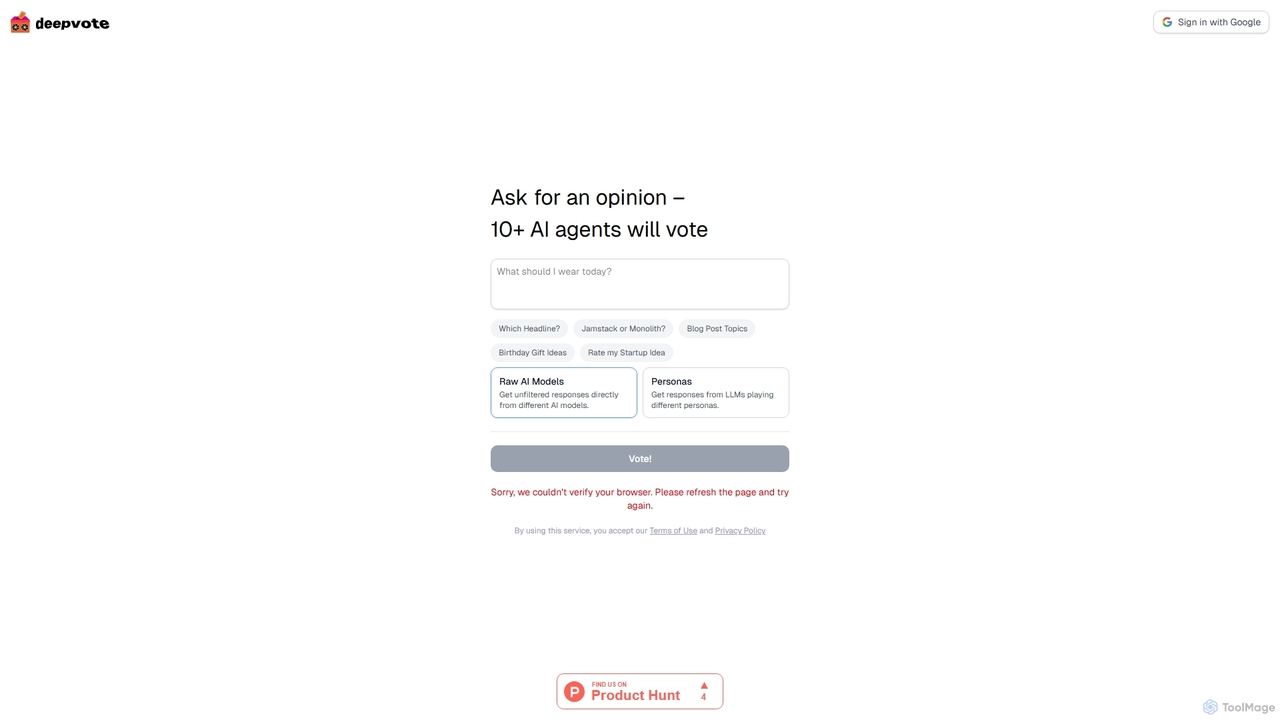
DeepVote
DeepVote is an innovative AI tool that gathers diverse opinions from over 10 AI agents on any given …
DeepVote is an innovative AI tool that gathers diverse opinions from over 10 AI agents on any given question or idea. It helps users make informed decisions, brainstorm ideas, and validate concepts by providing unfiltered, persona-based responses from multiple large language models.
About Ai Powered
AI Powered tools are a category of advanced solutions that leverage artificial intelligence to significantly enhance and automate decision-making processes. These tools utilize machine learning, natural language processing, and advanced data analytics to process vast amounts of information, identify complex patterns, and generate actionable insights. They empower individuals and organizations within the broader Decision Making domain to make faster, more accurate, and data-driven choices, moving beyond traditional rule-based systems.
Core Features
- Predictive Modeling: Analyzes historical data to forecast future trends and potential outcomes with high accuracy.
- Automated Insight Generation: Processes complex datasets to uncover hidden correlations and actionable business intelligence.
- Recommendation Engines: Provides intelligent suggestions for optimal actions, strategies, or resource allocation.
- Risk Analysis & Mitigation: Identifies potential risks and vulnerabilities, offering data-backed strategies to minimize impact.
- Scenario Simulation: Models various "what-if" scenarios to evaluate potential consequences of different decisions.
Applicable Scenarios
AI-powered decision tools are invaluable across diverse sectors. In finance, they assist in algorithmic trading and fraud detection. For marketing, they optimize campaign spend and personalize customer experiences. Operations managers use them for supply chain optimization and predictive maintenance, ensuring efficient resource utilization and proactive problem-solving.
How to Choose
When selecting AI-powered decision tools, prioritize solutions with robust data integration capabilities to connect with your existing systems. Evaluate the transparency and explainability (XAI) of their AI models to understand decision logic. Consider scalability to handle growing data volumes and the flexibility for customization to align with specific business rules and evolving needs. Finally, assess the user interface for ease of use by non-technical stakeholders.
Ai PoweredUse Cases
Optimizing Supply Chain Logistics
Logistics managers utilize AI-powered tools to analyze historical shipping data, real-time traffic conditions, and weather patterns. The AI predicts demand fluctuations, optimizes delivery routes, and identifies potential bottlenecks before they occur. This leads to reduced transportation costs, improved delivery times, and enhanced overall operational efficiency by proactively adjusting logistics strategies.
Optimizing Marketing Spend Allocation
Marketing teams use AI-powered tools to analyze past campaign performance, customer demographics, and market trends. The AI recommends the most effective channels and budget distribution to maximize return on investment (ROI), ensuring every marketing dollar is spent strategically.
Personalized Marketing Campaign Strategy
Marketing teams deploy AI-powered platforms to segment customer bases, analyze purchasing behaviors, and predict future preferences. The AI generates personalized content recommendations, identifies optimal channels for engagement, and suggests the best timing for campaign launches. This results in higher conversion rates, increased customer satisfaction, and more efficient allocation of marketing budgets.
Predictive Maintenance for Industrial Equipment
Manufacturers deploy AI to monitor real-time sensor data from machinery. The AI identifies subtle anomalies and predicts potential equipment failures before they occur, allowing maintenance teams to schedule proactive repairs, reduce downtime, and extend asset lifespan.
Financial Risk Assessment and Fraud Detection
Financial institutions leverage AI-driven systems to process vast amounts of transaction data, identify unusual patterns, and assess creditworthiness with greater accuracy. The AI can detect fraudulent activities in real-time, predict loan default risks, and provide insights into market volatility. This significantly reduces financial losses and strengthens compliance with regulatory requirements.
Personalized Financial Portfolio Management
Financial advisors leverage AI to assess individual clients' risk tolerance, financial goals, and market conditions. The AI then generates personalized investment recommendations and portfolio adjustments, helping clients achieve their long-term financial objectives.
Strategic Business Forecasting
Business strategists and executives use AI-powered tools to synthesize market trends, economic indicators, competitor data, and internal performance metrics. The AI generates highly accurate revenue forecasts, identifies growth opportunities, and predicts potential market shifts. This enables proactive strategic planning, resource allocation, and competitive positioning for long-term success.
Enhanced Supply Chain Demand Forecasting
Retailers and logistics companies utilize AI to analyze historical sales data, seasonality, promotional impacts, and external factors like weather or economic indicators. This enables highly accurate demand predictions, optimizing inventory levels, reducing stockouts, and streamlining logistics.
Healthcare Diagnostic Support
Medical professionals employ AI-powered diagnostic tools to analyze patient data, medical images, and lab results. The AI assists in identifying subtle disease patterns, predicting patient outcomes, and recommending personalized treatment pathways. This enhances diagnostic accuracy, supports clinical decision-making, and ultimately improves patient care by providing data-driven insights.
Real-time Fraud Detection in Financial Transactions
Banks and payment processors employ AI to continuously monitor millions of transactions. The AI identifies unusual patterns, anomalies, or deviations from normal behavior in real-time, flagging suspicious activities instantly to prevent financial losses and protect customers.
Automated Customer Service Prioritization
Customer service centers integrate AI-powered systems to analyze incoming inquiries across various channels. The AI automatically categorizes tickets, assesses urgency based on sentiment and keywords, and routes them to the most appropriate agents or departments. This ensures critical issues are addressed promptly, reduces response times, and significantly improves overall customer satisfaction.
Strategic Workforce Planning & Talent Acquisition
HR departments use AI to analyze internal talent data, external labor market trends, and business growth projections. The AI provides insights into future staffing needs, identifies skill gaps, and recommends optimal recruitment strategies to build a resilient and capable workforce.