splash9
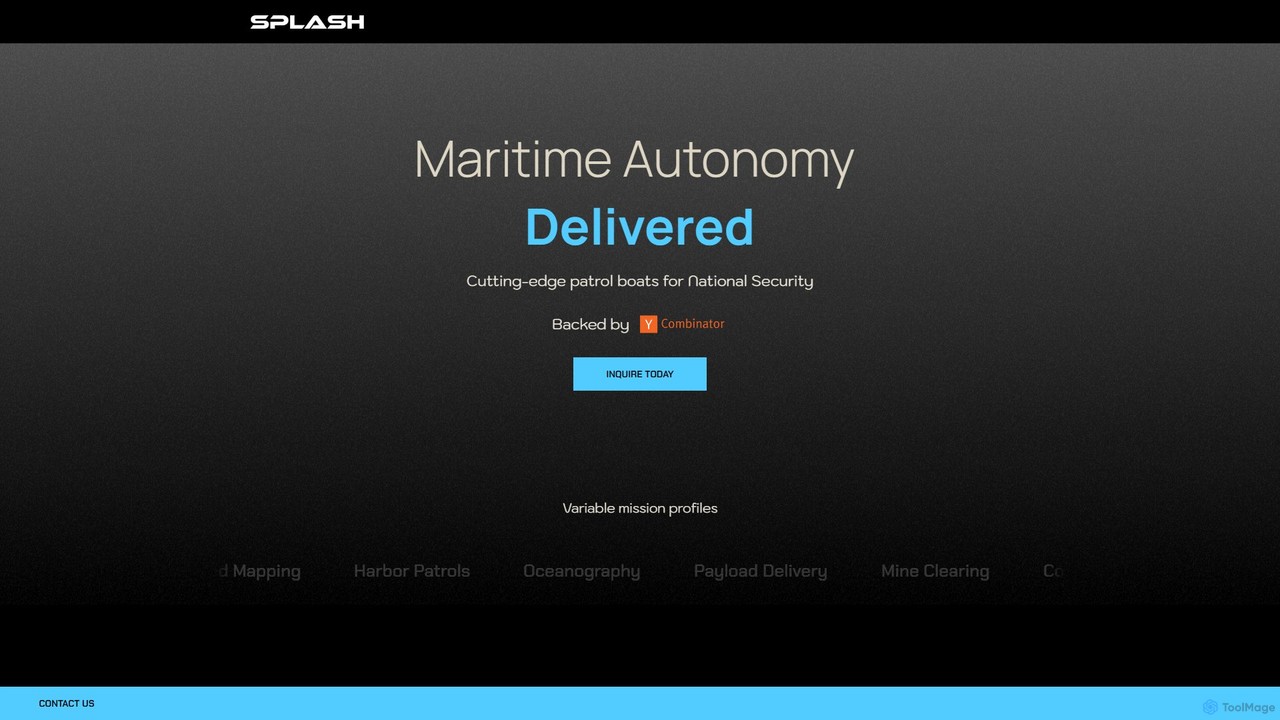
splash9 by Splash Industries provides cutting-edge autonomous surface vessels (ASVs) for national security, commercial, and research missions. These …
splash9 by Splash Industries provides cutting-edge autonomous surface vessels (ASVs) for national security, commercial, and research missions. These high-performance drone-boats offer complete autonomy, long-range capabilities, and multi-mission versatility for tasks like coastal patrol, infrastructure security, and seabed mapping.
About Maritime Security
AI Maritime Security tools are a specialized category of defense technology that use machine learning to analyze vast maritime data for threat detection and situational awareness. These systems process diverse inputs like satellite imagery, AIS signals, and sonar data to identify anomalies, track vessels, and predict potential risks in real-time. They provide critical intelligence to navies, coast guards, and port authorities, enhancing their ability to protect sea lanes, combat illegal activities, and secure national waters. The core value lies in automating the analysis of complex data streams that exceed human capacity.
Core Features
- Vessel Anomaly Detection: Automatically identifies unusual vessel behavior, such as unexpected course changes, 'dark' vessel activity (AIS off), or loitering in sensitive areas.
- Predictive Threat Assessment: Uses historical data and real-time intelligence to forecast high-risk zones for piracy, smuggling, or illegal fishing.
- Automated Image & Signal Analysis: Processes satellite (SAR/EO), drone, and RF signal data to classify vessels and detect objects of interest without manual review.
- Integrated Maritime Domain Awareness: Fuses data from multiple sources into a single, unified operational picture for comprehensive monitoring and decision-making.
- Port & Coastal Surveillance: Monitors vessel traffic and infrastructure in and around ports to detect unauthorized access, potential threats, and security breaches.
Use Cases
These tools are primarily used by government defense and security agencies, including navies and coast guards, for national security and law enforcement. They are also adopted by commercial entities such as shipping companies for route optimization and anti-piracy measures, port authorities for operational security, and environmental organizations for monitoring illegal fishing and pollution.
How to Choose
When selecting an AI Maritime Security tool, consider its data integration capabilities—ensure it supports your existing sensor types (e.g., AIS, SAR, sonar). Evaluate the system's real-time processing speed and scalability for your area of operation. Assess the accuracy and specificity of its AI models for the threats you face. Finally, consider its integration with existing command and control (C2) systems and the intuitiveness of its user interface for operators.

Maritime SecurityUse Cases
Combating Illegal, Unreported, and Unregulated (IUU) Fishing
An international environmental agency uses an AI maritime security platform to monitor a large marine protected area. The system continuously analyzes satellite radar (SAR) imagery and cross-references it with public AIS broadcast data. When the AI detects a vessel without a corresponding AIS signal—a 'dark vessel'—it flags the activity as suspicious. The platform then analyzes the vessel's track and behavior to assess if it matches known IUU fishing patterns. This automated surveillance allows the agency to efficiently direct limited patrol resources to intercept and investigate potential illegal fishing operations, protecting vulnerable ecosystems.
Predictive Piracy Risk Assessment for Commercial Shipping
A global logistics company's security operations center integrates an AI threat assessment tool to safeguard its fleet. The tool analyzes historical piracy data, current geopolitical events, weather patterns, and real-time vessel density in high-risk areas like the Gulf of Aden. It generates dynamic risk maps, providing captains with recommended route adjustments to avoid emerging threats. If a vessel must transit a high-risk zone, the AI provides specific threat intelligence, such as the likely type of attack (e.g., small skiffs) and the most probable times of day, allowing the crew to implement heightened, targeted security measures precisely when needed.
Automated Port Security and Anomaly Detection
A major port authority deploys an AI-powered surveillance system to enhance its security. The system integrates data from CCTV cameras, radar, and AIS feeds. AI algorithms continuously monitor for anomalies, such as a small, fast-moving boat entering a restricted channel, a vessel loitering near critical infrastructure like a fuel depot, or a ship deviating from its declared docking path. When an anomaly is detected, the system automatically alerts security personnel, providing live video feeds and vessel identification data. This allows for a rapid response, preventing potential security breaches, smuggling, or sabotage before they escalate.
Monitoring for Sanctions Evasion and Smuggling
A national customs and border protection agency uses an AI tool to detect vessels attempting to evade economic sanctions. The AI analyzes global shipping data for patterns indicative of illicit activities, such as 'flag hopping' (frequently changing a ship's country of registration), complex ownership structures, and ship-to-ship transfers in unusual locations. It can also identify vessels that turn off their AIS transponders near sanctioned ports. By flagging these high-risk vessels, the system enables investigators to focus their efforts, leading to more effective enforcement of international sanctions and disruption of smuggling networks.
Optimizing Naval Patrol Routes for Threat Interception
A navy's operational command uses a predictive analytics platform to optimize patrol routes for its fleet. The AI model ingests intelligence reports, historical threat data, environmental conditions, and commercial traffic patterns. It then generates probability maps highlighting areas where illicit activities are most likely to occur in the next 24-48 hours. Based on these predictions, the system recommends optimized patrol routes for frigates and aircraft that maximize coverage of high-risk zones while minimizing fuel consumption. This data-driven approach enhances the navy's deterrent presence and increases the probability of intercepting threats before they materialize.
Monitoring Subsea Infrastructure Security
An offshore energy company employs an AI system to protect its subsea pipelines and communication cables. The system analyzes acoustic data from hydrophones and sonar data from autonomous underwater vehicles (AUVs). The AI is trained to distinguish between normal marine life sounds and anomalous acoustic signatures, such as those from unauthorized AUVs, diver propulsion vehicles, or anchoring activities in restricted zones. When a potential threat is detected, the system alerts a remote operations center, providing the location and classification of the threat, enabling a swift security response to protect critical national infrastructure.