OpenMeter
OpenMeter is an open-source, real-time usage metering and billing platform designed for modern AI and DevOps companies. It …
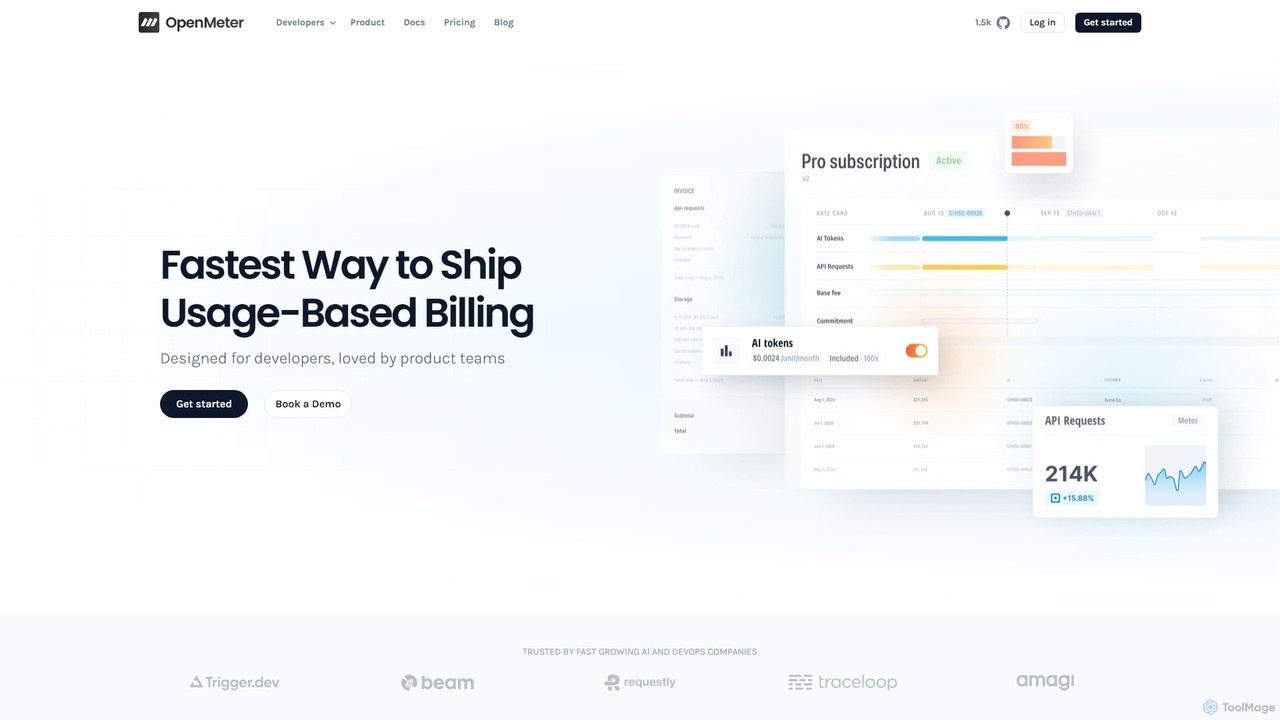
OpenMeter is an open-source, real-time usage metering and billing platform designed for modern AI and DevOps companies. It simplifies the implementation of usage-based pricing by turning events, logs, and metrics into actionable revenue streams, complete with customer-facing dashboards and billing automation.
About Billing & Metering
Billing & Metering tools are specialized platforms designed to track, manage, and automate charging for the consumption of AI and API-based services. These tools operate by metering granular usage events, such as API calls, token consumption, or compute time, and translating them into billable items. This enables businesses, particularly in the developer tools space, to implement complex, usage-based pricing models like pay-as-you-go without building the entire infrastructure from scratch. They provide the critical link between service consumption and revenue generation for modern AI applications.
Core Features
- Usage Metering: Accurately track granular consumption data like API calls, data processed, or active users in real-time.
- Flexible Pricing Models: Define and implement various billing logic, including pay-per-use, tiered subscriptions, and prepaid credits.
- Automated Invoicing: Automatically generate and deliver detailed invoices to customers based on their metered usage.
- Customer Portal & Analytics: Provide dashboards for end-users to monitor their consumption and for businesses to analyze revenue trends.
Use Cases
These tools are essential for SaaS companies offering AI-powered APIs, platforms with generative AI features that incur variable costs, and enterprises that need to allocate internal resource costs. For example, an AI writing assistant can use it to bill per word generated, while a cloud platform can use it to charge for GPU usage.
How to Choose
When selecting a Billing & Metering tool, consider its integration capabilities (APIs and SDKs), the flexibility of its pricing model engine, its ability to scale with high-volume events, and its reporting and analytics features. Also, evaluate its support for payment gateways and compliance with financial regulations.

Billing & MeteringUse Cases
Monetizing a Usage-Based AI API
A developer startup has built a powerful image analysis API. To commercialize it, they integrate a Billing & Metering tool. The tool's SDK is used to send an event for each API call, capturing metadata like the features used and image size. They configure a pricing plan that charges a different rate per call based on the analysis complexity. The platform automatically aggregates usage for each customer, calculates their monthly bill, and processes the payment via a connected Stripe account, allowing the startup to focus on their API technology instead of billing logic.
Implementing Pay-As-You-Go for a SaaS Feature
A project management SaaS platform introduces an "AI Summary" feature that uses a large language model to summarize long discussion threads. Since the cost of this feature is variable, they use a metering service to track token consumption for each summary generated by a user. This usage data is then added as a line item to the customer's regular monthly subscription invoice. This allows the company to offer a powerful new feature without financial risk, ensuring that costs are covered directly by the users who benefit from it.
Internal Cost Allocation for Enterprise AI Platforms
A large corporation develops an internal machine learning platform for its data science, marketing, and finance teams. To promote responsible usage and manage budgets, they implement a metering tool. It tracks resource consumption, such as GPU hours and model training jobs, for each department. At the end of each quarter, the platform generates detailed reports showing the "cost" incurred by each team. This data is used for internal chargebacks, helping department heads understand their AI spending and optimize their resource utilization.
Managing API Quotas and Freemium Tiers
A company offering a weather data API wants to provide a free tier to attract developers, but needs to prevent abuse. They use a Billing & Metering tool to enforce usage limits. New users are automatically placed on a free plan with a quota of 10,000 API calls per month. The tool monitors each user's consumption in real-time. When a user approaches their limit, the system can automatically send them an email notification, and if they exceed the quota, their API access is temporarily rate-limited until they upgrade to a paid plan.
Offering Tiered and Overage Pricing for an AI Tool
An AI-powered video transcription service offers several subscription tiers: a "Starter" plan with 60 minutes of transcription per month and a "Pro" plan with 600 minutes. A metering platform tracks the total minutes transcribed for each user. If a "Starter" user transcribes more than 60 minutes, the system automatically charges them a per-minute overage fee for the extra usage. This hybrid model provides predictable recurring revenue from subscriptions while capturing additional revenue from high-volume users.
Billing for AI Compute Resources in a Platform
A cloud development platform allows users to deploy and run custom AI models. Billing is complex, as it depends on CPU/GPU time, memory allocation, and data storage. They integrate a specialized metering tool that can capture these multiple dimensions of resource usage. The platform allows them to create sophisticated pricing rules that combine these metrics into a single, understandable cost for the end-user. This provides transparency and ensures the platform's infrastructure costs are accurately passed on to customers.