Developer Tools Best in category 2 results Code Auditing AI Tool

Popular AI tools in the Code Auditing field of Developer Tools include Code Genie、Kritisi, etc., helping you quickly improve efficiency.

Code Genie

Code Genie

Code Genie is an AI-powered, one-click auditing tool for Ethereum-based smart contracts. It leverages Large Language Models (LLMs) …

2.1K
Free
Kritisi

Kritisi

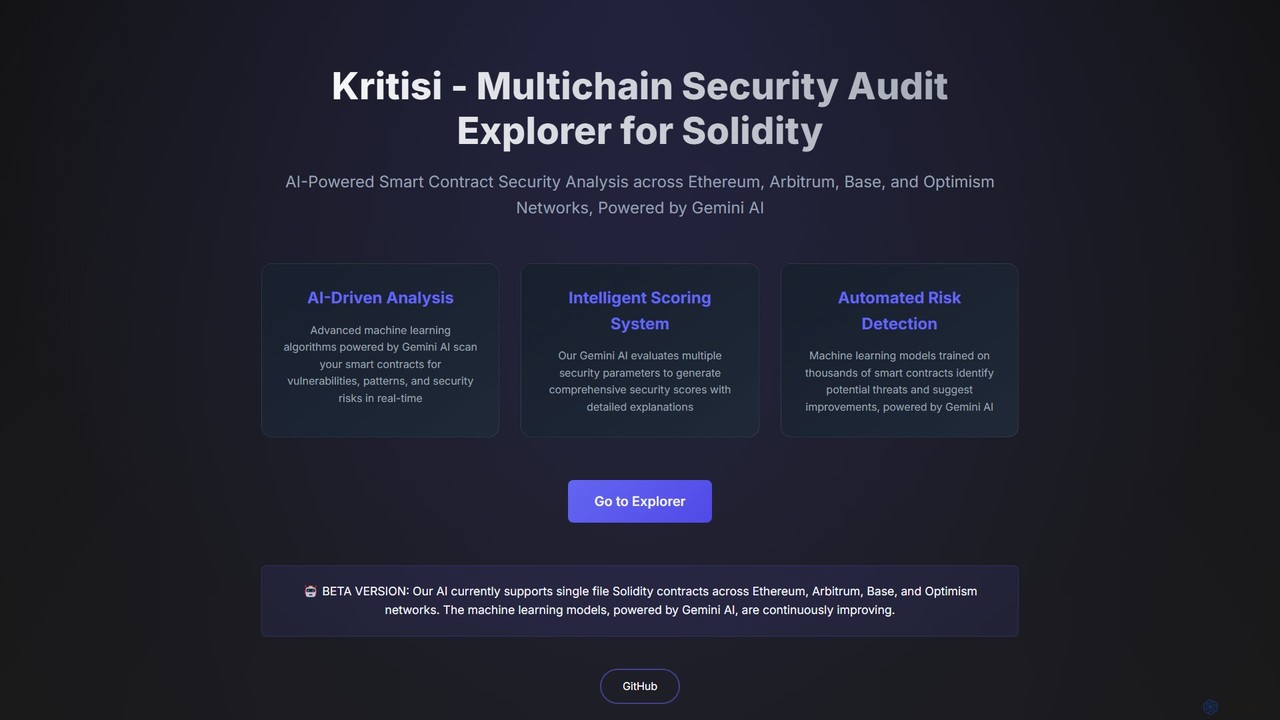
Kritisi is an AI-powered security audit explorer for Solidity smart contracts. Powered by Google's Gemini AI, it scans …

2.1K

About Code Auditing

AI Code Auditing tools are specialized applications that automatically analyze source code to identify security vulnerabilities, bugs, and quality issues. These tools leverage machine learning models and advanced static analysis (SAST) to detect complex flaws that traditional linters might miss. Their primary value lies in enabling development teams to proactively secure software, ensure compliance with standards like OWASP, and improve code maintainability throughout the development lifecycle. By integrating into CI/CD pipelines, they provide continuous security feedback, making security a shared responsibility.

Core Features

  • Vulnerability Detection: Identifies common security risks such as SQL injection, cross-site scripting (XSS), and insecure configurations.
  • Code Quality Analysis: Assesses code for complexity, duplication, and adherence to established coding best practices and style guides.
  • Automated Fix Suggestions: Provides context-aware recommendations or generates code patches to resolve identified issues efficiently.
  • Dependency Scanning: Analyzes third-party libraries and open-source components for known vulnerabilities (Software Composition Analysis - SCA).
  • Compliance Verification: Checks code against industry security standards and regulations, including OWASP Top 10, CWE, and CERT.

Use Cases

AI Code Auditing tools are essential for software development teams, DevOps engineers, and cybersecurity professionals. They are widely used in technology companies, financial institutions, and healthcare organizations to secure proprietary applications. A key application is their integration into CI/CD pipelines to automate security checks on every code commit, preventing vulnerabilities from reaching production environments.

How to Choose

When selecting an AI Code Auditing tool, consider the following: First, verify its support for your project's programming languages and frameworks. Second, evaluate its integration capabilities with your existing development ecosystem, such as GitHub, GitLab, or Jenkins. Third, assess the tool's accuracy and the rate of false positives to avoid alert fatigue for your team. Finally, consider the depth of analysis provided, whether it's static analysis (SAST), dynamic analysis (DAST), or a combination.


Code AuditingUse Cases

1

Automating Security Reviews in CI/CD Pipelines

A DevOps engineer integrates an AI code auditing tool into their GitHub Actions workflow. The tool is configured to automatically scan every pull request submitted to the main branch. When a developer pushes new code containing a potential SQL injection vulnerability, the CI/CD job fails, blocking the merge. The tool provides immediate, actionable feedback directly in the pull request, explaining the vulnerability and suggesting a corrected code snippet. This prevents insecure code from ever reaching production and reduces the manual workload for senior security reviewers.

2

Securing Legacy Codebases

A software architect is tasked with modernizing a large, decade-old monolithic application. The original developers are no longer with the company, and the security posture is unknown. They use an AI code auditing tool to perform a deep scan of the entire codebase. The tool generates a comprehensive report, prioritizing hundreds of vulnerabilities by severity. This allows the team to create a strategic remediation plan, tackling critical issues like outdated cryptographic libraries and hardcoded secrets first, thereby systematically reducing the application's attack surface and technical debt.

3

Preparing for Third-Party Security Audits

A compliance manager at a FinTech company needs to prepare for an upcoming SOC 2 audit. To ensure a smooth process, they run the company's primary application code through an AI auditing tool. The tool is configured with rulesets specific to financial industry regulations. It flags several areas of non-compliance, such as inadequate logging and potential data exposure risks. The development team addresses these findings before the official auditors arrive, significantly increasing the chances of passing the audit on the first attempt and demonstrating a proactive approach to security and compliance.

4

Enforcing Coding Standards Across Teams

An engineering manager wants to ensure consistent code quality across a distributed team of 50 developers. They configure their AI code auditing tool with a custom ruleset that enforces the company's specific style guide, naming conventions, and architectural patterns. The tool is integrated directly into the developers' IDEs (like VS Code). As developers write code, the tool provides real-time feedback, highlighting deviations from the standards. This automated enforcement helps maintain a uniform codebase, making it easier to read, debug, and onboard new team members, without requiring constant manual oversight from tech leads.

5

Open Source Dependency Vulnerability Management

A security analyst is responsible for managing supply chain risk. They use an AI code auditing tool that includes Software Composition Analysis (SCA) capabilities. The tool scans the project's dependency files (e.g., `package-lock.json`, `pom.xml`) and identifies a third-party library with a critical remote code execution (RCE) vulnerability. The tool not only alerts the team but also provides context, linking to the official CVE entry and suggesting the minimum safe version to upgrade to. This allows the team to quickly patch the vulnerability before it can be exploited, securing the application from inherited risks.

6

Accelerating Developer Onboarding and Training

A junior developer joins a team and is unfamiliar with the company's secure coding practices. An AI code auditing tool is integrated into their IDE. As they write their first feature, the tool provides real-time, inline suggestions. For instance, when they write a database query using string concatenation, the tool flags it as a potential SQL injection risk and suggests using a parameterized query instead, providing a code example. This acts as a continuous, context-aware mentor, helping the new hire learn and adopt secure coding habits organically, reducing the training burden on senior developers.

Code AuditingFrequently Asked Questions