Sourcegraph
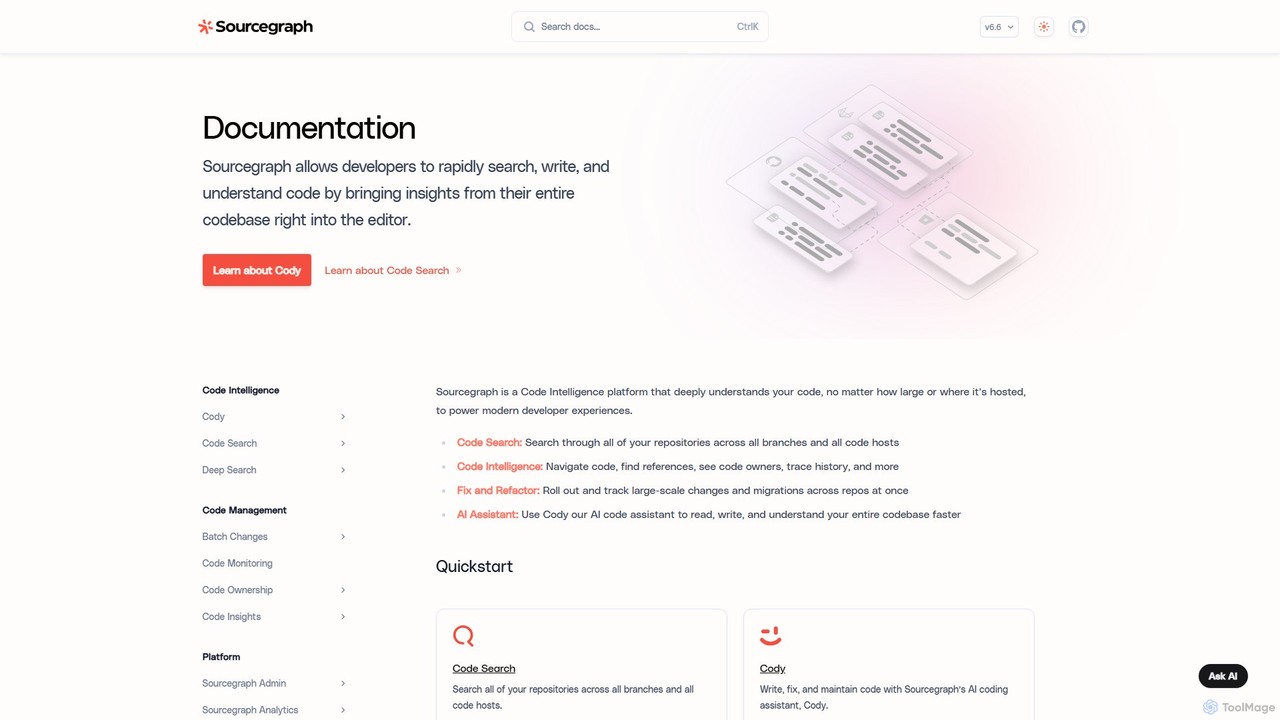
Sourcegraph is a code intelligence platform that creates a universal map of your entire codebase. It features Cody, …
Sourcegraph is a code intelligence platform that creates a universal map of your entire codebase. It features Cody, an AI coding assistant, to help developers search, write, understand, and refactor code across any repository, code host, or language, significantly boosting developer productivity.
About Code Refactoring
Code Refactoring tools are AI-powered solutions designed to restructure existing source code without changing its external behavior. These tools leverage advanced algorithms to analyze code, identify areas for improvement, and suggest or automatically apply changes that enhance readability, maintainability, and efficiency. They empower developers to clean up technical debt, simplify complex logic, and prepare codebases for future development, ultimately leading to more robust and scalable software.
Core Features
- Automated Code Analysis: Identifies code smells, redundancies, and potential performance bottlenecks.
- Refactoring Suggestions: Proposes specific refactoring patterns like extract method, rename variable, or introduce parameter object.
- Semantic Understanding: Comprehends the code's intent and context to ensure refactoring preserves functionality.
- Multi-language Support: Offers refactoring capabilities across various programming languages and frameworks.
- Integration with IDEs & CI/CD: Seamlessly integrates into development environments and automated pipelines for continuous improvement.
Use Cases
Software development teams utilize these tools to maintain high code quality over time. They are crucial for improving legacy systems, preparing code for new feature implementations, and ensuring consistency across large projects. Developers can quickly identify and resolve issues that might otherwise lead to bugs or hinder future development efforts.
How to Choose
When selecting a Code Refactoring tool, consider its language support, the depth of its analysis capabilities, and its integration options with your existing development workflow (IDEs, version control, CI/CD). Evaluate the accuracy of its suggestions, the level of automation it provides, and its ability to handle complex codebases without introducing regressions. Scalability and community support are also important factors.

Code RefactoringUse Cases
Improving Legacy Code Readability
A senior developer working on a decades-old enterprise application uses AI-powered refactoring tools to untangle spaghetti code. The tool analyzes complex functions, suggests extracting smaller, more manageable methods, and renames ambiguous variables, transforming an unmaintainable codebase into a modular, understandable structure. This significantly reduces the time new team members need to onboard and understand the system.
Optimizing Performance Hotspots
A backend engineer identifies a performance bottleneck in a critical service. The refactoring tool helps by suggesting more efficient data structures, simplifying complex loops, or identifying redundant computations. By applying these AI-driven refactorings, the engineer can achieve a 15-20% improvement in response times without altering the service's external API, directly impacting user experience.
Preparing for New Feature Development
Before adding a major new feature, a development team uses code refactoring to clean up the relevant modules. The tool helps standardize naming conventions, consolidate duplicate code, and break down large classes into smaller, more focused components. This ensures the new feature can be integrated smoothly into a clean, well-structured codebase, reducing future technical debt.
Enforcing Coding Standards Across Teams
A large organization with multiple development teams struggles to maintain consistent coding standards. An AI refactoring tool is integrated into their CI/CD pipeline, automatically identifying and suggesting fixes for deviations from established style guides and architectural patterns. This ensures all submitted code adheres to company standards, improving collaboration and code quality.
Facilitating Codebase Migrations
When migrating a large application from one framework or language version to another, developers face extensive code changes. Refactoring tools can assist by identifying patterns that need updating, suggesting equivalent constructs in the new environment, or even automating some of the transformation. This drastically reduces manual effort and the risk of errors during complex migrations.
Reducing Technical Debt Proactively
A DevOps team integrates an AI refactoring tool into their daily workflow to continuously monitor and improve code health. The tool provides regular reports on code complexity and technical debt, suggesting small, incremental refactorings that can be applied during routine maintenance. This proactive approach prevents technical debt from accumulating, keeping the codebase agile and easy to evolve.