Airbyte
Airbyte is an open-source data integration platform that simplifies building and managing data pipelines. It enables you to …
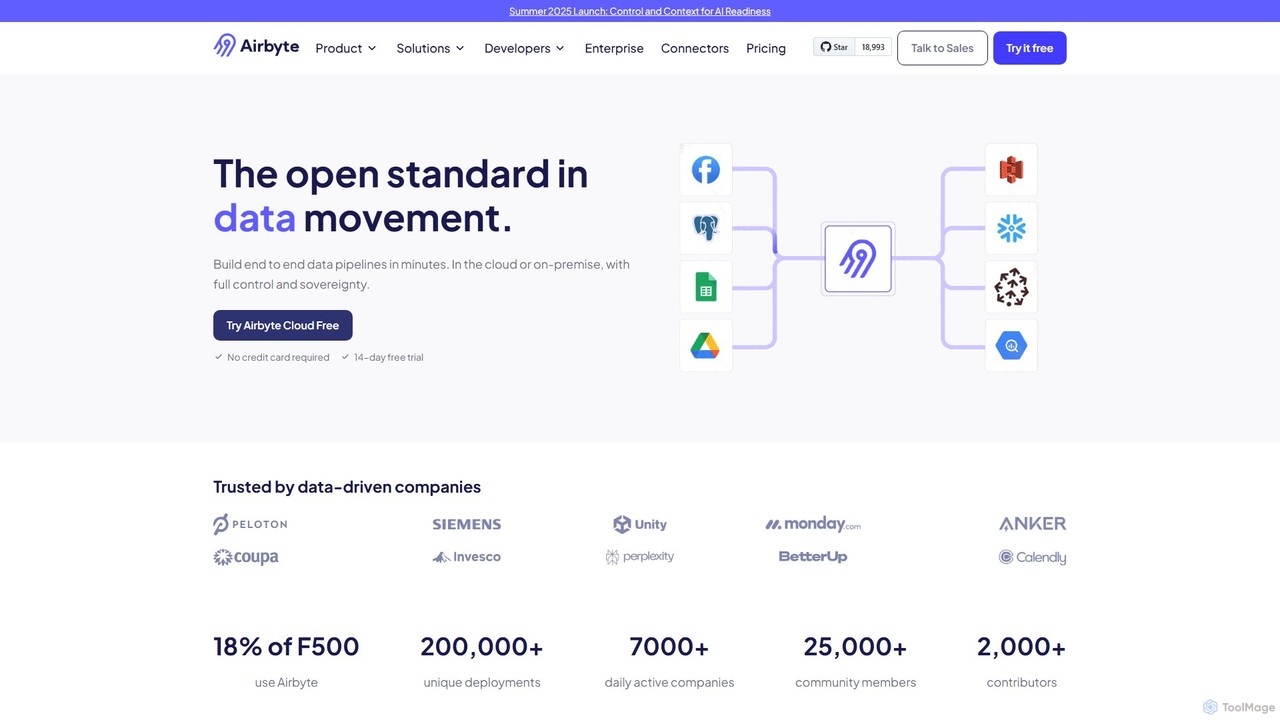
Airbyte is an open-source data integration platform that simplifies building and managing data pipelines. It enables you to move data from hundreds of sources to destinations like data warehouses, lakes, and vector databases in minutes, using a vast catalog of pre-built connectors or by creating your own with a low-code builder. It supports both cloud and self-hosted deployments, focusing on data security, governance, and scalability for modern data and AI applications.
Lume AI
Lume AI is an AI-powered platform designed to automate and accelerate customer data implementation. It intelligently maps, analyzes, …
Lume AI is an AI-powered platform designed to automate and accelerate customer data implementation. It intelligently maps, analyzes, and ingests customer data, eliminating engineering bottlenecks and reducing onboarding time from weeks to days. By offering both a no-code interface and a flexible API, Lume AI helps businesses streamline data integration, normalize data from various sources, and manage complex data pipelines, allowing teams to focus on their core product value.
About Data Integration
Data Integration tools are platforms designed to consolidate data from various disparate sources into a single, unified view. They automate the process of extracting, transforming, and loading (ETL) or extracting, loading, and transforming (ELT) data to create reliable data pipelines. This enables organizations to perform comprehensive analysis, generate business intelligence insights, and power data-driven applications. As a key part of the developer toolkit, these platforms ensure data consistency and accessibility across an enterprise.
Core Features
- Extensive Connector Library: Provides pre-built connectors to a wide range of databases, SaaS applications, APIs, and file storage systems.
- Data Transformation Engine: Offers capabilities to clean, map, enrich, and restructure data using either a graphical interface or code (SQL, Python).
- Workflow Automation & Scheduling: Allows users to design, schedule, and orchestrate complex data pipelines to run automatically at specified intervals.
- Monitoring and Alerting: Delivers dashboards and notifications to track pipeline health, data quality, and performance issues in real-time.
- Scalability and Performance: Engineered to handle large volumes of data and scale resources efficiently based on workload demands.
Applicable Scenarios
These tools are essential for data engineers, data analysts, and IT teams. Common applications include building and maintaining data warehouses for business intelligence, synchronizing customer data between CRM and marketing platforms, migrating legacy systems to the cloud, and feeding clean, prepared data to machine learning models.
Selection Criteria
When choosing a Data Integration tool, consider the breadth of its connector ecosystem, the complexity of its transformation capabilities (GUI vs. code), its data processing paradigm (batch vs. real-time streaming), its pricing model (volume-based vs. connector-based), and its security and compliance certifications (e.g., GDPR, HIPAA).
Data IntegrationUse Cases
Building a Centralized Data Warehouse for BI
A business intelligence team needs to combine sales data from Salesforce, marketing data from Google Analytics, and support tickets from Zendesk. They use a data integration tool to create automated pipelines that extract data from each source, standardize formats (e.g., date fields, currency), and load it into a central warehouse like Amazon Redshift. This allows them to build unified dashboards in a tool like Tableau to track the entire customer journey and measure marketing ROI accurately.
Synchronizing Customer Data Across Applications
A marketing operations manager needs to ensure customer information is consistent between their CRM (e.g., HubSpot) and email marketing platform (e.g., Mailchimp). They set up a two-way sync using a data integration tool. When a new lead is added in HubSpot, it's automatically created in Mailchimp. If a user unsubscribes in Mailchimp, their status is updated in HubSpot, ensuring compliance and preventing communication errors.
Migrating On-Premise Data to the Cloud
An IT team is tasked with migrating a legacy on-premise SQL Server database to a cloud-based solution like Snowflake. They use a data integration platform to manage the complex migration. The tool helps map the old schema to the new one, handles data type conversions, and efficiently transfers terabytes of historical data in batches. This minimizes downtime and ensures data integrity throughout the migration process, validating data counts and formats post-transfer.
Powering a Customer 360-Degree View
A data science team aims to create a comprehensive profile for each customer. They use a data integration tool to pull data from various touchpoints: website clicks from a tracking script, purchase history from an e-commerce platform, and interaction data from a mobile app. The tool consolidates this information into a single, clean dataset, which is then used to train personalization algorithms, improve customer segmentation, and calculate customer lifetime value (CLV).
Automating Financial Reporting and Consolidation
A finance department in a multinational corporation needs to consolidate financial data from subsidiaries using different accounting systems (e.g., SAP, Oracle NetSuite). An integration tool automates the extraction of trial balances and transaction data, handles currency conversions, and maps different charts of accounts to a unified corporate standard. This drastically reduces the manual effort required for month-end closing and ensures accurate, timely reporting for regulatory compliance.
Preparing Datasets for Machine Learning Models
A machine learning engineer is building a churn prediction model. They require clean, feature-rich data from multiple sources. They use a data integration tool to extract raw user activity logs, join them with subscription data from Stripe, and perform transformations like calculating session durations and purchase frequency. The tool automates this feature engineering pipeline, ensuring the model is always trained on fresh, consistent, and well-structured data, improving model accuracy and reliability.