Lightchain
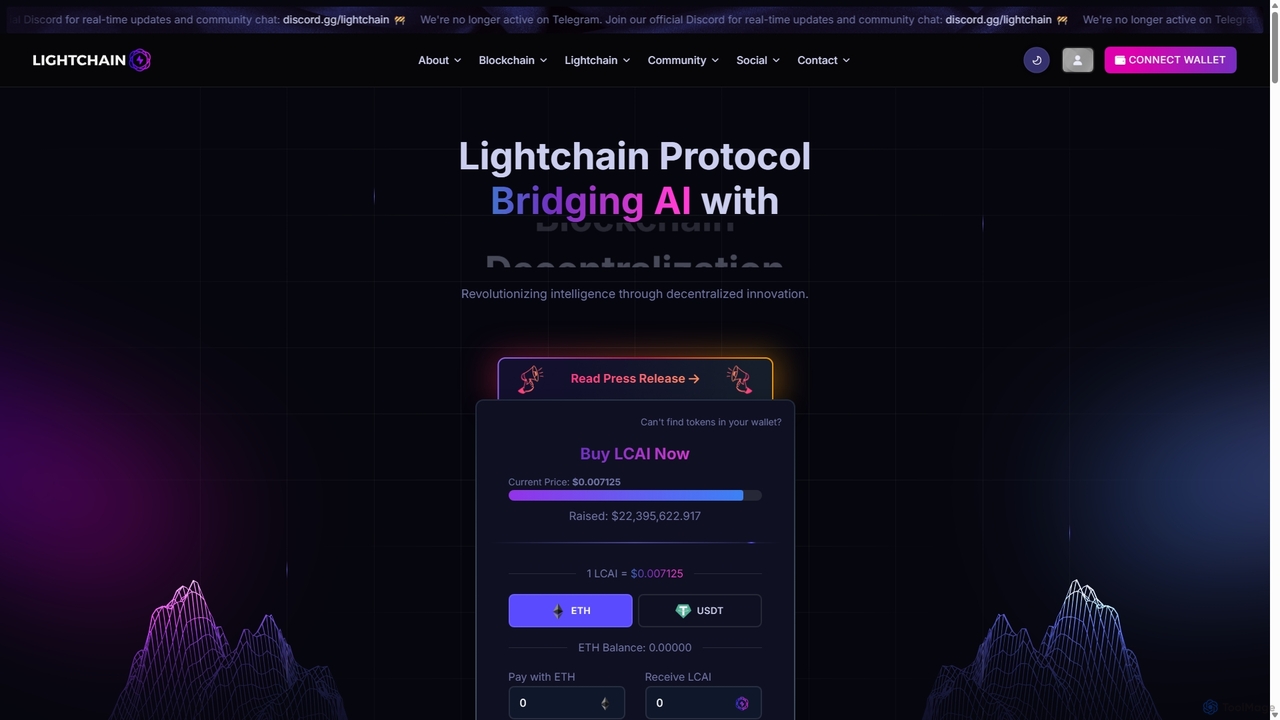
Lightchain is a revolutionary Layer 1 blockchain protocol that integrates Artificial Intelligence at its core. It features a …
Lightchain is a revolutionary Layer 1 blockchain protocol that integrates Artificial Intelligence at its core. It features a novel Proof of Intelligence (PoI) consensus mechanism and an AI Virtual Machine (AIVM), designed to power intelligent decentralized applications (dApps) and transform computational work into valuable AI development.
Cortex Labs
Cortex Labs is a decentralized, open-source public blockchain designed to run AI models and AI-powered dApps directly on-chain. …
Cortex Labs is a decentralized, open-source public blockchain designed to run AI models and AI-powered dApps directly on-chain. It features the Cortex Virtual Machine (CVM) for efficient AI inference and a ZkRollup Layer 2 solution, ZkMatrix, for scalability. It aims to democratize AI by creating an ecosystem where developers can build, share, and monetize AI models within smart contracts.
About Decentralized Applications
Decentralized Applications (DApp) tools are a specialized suite of software for building, testing, and deploying applications on blockchain networks. As a key part of the Developer Tools ecosystem, they provide frameworks and libraries that interact with smart contracts and peer-to-peer protocols, eliminating the need for central servers. They enable developers to create transparent, censorship-resistant, and user-controlled services. The core advantage lies in building systems with inherent trust and security, powered by cryptographic verification.
Core Features
- Smart Contract Development: Provides IDEs, compilers, and debuggers for languages like Solidity or Rust to write on-chain logic.
- Blockchain Interaction Libraries: Offers toolkits like Ethers.js or Web3.js to connect user interfaces with blockchain data and functions.
- Local Test Environments: Enables simulation of a blockchain network locally for rapid testing and debugging without real costs.
- Wallet Integration SDKs: Simplifies the process of connecting DApps to user crypto wallets for authentication and transactions.
- Deployment & Management: Automates the process of deploying smart contracts to various networks and managing their versions.
Use Cases
These tools are essential for developers in the Web3 space. They are used to build Decentralized Finance (DeFi) protocols, create and manage NFT marketplaces, establish Decentralized Autonomous Organizations (DAOs), and develop blockchain-based games (GameFi). Any project requiring on-chain logic and user asset control relies on these tools.
How to Choose
When selecting a DApp tool, consider its compatibility with your target blockchain (e.g., EVM-compatible, Solana). Evaluate the supported programming languages (Solidity, Rust, etc.) and the quality of its documentation and community support. For production-level projects, assess the robustness of its testing framework and integration with security auditing tools.
Decentralized ApplicationsUse Cases
Building a Decentralized Finance (DeFi) Protocol
A team of blockchain developers uses a development framework like Hardhat to write, test, and deploy smart contracts for a lending and borrowing platform. They utilize testing libraries to simulate thousands of transactions, ensuring robustness. An interaction library like Ethers.js is used to build a web interface, allowing them to securely manage user deposits and loans on-chain without a central intermediary, creating a trustless financial service.
Launching a Non-Fungible Token (NFT) Marketplace
A startup aims to create a platform for trading digital art. They use tools to generate and deploy an ERC-721 smart contract. The front-end is built using libraries that connect to user wallets like MetaMask, allowing for seamless minting, buying, and selling of NFTs. This ensures verifiable ownership and provenance for each digital asset directly on the blockchain, empowering creators and collectors in a decentralized ecosystem.
Establishing a Decentralized Autonomous Organization (DAO)
A community wants to govern a project collectively. They utilize DAO frameworks that provide templates for governance contracts. These tools help set up on-chain voting mechanisms, proposal submission systems, and treasury management rules. Members can then use their governance tokens to vote on decisions, with outcomes executed automatically by the smart contract, ensuring transparent and democratic control over the organization's future.
Developing a Play-to-Earn (P2E) Blockchain Game
Game developers integrate blockchain elements into their game using specialized SDKs. These tools connect the game engine (like Unity) to a blockchain, enabling them to represent in-game items like swords or armor as NFTs. The in-game currency can also be a cryptographic token. This creates a player-owned economy where users can truly own, trade, and sell their digital assets, enhancing player engagement and creating new revenue models.
Auditing Smart Contract Security with AI Tools
Before deploying a high-value DeFi protocol, a security auditor uses AI-powered static analysis tools. These tools automatically scan Solidity code for common vulnerabilities like reentrancy attacks, integer overflows, and access control issues. The AI provides a detailed report highlighting potential risks and suggesting code fixes. This proactive security measure is critical for protecting user funds and maintaining the integrity of the decentralized application.
Creating a Censorship-Resistant Social Platform
A developer builds a social media platform that cannot be controlled by a single entity. They use tools to integrate with decentralized storage solutions like IPFS for hosting content. User identity is managed through blockchain addresses via wallet connections, giving creators full control and ownership over their content. This architecture ensures that posts and user data cannot be arbitrarily removed by a central authority, fostering free speech.