AIM: AI Instant Messenger
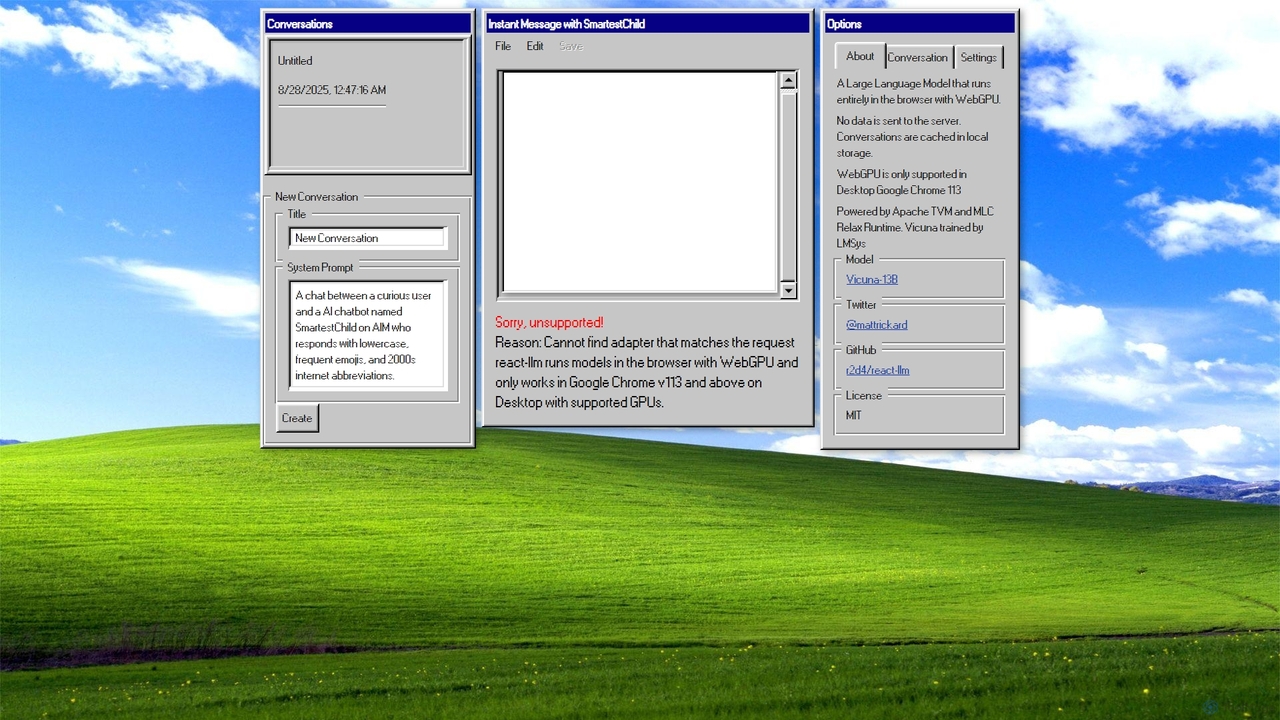
A privacy-focused AI chatbot that runs a large language model (Vicuna-13B) entirely in your browser using WebGPU. No …
A privacy-focused AI chatbot that runs a large language model (Vicuna-13B) entirely in your browser using WebGPU. No data is sent to a server, ensuring complete confidentiality of your conversations.
About Demos & Experiments
AI Demos & Experiments are interactive platforms designed to showcase the capabilities of specific artificial intelligence models or algorithms. As a specialized category within Developer Tools, they provide a direct, hands-on way to test and understand cutting-edge AI technologies without requiring complex setup or coding. These tools serve as proofs-of-concept, research previews, or educational resources, allowing users to explore everything from new language models to experimental image generation techniques. Their primary value lies in making advanced AI accessible for rapid evaluation, inspiration, and feasibility testing.
Core Features
- Interactive Interface: Allows users to provide inputs like text or images and receive real-time AI-generated outputs.
- Model-Specific Focus: Each demo typically highlights a single AI model or research paper, demonstrating its unique strengths and limitations.
- Simplified User Experience: Removes technical barriers, enabling both developers and non-technical users to engage with the technology directly.
- Resource Limitations: Often includes usage caps or rate limits to manage computational costs for public access and experimentation.
Use Cases
These tools are frequently used by AI researchers to validate model behavior, product managers to assess the potential of new AI features, and content creators to find inspiration from novel generative outputs. Educators also leverage them to provide students with tangible examples of complex AI concepts in action, making abstract theories more understandable.
How to Choose
When selecting a tool, first clarify your objective: are you evaluating a specific model, exploring a general capability, or seeking creative ideas? Investigate the underlying technology or research paper it's based on. Finally, review any provided documentation on the model's limitations, training data, and intended use cases to ensure your evaluation is well-informed and contextualized.
Demos & ExperimentsUse Cases
Evaluating a New Language Model's Capabilities
An AI researcher needs to assess the performance of a newly released large language model (LLM). Instead of setting up a complex local environment, they use an official web demo. They test its capabilities by providing various prompts, including complex reasoning questions, creative writing tasks, and code generation requests. The demo's interactive interface allows for rapid iteration, helping the researcher quickly identify the model's strengths in logical consistency and its weaknesses in handling nuanced or ambiguous queries, providing valuable insights for their research paper.
Exploring AI for Product Feature Ideation
A product manager at a tech company is exploring the possibility of adding an AI-powered image editing feature to their application. They use several experimental image generation demos to understand the current state of the art. By uploading sample images and testing various editing commands like 'remove object' or 'change background style', they can quickly gauge the technology's maturity and potential user experience issues. This hands-on experimentation helps them create a more informed feature proposal and communicate the technology's potential to stakeholders without needing a dedicated engineering prototype.
Using Experimental AI for Artistic Inspiration
A digital artist is experiencing a creative block and is looking for new visual styles. They turn to an experimental AI art demo that combines different artistic movements. By inputting a simple prompt like 'a forest in the style of cubism and impressionism,' the artist receives several unique, unexpected visual interpretations. While not final pieces, these generated images serve as powerful mood boards and starting points, sparking new ideas for composition, color palettes, and textures that they can incorporate into their original work, breaking through their creative slump.
Educational Demonstration of AI Concepts
A university professor teaching an 'Introduction to AI' course wants to illustrate the concept of neural style transfer. Instead of only showing slides, they use a live web demo in the classroom. Students are invited to upload their own photos and choose famous art styles. Seeing their own images instantly transformed helps solidify their understanding of how the algorithm works in a tangible and memorable way. This interactive experiment makes a complex topic more accessible and engaging for beginners compared to purely theoretical explanations.
Rapid Feasibility Testing for a Startup Idea
An entrepreneur has an idea for an app that summarizes legal documents. Before hiring a team of engineers, they use several AI text summarization demos to test the core concept. They upload various types of legal contracts and articles to see how accurately different models can extract key clauses and obligations. This low-cost experiment allows them to quickly validate whether current AI technology is powerful enough for their specific use case. The results help them decide whether to proceed with the business idea, pivot, or wait for the technology to mature further.
Gathering Community Feedback on a Research Model
A research lab develops a novel AI model for detecting bias in text. To gather diverse feedback before publishing their paper, they release a public demo. Journalists, ethicists, and the general public can input text snippets to see what the model flags as biased. This process uncovers edge cases and cultural nuances the researchers hadn't considered, such as sarcasm or specific dialects. The feedback collected through the demo is invaluable for improving the model's robustness and for discussing its limitations transparently in their final research publication.