Flowfast
Flowfast is an AI-powered development platform that automates the entire full-stack application workflow. Describe your app in plain …
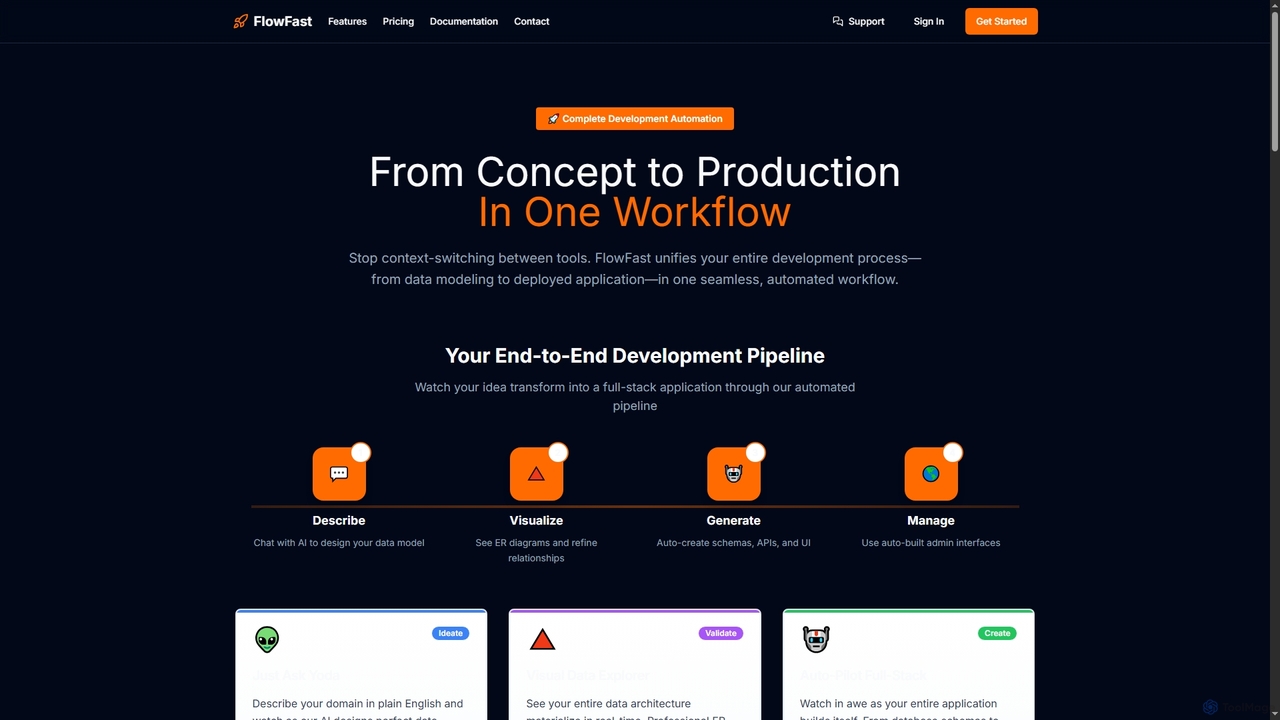
Flowfast is an AI-powered development platform that automates the entire full-stack application workflow. Describe your app in plain English via its CLI, and Flowfast generates data models, visual ER diagrams, ORM schemas, tRPC APIs, and Next.js admin panels, enabling developers to ship production-ready apps up to 10x faster.
About Full Stack
Full Stack AI tools are integrated platforms designed to streamline the entire lifecycle of AI application development, from data ingestion and model training to deployment, monitoring, and user interface integration. These comprehensive solutions provide a unified environment, enabling developers and teams to build, deploy, and manage AI-powered applications more efficiently without needing to stitch together disparate tools. They significantly reduce the complexity and time involved in bringing AI innovations to market.
Core Features
- End-to-End Development Environment: A unified workspace for data scientists and developers to manage all stages of AI project development.
- Data Management & Feature Engineering: Tools for efficient data collection, cleaning, transformation, and creation of relevant features for models.
- Model Training & Experimentation: Support for various machine learning frameworks, hyperparameter optimization, and tracking of model experiments.
- Seamless Deployment & MLOps: Capabilities for deploying trained models as scalable APIs, managing inference, and automating operational tasks like monitoring and retraining.
- Frontend Integration & UI Components: Often includes pre-built components or APIs to easily integrate AI outputs into web or mobile applications.
Applicable Scenarios
Full Stack AI tools are ideal for organizations aiming to rapidly develop and deploy AI-driven products or internal solutions. They are particularly valuable for startups building AI-first applications, enterprises looking to standardize their AI development processes, and teams seeking to reduce the overhead of managing complex AI infrastructure across different stages of development.
How to Choose
When selecting a Full Stack AI tool, consider its breadth of coverage from data to deployment, compatibility with your preferred machine learning frameworks, and scalability to meet future demands. Evaluate the platform's ease of use, the level of abstraction it offers (low-code vs. code-first), and its integration capabilities with your existing data sources and IT infrastructure. Cost-effectiveness and community support are also crucial factors.
Full StackUse Cases
Rapid Prototyping of AI-Powered Web Applications
A startup team needs to quickly validate a new AI-driven product idea, such as a personalized content recommendation engine. Using a Full Stack AI tool, they can ingest diverse data, train a custom recommendation model, and deploy it as an API, simultaneously building a basic web interface with integrated UI components, all within a single, streamlined environment to accelerate market validation.
Developing Enterprise-Grade Predictive Analytics Solutions
An enterprise requires a robust system to predict equipment failures in its manufacturing plants. A Full Stack AI platform allows their data science and engineering teams to manage sensor data streams, develop and refine predictive models, deploy these models to production for real-time anomaly detection, and integrate alerts into existing operational dashboards, ensuring high reliability and compliance.
Building Custom AI-Driven Customer Service Bots
A customer service department aims to enhance its support capabilities with an intelligent chatbot that can handle complex queries and integrate with CRM systems. With a Full Stack AI tool, developers can build the natural language understanding (NLU) model, integrate it with backend databases for personalized responses, and deploy the bot across multiple channels (web, mobile), while continuously monitoring its performance and retraining as needed.
Automating Personalized Marketing Campaign Generation
A marketing agency wants to create highly personalized ad creatives and copy for various client campaigns at scale. Leveraging a Full Stack AI platform, they can feed in customer data and campaign objectives, train generative AI models to produce diverse marketing assets, and then deploy these models to automatically generate tailored content variations, significantly reducing manual effort and improving campaign relevance.
Implementing Real-time Fraud Detection Systems
A financial institution needs to detect fraudulent transactions in real-time to minimize losses. A Full Stack AI solution provides the infrastructure to ingest high-volume transaction data, train sophisticated anomaly detection models, deploy these models with low latency for immediate scoring, and integrate the fraud alerts directly into their security operations center, ensuring rapid response and enhanced security.
Creating AI-Powered E-commerce Product Personalization
An e-commerce platform seeks to offer highly personalized shopping experiences, from product recommendations to dynamic pricing. A Full Stack AI tool enables them to manage customer browsing data, purchase history, and product catalogs, train recommendation and pricing optimization models, and seamlessly integrate these AI services into the storefront's user interface, leading to increased conversion rates and customer satisfaction.