Brainboard
Brainboard is an AI-powered collaborative platform for visually designing, deploying, and managing cloud infrastructure. It automatically generates Infrastructure …
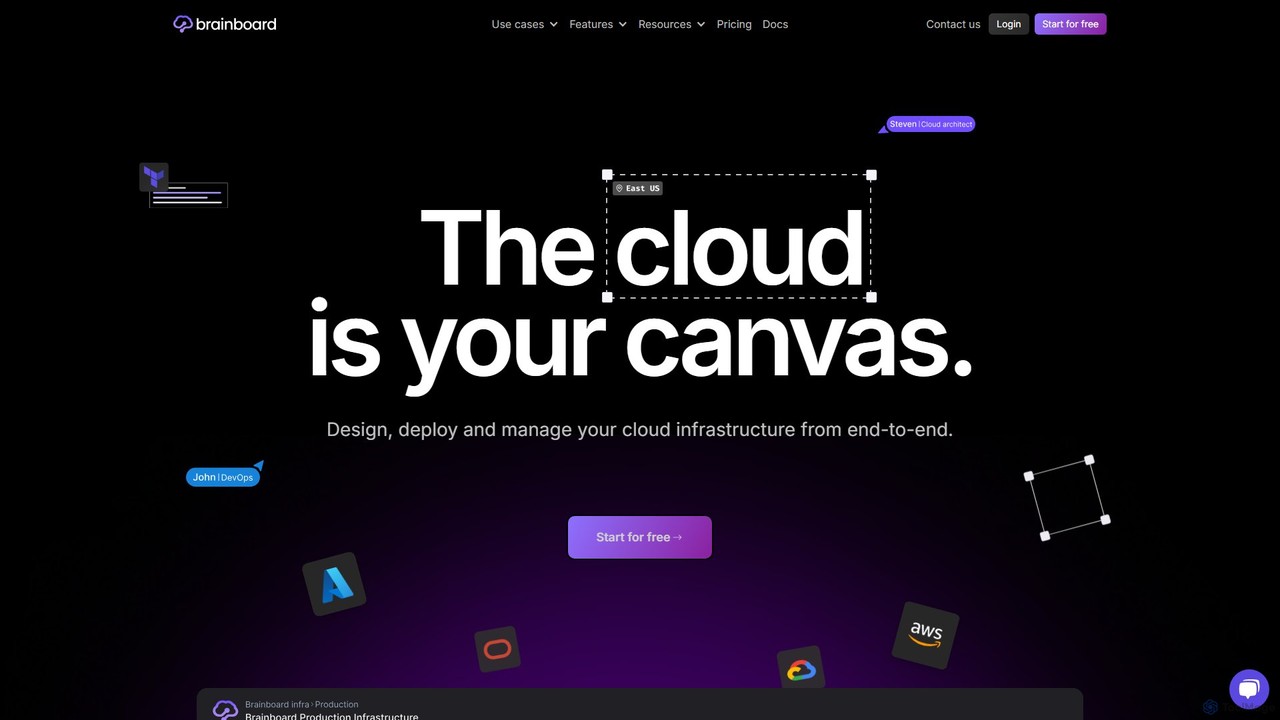
Brainboard is an AI-powered collaborative platform for visually designing, deploying, and managing cloud infrastructure. It automatically generates Infrastructure as Code (IaC) from diagrams, supporting multi-cloud environments like AWS, Azure, and GCP, and streamlines DevOps workflows with integrated CI/CD and GitOps.
AIaC by Firefly
AIaC by Firefly is a free, open-source CLI tool that uses AI to generate Infrastructure-as-Code (IaC) from natural …
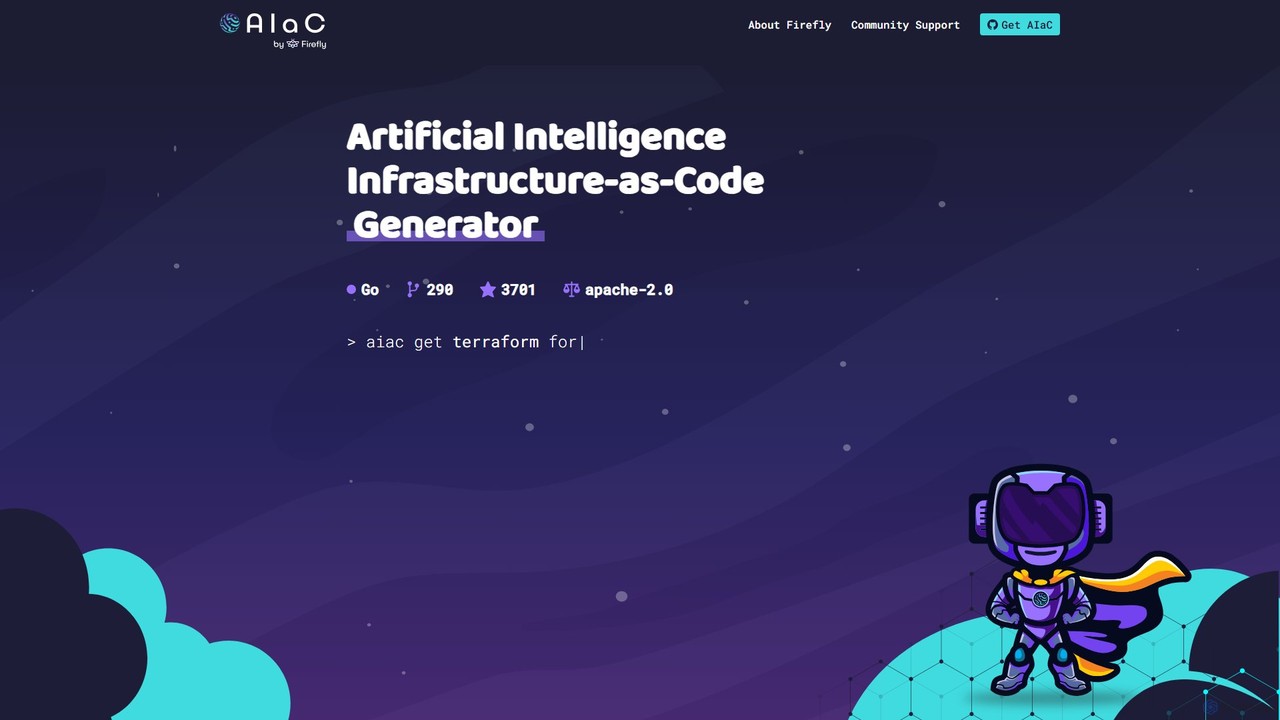
AIaC by Firefly is a free, open-source CLI tool that uses AI to generate Infrastructure-as-Code (IaC) from natural language prompts. It helps developers and DevOps engineers quickly create configuration code for various cloud platforms and IaC frameworks like Terraform, Pulumi, and CloudFormation, significantly speeding up development and reducing syntax errors.
Pulumi
Pulumi is a universal Infrastructure as Code (IaC) platform that allows developers and infrastructure teams to build, deploy, …
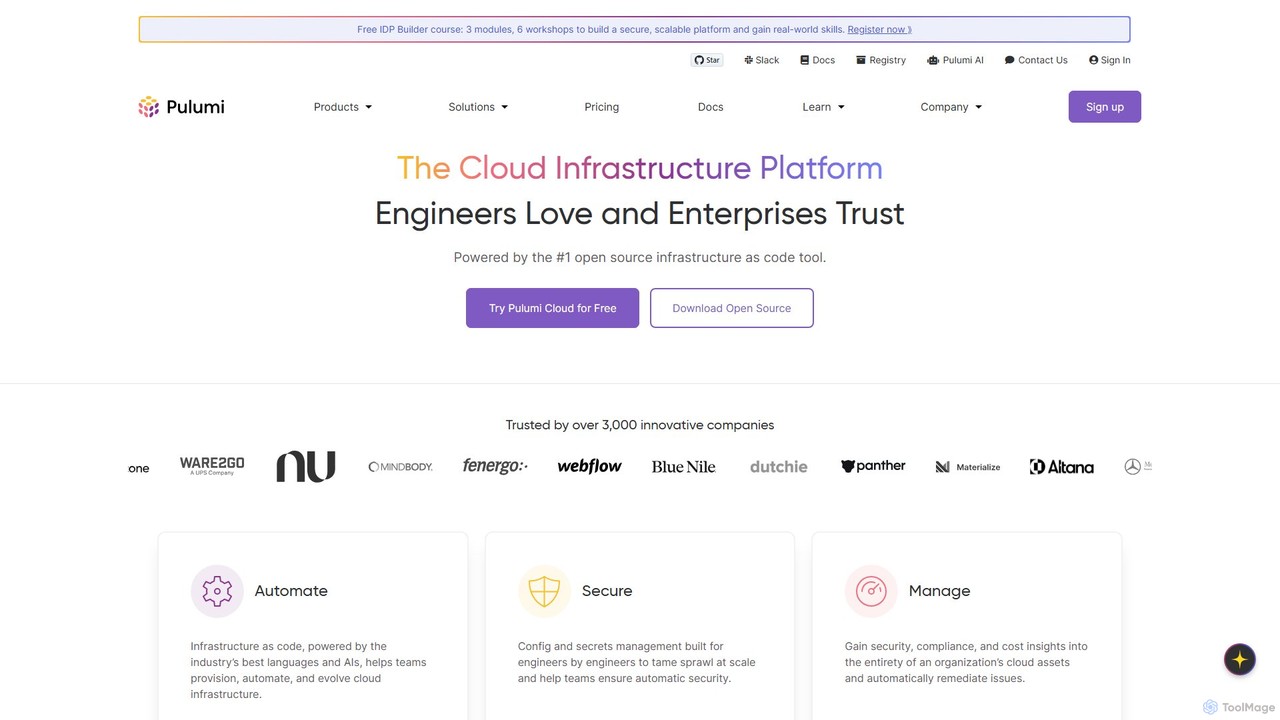
Pulumi is a universal Infrastructure as Code (IaC) platform that allows developers and infrastructure teams to build, deploy, and manage cloud infrastructure using familiar programming languages like Python, TypeScript, Go, and C#. It integrates AI to enhance security, compliance, and operational efficiency.
About Infrastructure As Code
Infrastructure as Code (IaC) refers to managing and provisioning computing infrastructure through machine-readable definition files, rather than manual processes or interactive configuration tools. This approach treats infrastructure components like servers, networks, databases, and load balancers as software, enabling developers and operations teams to define, deploy, and manage them using version control, automated testing, and continuous integration/delivery (CI/CD) pipelines. IaC ensures consistency, repeatability, and scalability across development, testing, and production environments, significantly reducing human error and accelerating deployment cycles, making it a cornerstone of modern DevOps practices within developer tools.
Core Features
- Declarative Configuration: Defines the desired state of infrastructure, allowing tools to automatically achieve and maintain that state, simplifying complex setups.
- Version Control Integration: Manages infrastructure definitions in source control systems (e.g., Git), tracking changes, enabling rollbacks, and facilitating team collaboration.
- Automation & Orchestration: Automates the provisioning, configuration, and deployment of infrastructure resources across various cloud providers or on-premises systems.
- Idempotence: Ensures that applying the same configuration multiple times yields the exact same result, preventing unintended side effects and ensuring predictable outcomes.
- Modularity & Reusability: Allows infrastructure components to be defined as reusable modules or templates, promoting efficiency, standardization, and faster deployment of new environments.
Applicable Scenarios
IaC is indispensable in cloud-native development for automating the setup of virtual machines, containers, serverless functions, and network configurations. It is crucial for creating and maintaining consistent development, staging, and production environments, effectively eliminating configuration drift and manual errors. Organizations leverage IaC for rapid disaster recovery by quickly rebuilding entire infrastructure stacks from version-controlled code, and for implementing robust security and compliance policies that are automatically enforced across all environments.
How to Choose
When selecting an IaC tool, consider its compatibility with your existing cloud providers (e.g., AWS CloudFormation, Azure Resource Manager, Google Cloud Deployment Manager, or multi-cloud tools like Terraform). Evaluate its learning curve, the strength of its community support, and whether it aligns with your team's preference for declarative or imperative approaches. Assess the tool's ability to integrate seamlessly with your existing CI/CD pipelines, its modularity for managing complex infrastructure, and its overall cost model, including any associated cloud service fees or licensing.
Infrastructure As CodeUse Cases
Automated Cloud Environment Provisioning
DevOps engineers and cloud architects use IaC tools to automatically provision and configure entire cloud environments, including virtual machines, networks, storage, and security groups. By defining infrastructure in code, they can spin up consistent development, testing, and production environments on platforms like AWS, Azure, or GCP in minutes, ensuring uniformity and reducing manual setup time and errors.
Consistent Multi-Environment Deployment
Software development teams leverage IaC to maintain identical infrastructure configurations across different stages of their software delivery pipeline (e.g., development, staging, production). This prevents "it works on my machine" issues and ensures that applications behave consistently in all environments, facilitating smoother transitions and more reliable deployments. Changes are applied uniformly through version-controlled code.
Rapid Disaster Recovery and High Availability
Organizations implement IaC to define their entire infrastructure stack as code, enabling rapid recovery from outages or disasters. In the event of a system failure, the infrastructure can be quickly rebuilt from the IaC definitions, significantly reducing recovery time objectives (RTO) and minimizing data loss. This approach enhances business continuity and resilience.
Security and Compliance Automation
Security and compliance teams use IaC to embed security policies and compliance standards directly into infrastructure definitions. This allows for automated enforcement of security best practices, such as network access controls, encryption settings, and identity and access management (IAM) roles, across all deployed resources. It ensures that infrastructure remains compliant from inception, simplifying audits.
Scalable Application Infrastructure Management
For applications requiring dynamic scaling, IaC enables the automated provisioning and de-provisioning of resources based on demand. For instance, an e-commerce platform can use IaC to automatically scale up web servers and database capacity during peak shopping seasons and scale down during off-peak hours, optimizing resource utilization and cost efficiency without manual intervention.
Version Control and Collaboration for Infrastructure
Development and operations teams collaborate more effectively by managing infrastructure definitions in version control systems like Git. This allows multiple team members to work on infrastructure changes concurrently, track every modification, review code before deployment, and easily roll back to previous stable states if issues arise. It brings software development best practices to infrastructure management.