Developer Tools Best in category 1 results Llm Evaluation AI Tool

Popular AI tools in the Llm Evaluation field of Developer Tools include Cleanlab Chat, etc., helping you quickly improve efficiency.

Cleanlab Chat

Cleanlab Chat

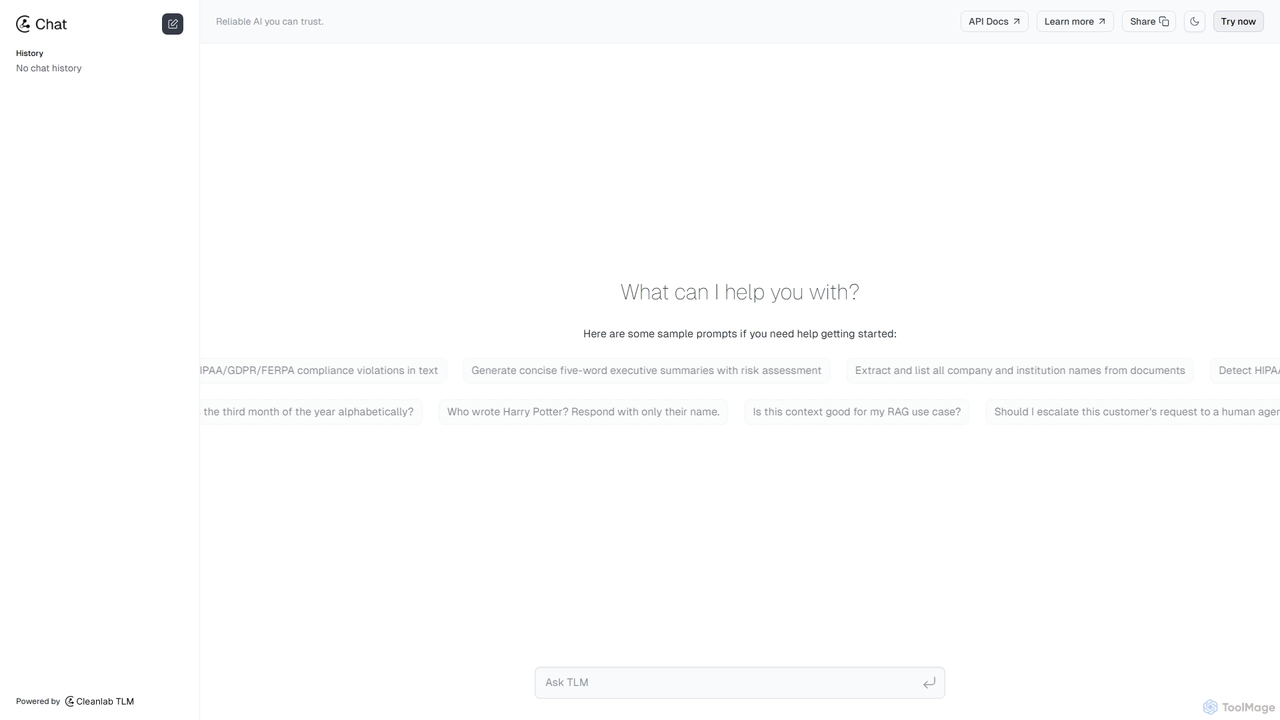
Cleanlab Chat is an advanced AI chat interface powered by Cleanlab's Trustworthy Language Model (TLM). It's designed for …

2.5K

About Llm Evaluation

LLM Evaluation tools are a specialized category of developer utilities designed to systematically measure, analyze, and compare the performance of Large Language Models (LLMs). These platforms provide frameworks for running standardized benchmarks, calculating key metrics, and conducting qualitative assessments to ensure model reliability, accuracy, and safety. They are essential for developers and organizations to validate model behavior before deployment, monitor performance in production, and make data-driven decisions when selecting or fine-tuning models. This process helps identify weaknesses, biases, and potential risks associated with LLM outputs.

Core Features

  • Automated Benchmarking: Run models against standard academic and industry datasets (e.g., MMLU, HellaSwag) to get comparable performance scores.
  • Metric Calculation: Automatically compute quantitative metrics such as accuracy, perplexity, BLEU/ROUGE scores, toxicity levels, and bias indicators.
  • Human-in-the-Loop (HITL) Evaluation: Provide interfaces for human reviewers to rate, rank, or compare model outputs side-by-side for qualitative analysis.
  • Adversarial Testing & Red Teaming: Systematically probe models for vulnerabilities, safety flaws, and unexpected behaviors by generating challenging or malicious inputs.
  • Performance & Cost Tracking: Monitor operational metrics like latency, throughput, and API costs during the evaluation process to assess production readiness.

Use Cases

LLM Evaluation tools are critical throughout the AI development lifecycle. They are used by ML engineers for regression testing after fine-tuning a model, by AI safety teams for auditing bias and toxicity before a public release, and by product managers to compare different third-party models (like GPT vs. Claude) for a specific application. These tools are also vital for continuous monitoring to detect performance degradation or model drift in live applications.

How to Choose

When selecting an LLM Evaluation tool, consider its support for various models (both proprietary APIs and open-source), the breadth of its built-in benchmarks and metrics, and its flexibility for defining custom evaluation datasets and criteria. Also, evaluate its integration capabilities with MLOps pipelines (like CI/CD), its features for collaborative human feedback, and its scalability to handle large-scale testing. The pricing model—whether based on usage, seats, or features—is another important factor.

Llm EvaluationUse Cases

1

Selecting the Best LLM for a Customer Service Chatbot

A product team at an e-commerce company needs to choose the most suitable LLM for their new AI customer service agent. They use an LLM evaluation platform to compare three candidates: GPT-4o, Claude 3 Opus, and a fine-tuned Llama 3 model. The team creates a custom evaluation dataset of 1,000 real-world customer queries, covering topics like order tracking, returns, and product questions. The tool automates the process of running each query through all three models and calculates metrics for accuracy, helpfulness, and adherence to the company's desired tone. Human reviewers then use the platform's side-by-side comparison interface to score responses on nuanced qualities, leading to a data-backed decision.

2

Automating Regression Testing for Model Updates

An enterprise software company fine-tunes its proprietary code generation model quarterly with new data. To prevent performance degradation, their MLOps team integrates an LLM evaluation tool into their CI/CD pipeline. After each fine-tuning run, the pipeline automatically triggers an evaluation job. This job runs the updated model against a 'golden dataset' of 500 complex programming challenges with known optimal solutions. The tool measures code correctness, efficiency, and adherence to style guides. If any key metric drops below a predefined threshold, the build fails, and the team is alerted, preventing a flawed model from being deployed to production.

3

Conducting AI Safety and Bias Audits

A financial services company is developing an LLM to assist with summarizing regulatory documents. Before deployment, their compliance and AI safety team uses an evaluation tool to conduct a thorough audit. They use the tool's red teaming features to generate adversarial prompts designed to test for biases related to protected characteristics (e.g., age, gender) and to probe for security vulnerabilities, such as prompt injection attacks. The platform automatically flags toxic, biased, or non-compliant responses and generates a detailed report. This allows the development team to identify and mitigate critical safety risks before the model is used internally.

4

Comparing Prompt Engineering Strategies

A marketing team is using an LLM to generate social media ad copy. To find the most effective prompt structure, they use an evaluation tool to A/B test different prompting techniques, such as zero-shot, few-shot, and chain-of-thought. They create a test suite with 100 different product descriptions. The tool runs each description through the LLM using five different prompt templates. The outputs are then automatically scored against a rubric for creativity, clarity, and brand voice consistency. This systematic approach allows the team to identify the prompt template that consistently produces the highest quality copy, optimizing their content creation workflow.

5

Monitoring Production Models for Performance Drift

A legal tech firm uses an LLM to power a document summarization feature. To ensure its quality remains high over time, they employ an evaluation tool for continuous monitoring. The tool is configured to sample 1% of all production requests and their corresponding summaries daily. It automatically calculates ROUGE and BERTScore metrics by comparing the LLM's output to a reference summary (when available) or other heuristics. A dashboard visualizes these metrics over time. If the average ROUGE score drops by more than 5% in a week, an alert is sent to the engineering team, signaling potential model drift and prompting an investigation or retraining cycle.

6

Optimizing for Cost and Latency in Real-Time Applications

A developer is building a real-time translation feature for a mobile app and needs to balance quality, speed, and cost. They use an LLM evaluation tool to compare a large, high-quality model (like GPT-4) against a smaller, faster, and cheaper model (like a distilled open-source model). They run a test suite of 2,000 common phrases across both models. The evaluation tool logs not only the translation accuracy (using BLEU scores) but also the average latency and the API cost for each model. The resulting report provides a clear trade-off analysis, allowing the developer to choose the model that meets the minimum quality bar for their users while staying within budget and latency targets.

Llm EvaluationFrequently Asked Questions